


Summary
The nursing field is evolving more quickly than in the past. Artificial Intelligence (AI) is a major factor in this shift. AI-powered documentation tools and intelligent patient monitoring systems are examples of how technology is permeating nursing practice on a daily basis. AI is predicted to have a greater influence on nursing’s future as healthcare systems become more intricate.
It is crucial for nursing students to comprehend how nursing will develop in the era of artificial intelligence. Many students are concerned about whether AI will diminish the human element in nursing or replace nurses. Others are enthusiastic about fresh prospects and cutting-edge equipment that will enhance patient care. In the middle is where the truth is found.
This article describes how artificial intelligence will influence nursing practice, education, and responsibilities in the future.
Understanding Artificial Intelligence in Modern Nursing
Computer programs that can analyze data, recognize trends, and assist in decision-making are referred to as artificially intelligent. AI is already being utilized in nursing for things like medication safety, staffing scheduling, electronic health records, early warning systems, and patient monitoring.
Artificial intelligence does not think like a human nurse. Rather, it swiftly processes a lot of data. For instance, by analyzing continuous data, AI can detect changes in a patient’s vital signs before humans do. This enables nurses to attend to patients’ needs more quickly.
AI systems will grow more sophisticated and prevalent in clinics, hospitals, and community healthcare settings in the future. Today’s nursing students will operate in an environment where artificial intelligence is a standard component of daily operations.
How AI Will Change Nursing Roles and Responsibilities

The development of nursing roles is a key component of nursing’s future in the era of artificial intelligence. While AI won’t replace nurses, it will alter their profession and areas of focus.
AI systems may be able to perform more routine and repetitive jobs like data entry, scheduling, and simple monitoring. This will free up more time for nurses to provide direct patient care, provide emotional support, and make intricate clinical decisions.
Additionally, nurses will assume new technological tasks. They must comprehend AI results, challenge suggestions, and guarantee that technology is applied morally and safely. By providing compassionate and intelligible explanations of AI-supported judgments, nurses can serve as intermediaries between patients and technology.
For nursing students, this means future nurses will need both clinical skills and digital skills to succeed.
The Impact of AI on Patient Care and Safety
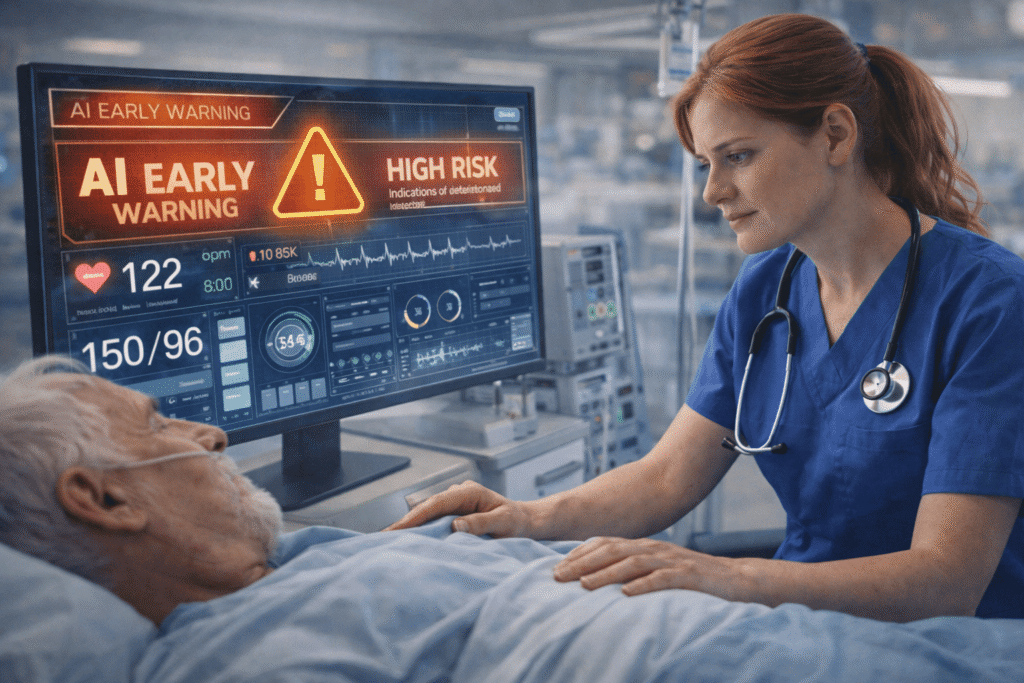
AI has the ability to greatly enhance patient safety, which is a fundamental aspect of nursing practice. AI technologies will assist nurses in the future with better care coordination, fewer drug errors, and early risk identification.
Early warning systems driven by AI are able to identify patient decline before symptoms become apparent. This enables nurses to act more quickly, possibly saving lives. By verifying dosages, allergies, and interactions, AI can also assist with precise pharmaceutical delivery.
Final decision-making will still fall under the purview of nurses, though. AI offers assistance rather than power. The patient must always be evaluated holistically by nurses, taking into account cultural, social, and emotional aspects that AI is unable to fully comprehend.
The best patient results in the future won’t come from technology alone, but rather from nurses working together with AI.
Nursing Education and Training in an AI-Driven Future
Artificial intelligence will have a significant impact on nursing education in the future. Students enrolled in nursing schools must be prepared for technologically advanced healthcare settings.
Artificial Intelligence (AI) is expected to be incorporated into nursing education through personalized learning platforms, intelligent tutoring systems, and virtual simulations. Before entering actual clinical settings, these resources can assist students in safely practicing clinical skills.
But educating students how to assess AI systems critically must also be a major component of nursing education. Students must be aware that AI may be biased and capable of making mistakes. A crucial professional skill will be the ability to challenge AI advice.
As crucial as anatomy, pharmacology, and therapeutic abilities will be in the future, so too will digital literacy and an ethical grasp of AI.
Ethical and Professional Responsibilities in the AI Era
Nurses will have increased ethical obligations as AI becomes increasingly integrated into healthcare. Nurses will have to defend patient privacy, guarantee data security, and promote moral technology use.
Patient data is essential to AI systems. It is the responsibility of nurses to make sure that this data is handled discreetly and appropriately. Additionally, they need to be conscious of the possibility of bias in AI systems and speak out if technology results in dangerous or unfair treatment.
Even when AI is used, nurses will still be held professionally accountable. This implies that nurses need to be sufficiently knowledgeable about AI to apply it appropriately.
Learning about AI ethics is crucial for nursing students’ professional growth in the contemporary healthcare system.
The Nurse–Patient Relationship in a High-Tech Future

The impact on the nurse-patient relationship is one worry regarding nursing’s future in the era of artificial intelligence. Technology should never take the place of human connection because nursing is based on communication, empathy, and trust.
Nurses will have to strike a balance between using technology and providing empathetic care in the future. Only nurses are able to offer emotional support, reassurance, and empathy, even while AI can deliver data and alerts.
The use of AI in patient care may raise concerns or doubts in the minds of patients. Explaining how technology enhances therapy while upholding a human-centered approach will be crucial for nurses.
One of the most crucial duties for aspiring nurses will be to safeguard the nurse-patient relationship.
Career Opportunities for Nurses in the AI Era
Additionally, nurses will have more employment options because to artificial intelligence. Clinical informatics, digital health, or healthcare technology management are areas of specialization for certain nurses.
AI-savvy nurses can pursue careers in research, education, policymaking, or system design. These positions will guarantee that AI systems promote patient safety and fulfill actual clinical needs.
This implies that there will be a greater variety of employment options available to nursing students in the future. Nurses will be well-positioned for leadership positions if they continue to learn and adjust to new technologies.
Challenges Nurses Must Prepare for in the Future
AI has both potential and challenges. Rapid technology advancements, greater responsibility, and the requirement for continual training may all be faced by nurses.
Learning new systems and adjusting to new workflows may cause stress. Additionally, nurses need to control alert weariness and refrain from becoming unduly reliant on technology.
Strong education, encouraging work environments, and a dedication to lifelong learning are necessary to prepare for these challenges.
Conclusion: Shaping the Future of Nursing with AI
The goal of nursing in the era of artificial intelligence is to change nursing practice rather than to replace nurses. AI will help nurses, improve patient safety, and open up new possibilities, but it will also require new abilities and duties.
It is crucial for nursing students to comprehend this future. Future nurses can guide healthcare toward a safer, more efficient, and more human-centered era by cultivating clinical knowledge, ethical awareness, digital literacy, and compassion.
Not only will technology influence nursing in the future, but so will the way nurses choose to use it.
People Also Ask
Will AI replace nurses in the future?
No, AI will support nurses, not replace them.
How will AI change nursing practice?
It will reduce routine tasks and support decision-making.
Do nursing students need to learn AI skills?
Yes, digital literacy will be essential for future nurses.
Can AI improve patient safety?
Yes, when used correctly alongside nursing judgment.
Is the nurse–patient relationship at risk because of AI?
Only if technology is used without human-centred care.
Useful Documents for every Nursing Student
CV Section Template for Nursing students
AHPRA – NMBA Registration Document Checklist (International Students-Graduates)
Clinical Placement Reflection Template (NMBA-aligned)
Cover Letter Template for Nursing Students
Disclaimer: “I researched this information on the internet; please use it as a guide and also reach out to a professional for assistance and advice.This information is not medical advice, so seek your medical professional’s assistance.”