


Summary
Obtaining Permanent Residency (PR) in Australia is a major career objective for many foreign nursing students and overseas-qualified nurses. In 2026, the need for nurses will only increase, and nearly all states are actively seeking qualified nurses through their migration initiatives. However, the PR process can be perplexing because states favor different nursing specializations, regulations are constantly changing, and many students don’t know how to strategically build points.
All of the PR pathways for nurses in 2026 are explained in this book, including state nomination, the points system, and the Nursepreneur Bridge, a new alternative that allows nurses to strengthen their careers through both clinical and non-clinical nursing entrepreneurship.
1. Why Nurses Have Strong PR Chances in 2025-26
Nursing remains one of the most in-demand occupations in Australia. The government has confirmed skill shortages across:
- Aged care
- Acute care
- Mental health
- ICU
- Community health
- Rural and remote nursing
This shortage is expected to continue for the next 10+ years due to:
- Australia’s ageing population
- High demand for aged-care reform
- Hospital staff shortages
- Growing rural health needs
This means international nursing students and overseas nurses have better PR opportunities than most other professions. But choosing the right visa and improving your points is very important.
2. Main PR Pathways for Nurses in Australia (2025-26)
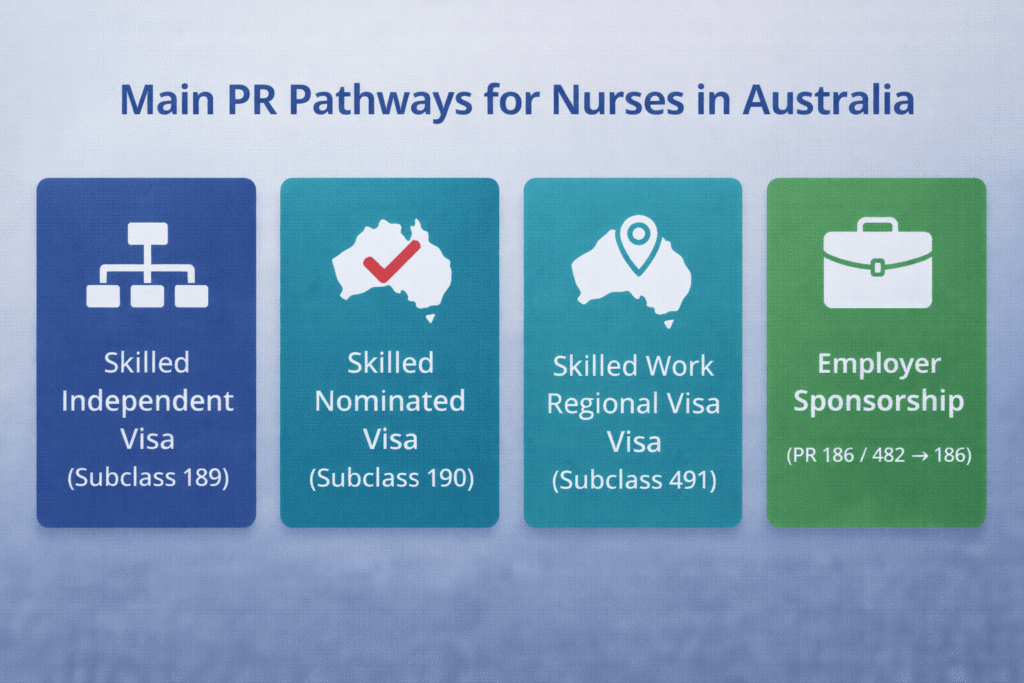
Below are the main PR visas suitable for nurses.
A. Skilled Independent Visa (Subclass 189)
This is a direct PR visa without state sponsorship.
But in 2025–26, the competition is high. Only nurses with:
✔ strong points (85–95+)
✔ high English scores
✔ work experience
usually receive invitations.
Best for:
- Registered Nurses
- Midwives
- Mental Health Nurses
- Child & Family Health Nurses
B. Skilled Nominated Visa (Subclass 190)
This is a state-nominated PR visa, much easier than 189.
Benefits:
- Guaranteed invitation if the state accepts you
- Only 65 points needed (after adding state’s 5 points)
States like Victoria, NSW, Western Australia, South Australia regularly invite nurses.
C. Skilled Work Regional Visa (Subclass 491)
This visa gives:
- 5-year temporary residency
- PR pathway after 3 years
Regional areas really prefer nurses.
States such as Tasmania, Northern Territory, South Australia often issue 491 nominations quickly to nurses.
D. Employer-Sponsored PR (ENS 186 / 482 → 186)
If a hospital or aged-care provider sponsors you:
- You can get PR after 2 years under the 186 visa
- No points test
- High chance of approval
Best for:
- Aged-care nurses
- Rural nurses
- Mental health nurses
3. Required Documents for Nurse PR in 2025-26
Before applying for PR, you MUST have the following:
✔ AHPRA Registration (or proof of eligibility)
✔ Skill Assessment (ANMAC or Modified ANMAC)
✔ English test (IELTS / PTE / OET)
✔ Passport + ID documents
✔ Work reference letters
✔ Clinical placement records
✔ Academic transcripts
Many nurses delay their ANMAC assessment, which slows down their PR process. Starting early is key.
4. Points Strategy for Nurses (How to Reach 85–90 Points)

The points system can be confusing, but nurses can increase points faster than most fields.
Below is a simple and effective strategy for 2026.
1. English Test (PTE/OET/IELTS) — Up to 20 Points
Achieving Superior English (20 points) is one of the easiest ways to boost your PR chances.
- PTE: 79+
- IELTS: 8 each band
- OET: A in all sections
Even Proficient English (10 points) already makes a big difference.
2. Skilled Work Experience — 5 to 15 Points
You can get points for:
✔ Overseas work
✔ Australian hospital work
✔ Aged-care experience
Tip: Many students work as AIN/PCAs during study → After AHPRA registration → start gaining skilled RN experience.
3. Partner Skill Points — 5 to 10 Points
If your partner:
- is under 45
- has English
- has a skill assessment
You can gain 10 extra points.
If single → you get 10 points automatically.
4. Education Points — 15 to 20 Points
A Bachelor of Nursing gives 15 points.
Additional qualifications can boost points:
- Diploma of Nursing
- Master of Nursing
- Specialised postgraduate study
5. State Nomination — 5 or 15 Points
- 190 visa → 5 points
- 491 visa → 15 points
Many nursing students rely on this to reach the 75–85 mark.
5. State-by-State PR Pathways for Nurses (2025-26)
Each state prefers different types of nurses.
Western Australia (WA) – Easiest for Nurses
- Invites most nursing occupations
- Large aged-care and hospital shortages
- Perfect for new graduates
Best roles:
✔ Aged care
✔ Mental health
✔ Medical–surgical nursing
South Australia (SA)
- Big demand for regional nurses
- Good pathway for international graduates
- High preference for 491 nominations
New South Wales (NSW)
- Competitive
- Prefers experienced RNs
- Higher points required
Best for:
✔ ICU nurses
✔ ED nurses
✔ Mental health nurses
Victoria (VIC)
- Highly competitive
- Prefers specialised nurses
- Usually invites high-point candidates
Tasmania (TAS)
- Very friendly for graduates
- Accepts nurses with minimal experience
- One of the fastest 491 pathways
Northern Territory (NT)
- Strong need for remote health nurses
- Good pathway for 491
6. The Nursepreneur Bridge (New Pathway for Career Strength)

Many nurses are now improving their PR chances by building clinical + entrepreneurial portfolios.
This is known as the Nursepreneur Bridge, where a nurse uses clinical skills combined with leadership and community work to strengthen:
- employability
- state nomination likelihood
- employer sponsorship potential
Examples:
✔ Community health workshops
✔ Mental health advocacy
✔ Aged-care consultancy
✔ First-aid training services
✔ Public health content creation
This does NOT replace clinical experience, but it gives nurses:
- stronger profiles
- better chances during interviews
- more options for sponsored visas
- leadership evidence that states value highly
States like NSW, SA and WA prefer applicants who demonstrate leadership or community service, which the Nursepreneur pathway strengthens.
7. Common Mistakes That Delay PR for Nurses
Many international nurses lose months or years because of simple mistakes.
1. Delaying ANMAC Skill Assessment
You should start ANMAC immediately after completing your course.
2. Wrong ANZSCO Code Selection
Choosing the wrong nursing category (e.g., “Personal Care Worker” instead of “Registered Nurse”) blocks PR applications.
3. Low English Scores
Most PR candidates who fail to receive invitations lack superior English.
4. Not Applying to Regional Areas
Regional Australia offers the fastest invitations for nurses.
5. No Work Experience
Even 6–12 months as an RN gives major points + improves state nomination chances.
8. Final Advice for Nursing PR Applicants (2025-26)
If you want to secure PR as a nurse in Australia, follow this strategy:
✔ Improve English to Superior level
✔ Complete ANMAC early
✔ Apply to regional states (TAS, SA, NT, WA)
✔ Build experience in aged care or acute care
✔ Keep your documents organised
✔ Use the Nursepreneur Bridge to strengthen your profile
Australia needs nurses more than ever, and the PR system in 2026 strongly supports international nursing graduates. With the right planning, you can move from student → graduate nurse → skilled worker → PR resident smoothly.
People Also Ask
1. What is the easiest PR pathway for nurses in 2025-26?
Regional state nomination (491 visa) is currently the easiest because regional areas urgently need nurses.
2. How many points do nurses need for PR?
Most nurses receive invitations at 75–85 points, especially through state nomination.
3. Which states are best for nursing PR?
WA, SA, TAS, and NT provide the easiest and fastest pathways.
4. Do international nursing graduates need work experience for PR?
Not always. Some states accept fresh graduates, but having experience increases your chances.
5. Does aged-care experience help with PR?
Yes. Aged-care nurses are in massive demand and often receive faster sponsorship and state invitations.
Useful Documents for every Nursing Student
CV Section Template for Nursing students
AHPRA – NMBA Registration Document Checklist (International Students-Graduates)
Clinical Placement Reflection Template (NMBA-aligned)
Cover Letter Template for Nursing Students
Disclaimer: “I researched this information on the internet; please use it as a guide and also reach out to a professional for assistance and advice.This information is not medical advice, so seek your medical professional’s assistance.”