

Summary
When evaluating nursing vs midwifery within the modern Australian healthcare system, it is vital to understand the structural differences in tertiary clinical specialisation, dual-registration healthcare pathways, and long-term career trajectories. Nurses frequently function as the versatile ‘generalists’ of the acute care medical infrastructure, equipped to operate across diverse environments from trauma emergency departments to advanced geriatric care facilities and enterprise healthcare informatics systems, whereas midwives serve as dedicated ‘specialists’ focusing exclusively on the complex obstetric and perinatal care spectrum.
This pivotal choice represents one of the most significant decisions faced by incoming healthcare students navigating AHPRA workforce analytics in 2026. While both professions are anchored in evidence-based clinical excellence, rigorous clinical competency frameworks, and patient advocacy, selecting the optimal pathway is not about determining which role holds greater societal value; both are indispensable. Rather, it centres on aligning your career with your professional goals, long-term healthcare economic trends, and desired patient outcomes. To assist you in making an informed academic investment, this 2026 comparative guide analyses the remuneration scales, daily operational workflows, and postgraduate clinical advancement pathways of both disciplines.
The Scope of Practice: Generalist vs. Specialist
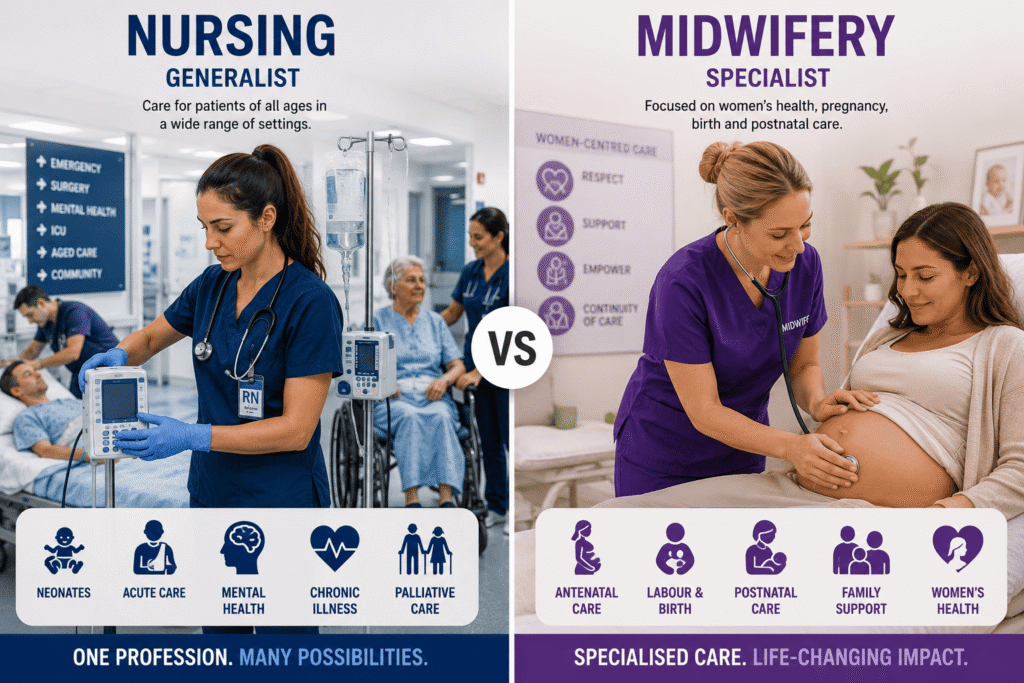
The main distinction is between the “Who” and the “Where.” The field of nursing is very vast. Your area of practice as a Registered Nurse (RN) enables you to work with patients of all ages, from elderly patients receiving palliative care to newborns in the NICU. You manage mental health, surgical recovery, chronic sickness, and acute illness. Nursing offers unmatched versatility if you want variation and want to switch up your specialty every few years.
In contrast, midwifery is a specialized field that sees pregnancy and childbirth as a normal part of life rather than a medical “illness.” The “Woman-Centred Care” approach is the main emphasis of your work as a midwife. You help women have successful pregnancies, support them during childbirth, and give them essential after care. Your main objective is to enable a safe and empowered delivery experience, even though you are prepared to tackle crises. Midwifery is a very fulfilling career choice if you have a strong interest in women’s health and wish to become an authority on a certain biological process.
Salary and Earnings: Which Pays More in 2026?

In Australia, the pay disparity between nurses and midwives has virtually vanished by 2026, particularly in the public sector. Usually, the same Enterprise Bargaining Agreements (EBAs) govern the compensation for both positions. The base pay for a first-year registered nurse or midwife should be between $78,000 and $85,000 annually. As you go through the “Pay Points,” this base may surpass $110,000.
In both occupations, “Real Earnings” are derived from shift penalties. You will receive substantial additional compensation for working on weekends, public holidays, and at night because both the Emergency Department and the Birth Suite are open around-the-clock. However, through “Midwifery Group Practice” (MGP) or “Continuity of Care” models, midwifery provides a distinctive earning track. In these positions, midwives receive a “all-inclusive” loaded salary or a high-percentage allowance that might exceed $140,000 annually. They are also frequently on call for their individual customers.
Daily Work Environment: Fast-Paced vs. Focused
Another important consideration is the “Vibe” of the workplace. In nursing, your day is frequently filled with quick activities, particularly in acute settings like the emergency department or surgical ward. You are overseeing several patients, liaising with physicians, giving prescriptions, and reacting to “Buzzers.” Those who enjoy multitasking and the “Adrenaline” of a bustling hospital will thrive in this high-energy setting.
Although midwifery frequently focuses more on one patient at a time, there are still high-adrenaline periods (labor can be unpredictable!). You might work a whole 12-hour shift in the Birth Suite, assisting a single woman as she goes through the phases of labor. It necessitates a great deal of patience as well as the capacity to offer long-term mental and physical assistance. Teaching new parents how to nurse, settle a baby, and take care of themselves is a major part of your day in the postnatal ward. Midwifery might be a better option for you if you would rather develop a close, brief relationship with a patient than the “task-based” pace of a ward.
Career Progression: Where Can You Go?
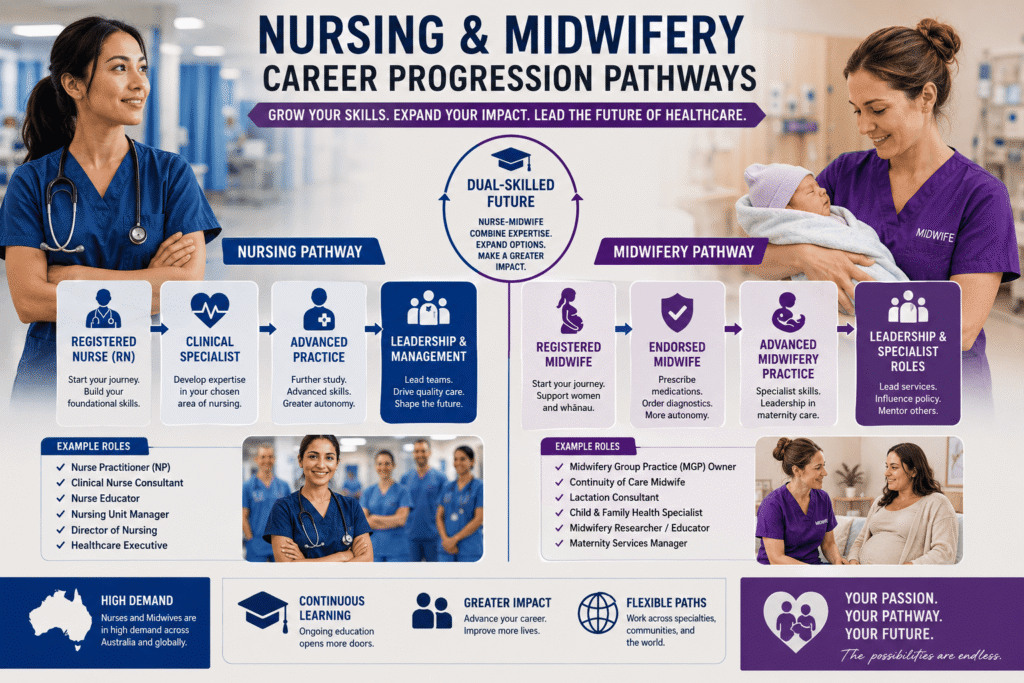
In 2026, both professions provide fantastic opportunities for growth. There are many “Postgraduate” choices in nursing. You can advance into high-level healthcare management or work as a nurse educator or nurse practitioner (NP). You can work as a nurse for the rest of your life and never get bored because there are so many specializations, such as oncology, intensive care unit, and perioperative nursing.
The advancement of midwifery is more vertical. You can obtain your own Medicare Provider Number, write prescriptions, and manage your own private practice by becoming an Endorsed Midwife. Additionally, a lot of midwives pursue careers in lactation consulting, child and family health, or maternal outcomes research. In 2026, “Nurse-Midwife” double degrees are becoming more and more common. These degrees enable professionals to work in both areas, which is particularly beneficial in remote and regional Australia where “Dual-Skilled” practitioners are in high demand.
The Emotional Impact: Resilience vs. Joy
Although the “Type” of stress varies, healthcare is emotionally taxing. You will unavoidably deal with mortality, dying, and the intricacies of chronic sickness while working as a nurse. High levels of “Emotional Resilience” and the capacity to care for patients who might be at their most challenging or vulnerable are prerequisites. Seeing a patient recover from a life-threatening illness or giving them dignity in their last moments is rewarding.
Although midwifery is frequently linked to the “Joy of New Life,” it also entails “High-Stakes” duty. When a birth goes wrong, it can happen extremely rapidly. Additionally, midwives provide specific “Grief Support” and empathy to women who are experiencing stillbirth or pregnancy loss. But few other occupations can provide the special satisfaction of being the first to hold a newborn and seeing a family come together.
People Also Ask (FAQ)
Q: Is it easier to find a job as a nurse or a midwife?
In 2026, both professions have critical shortages across Australia. However, because there are more hospitals and clinics than there are maternity units, there are technically more total job openings for nurses.
Q: Can I become a midwife if I am already a nurse?
Yes. This is a very common path. Many nurses complete a 12-18 month “Graduate Diploma of Midwifery” to become “Dual-Registered.” This makes you highly employable, especially in rural areas.
Q: Do midwives only work in hospitals?
No. Midwives work in hospitals, private clinics, community health centers, and some work in Home Birth settings or run their own private practices as Endorsed Midwives.
Q: Which degree is harder?
Both the Bachelor of Nursing and the Bachelor of Midwifery are demanding 3-year degrees. Midwifery students often find the “Continuity of Care” requirements (following a certain number of women throughout their whole pregnancy) a bit more time-consuming to manage.
Disclaimer: “I researched this information on the internet; please use it as a guide and also reach out to a professional for assistance and advice.This information is not medical advice, so seek your medical professional’s assistance.”