

Summary
Starting your career as a Registered Nurse (RN) is a period of immense growth, but it is also the time when you are most susceptible to “Transition Shock.” In 2026, the clinical environment in Australia is faster and more technologically advanced than ever, which can lead even the most dedicated new graduates to stumble. Mistakes in nursing are rarely about a lack of knowledge; they are usually the result of “System Pressures,” fatigue, and the steep learning curve of moving from theory to the bedside.
As a midwife and mentor who has seen many “New Grads” find their feet, I know that the fear of making a mistake is often the biggest stressor in your first year. However, most common errors follow predictable patterns. By understanding where these “potholes” are, you can develop the clinical habits needed to stay safe and protect your registration. This guide breaks down the top mistakes seen in 2026 and provides grounded, professional strategies to avoid them.
The “Silence Trap”: Not Asking for Help

The most frequent mistake new nurses make isn’t clinical it’s psychological. Many new graduates hesitate to ask questions because they fear appearing incompetent or “annoying” their senior colleagues. In a busy ward environment, this “Silence Trap” is dangerous. Nursing is a collaborative profession, and no one not even a nurse with 20 years of experience is expected to know everything.
How to Avoid It: Embrace the “Safety First” mindset. If you are even 1% unsure about a procedure, a medication, or a patient’s condition, you must speak up. In 2026, healthcare teams value “Safe Practitioners” over “Fast Practitioners.” Use phrases like, “I haven’t performed this procedure independently yet; could you talk me through it one more time?” or “This order looks slightly different from what I expected, can we double-check it?” Asking a question isn’t a sign of weakness; it is a sign of high-level clinical judgment.
Medication “Shortcuts” and Bypassing Safety Checks
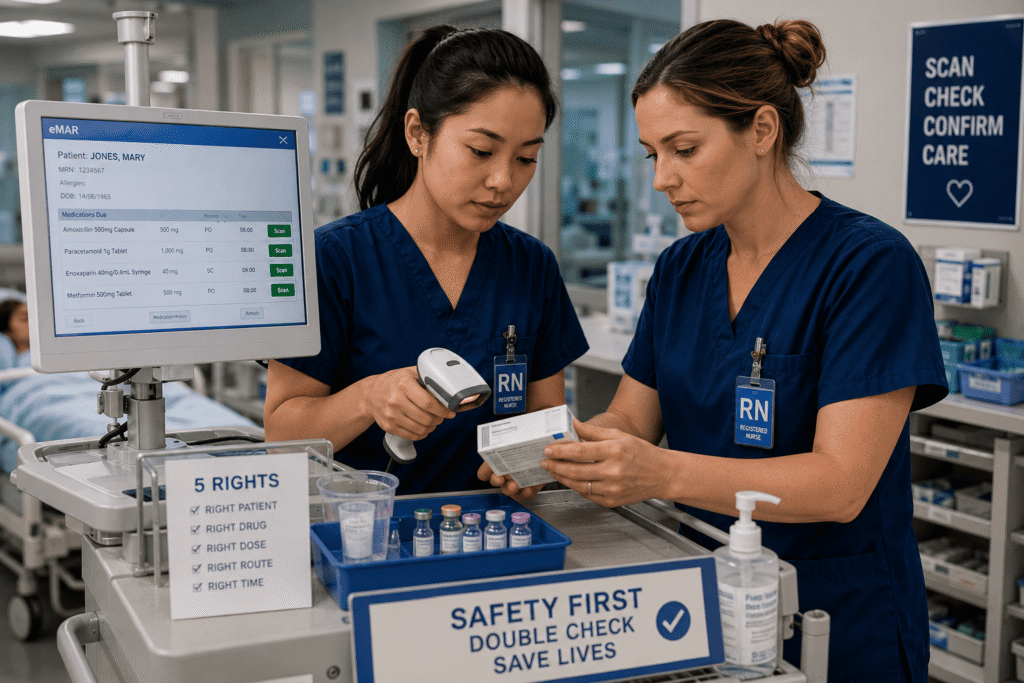
Medication errors remain one of the leading causes of clinical incidents in Australian hospitals. With the introduction of advanced Electronic Medication Administration Records (eMAR) and barcode scanning in 2026, many of the “Old Mistakes” are being phased out, but “Workarounds” are the new risk. New nurses, feeling the pressure of time, sometimes skip the “Bedside ID Check” or sign for a medication before the patient has actually taken it.
How to Avoid It: Never sacrifice the “Rights of Medication Administration” for speed. Even if you are an hour behind, you must perform the three checks of the label and the five rights (Right Patient, Right Drug, Right Dose, Right Route, Right Time). If your facility uses barcode scanning, use it every single time don’t “pre-scan” labels at the desk. For high-risk medications like insulin, anticoagulants, or IV potassium, always involve a second nurse for an independent double-check. These protocols exist to protect your patient’s life and your career.
Documentation: The “If It Isn’t Written, It Didn’t Happen” Rule
In 2026, nursing documentation is increasingly digital and transparent. A common mistake for new nurses is leaving “Gaps in the Record” or using vague, subjective language like “Patient had a good shift.” In a legal or coronial setting, such documentation is unhelpful. Late entries are another major pitfall; trying to remember what a patient’s vital signs were eight hours ago leads to inaccuracies that can compromise care.
How to Avoid It: Practice “Real-Time Charting.” Instead of waiting until the end of your shift to write your notes, try to document significant events, medication administration, and assessments as close to the time of care as possible. Use objective, measurable data: instead of “Patient is stable,” write “Patient’s BP 120/80, HR 72, denies pain, currently mobilizing with one-person assist.” If you had a conversation with a doctor or a family member that changed the care plan, document the name of the person and the time of the discussion. Accurate documentation is your best legal defense.
Ignoring the “Gut Feeling”: Underestimating Patient Deterioration
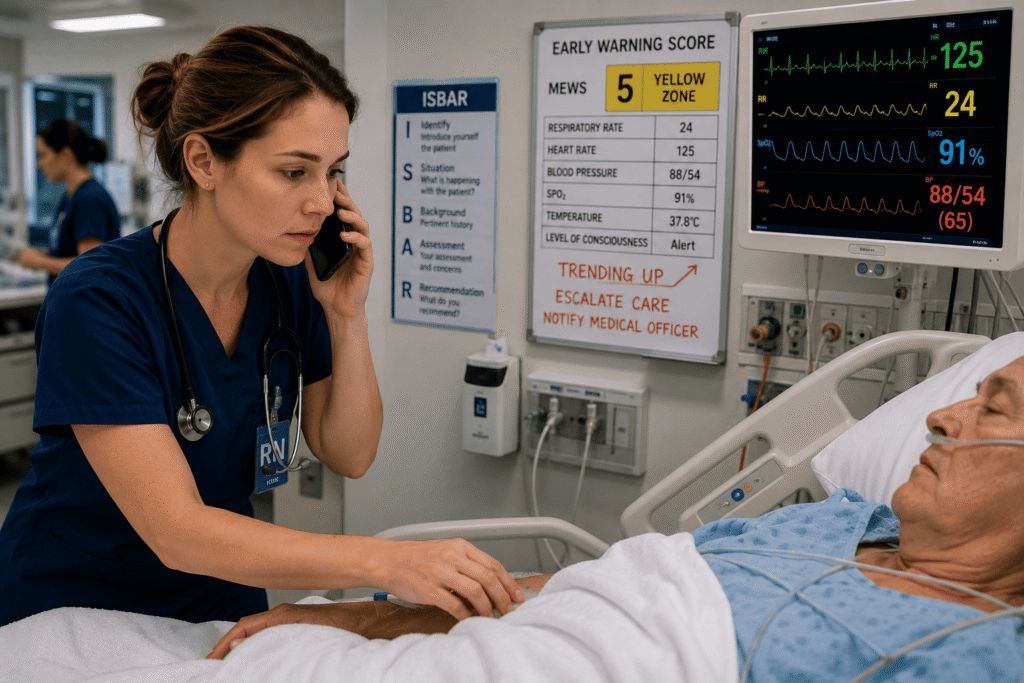
New nurses are often so focused on completing tasks (medications, showers, dressings) that they may miss the subtle signs of a patient “Slighting.” This is known as “Failure to Rescue.” You might notice a patient is slightly more confused than they were four hours ago, or their respiratory rate has climbed from 16 to 22. A common mistake is dismissing these as “minor” changes rather than recognizing them as early warning signs of deterioration.
How to Avoid It: Trust your clinical intuition. If a patient “doesn’t look right” to you, it is usually because they aren’t. In 2026, most Australian hospitals use the “Between the Flags” or “MEWS/PEWS” systems. If a patient’s observations are trending toward the “Yellow Zone,” escalate your concerns. Don’t wait for the “Red Zone” or a Cardiac Arrest. Use the ISBAR framework to communicate clearly with the Medical Officer: “I am calling because I am concerned about Patient X’s increasing respiratory rate and new-onset confusion.” It is always better to escalate a “False Alarm” than to ignore a real one.
Neglecting Self-Care and the “Burnout Cycle”
The final mistake is one that affects the nurse, not the patient: failing to set boundaries. New nurses often pick up every extra shift offered, skip their meal breaks to “catch up,” and spend their days off obsessing over their clinical performance. This leads to Compassion Fatigue and burnout before you’ve even reached your second year of practice.
How to Avoid It: You cannot provide high-quality care if you are running on empty. In 2026, we recognize that “Resilience” isn’t about working harder; it’s about recovering better. Take your designated breaks even 15 minutes away from the ward can reset your focus. Learn to say “No” to extra shifts if you are feeling exhausted. Your first year is a marathon, not a sprint. Investing in your own health proper sleep, nutrition, and time away from “Nursing Talk” is what will ensure you are still in the profession in five years’ time.
People Also Ask (FAQ)
Q: What is the most common medication error for new nurses in 2026?
Timing and Omission errors. In a busy ward, it’s easy to miss a “once-daily” dose or be late with antibiotics. Using your eMAR’s “Task List” effectively is the best way to prevent this.
Q: Should I report a “Near Miss” if no one was hurt?
Absolutely. A “Near Miss” is a gift it’s an opportunity to fix a system flaw before it actually hurts someone. Reporting these through your hospital’s incident system (like RiskMan) is a hallmark of a professional and safe nurse.
Q: How do I handle a doctor who is dismissive of my concerns?
Stay focused on the patient’s clinical data. If an intern or registrar is not listening, use the “Two-Challenge Rule” or escalate to your Nurse In Charge (NIC). Your duty of care is to the patient, not to the doctor’s ego.
Q: Is it normal to cry after a shift in the first year?Yes. Most nurses have a “car cry” or a “shower cry” at some point. Nursing is emotionally taxing work. If the crying becomes a daily occurrence, however, please reach out to your mentor or an Employee Assistance Program (EAP).
Disclaimer: “I researched this information on the internet; please use it as a guide and also reach out to a professional for assistance and advice.This information is not medical advice, so seek your medical professional’s assistance.”