

In 2026, the role of a Nurse Consultant in Australia has evolved into a powerhouse of healthcare leadership. Whether you are providing expert clinical advice, managing complex healthcare projects, or running your own independent consulting firm, you are operating at the highest level of the nursing profession. However, moving from a standard bedside role into the world of consultancy shifts your "Risk Profile." You are no longer just responsible for physical tasks; you are responsible for professional advice—and in the eyes of the law, bad advice can be just as damaging as a clinical error.
For nurses entering this space, understanding the "Legal Foundations" is critical to protecting both your career and your personal assets. Navigating the requirements set by AHPRA and the Nursing and Midwifery Board of Australia (NMBA) can be daunting, especially when you add the complexities of Australian business law, tax obligations, and specialized insurance products. This comprehensive 2026 guide simplifies the legal and insurance landscape, ensuring you can launch or grow your consultancy with total confidence and compliance.
1. AHPRA Registration and the "Scope of Practice" Requirement
Even if you are not working at the bedside, as a Nurse Consultant in 2026, you must maintain your AHPRA registration. The NMBA is very clear: "Practice" includes any role where you use your professional nursing skills and knowledge. This covers management, education, advisory roles, and policy development. To remain compliant, you must ensure your Scope of Practice is clearly defined. If you are a Registered Nurse (RN) but providing advice that falls into the territory of a Nurse Practitioner (NP), such as recommending specific medication changes without the proper endorsement, you are at risk of a professional conduct investigation.
Every year during your registration renewal, you must declare that you have met the Recency of Practice standards. For a consultant, this means you need to show that you have worked a minimum number of hours in a role that utilizes your nursing expertise. Furthermore, you are legally required to complete at least 20 hours of Continuing Professional Development (CPD) annually. In 2026, the NMBA has placed a higher emphasis on "Digital Health Literacy" and "Cultural Safety" as mandatory components of these hours. Failing to keep these records updated can lead to an audit, which can halt your consulting business overnight.
2. Professional Indemnity Insurance (PII): Your Essential Shield
The most important legal requirement for any Australian nurse practitioner or consultant is Professional Indemnity Insurance (PII). Under the National Law, you cannot practice without it. While hospital employees are usually covered by their employer's "Master Policy," as an independent consultant, the responsibility falls entirely on you. PII is designed to cover you if a client—whether it’s a hospital, a private clinic, or an individual—claims that your professional advice, report, or training led to a financial loss or a physical injury.
In 2026, a standard PII policy for a Nurse Consultant should provide a minimum of $5 million to $10 million in cover. It is important to look for a "Civil Liability" trigger, which covers a broad range of issues including breach of confidentiality, defamation, and even loss of documents. One specific feature you must check for is Run-Off Cover. Since PII is usually "Claims-Made," if you stop consulting in 2027 but someone sues you in 2029 for work you did today, you are only protected if your policy has run-off provisions. Many modern 2026 insurance packages through the Australian College of Nursing (ACN) or Guild Insurance now include this as a standard feature for retiring or departing professionals.
3. Business Structure and Public Liability Requirements
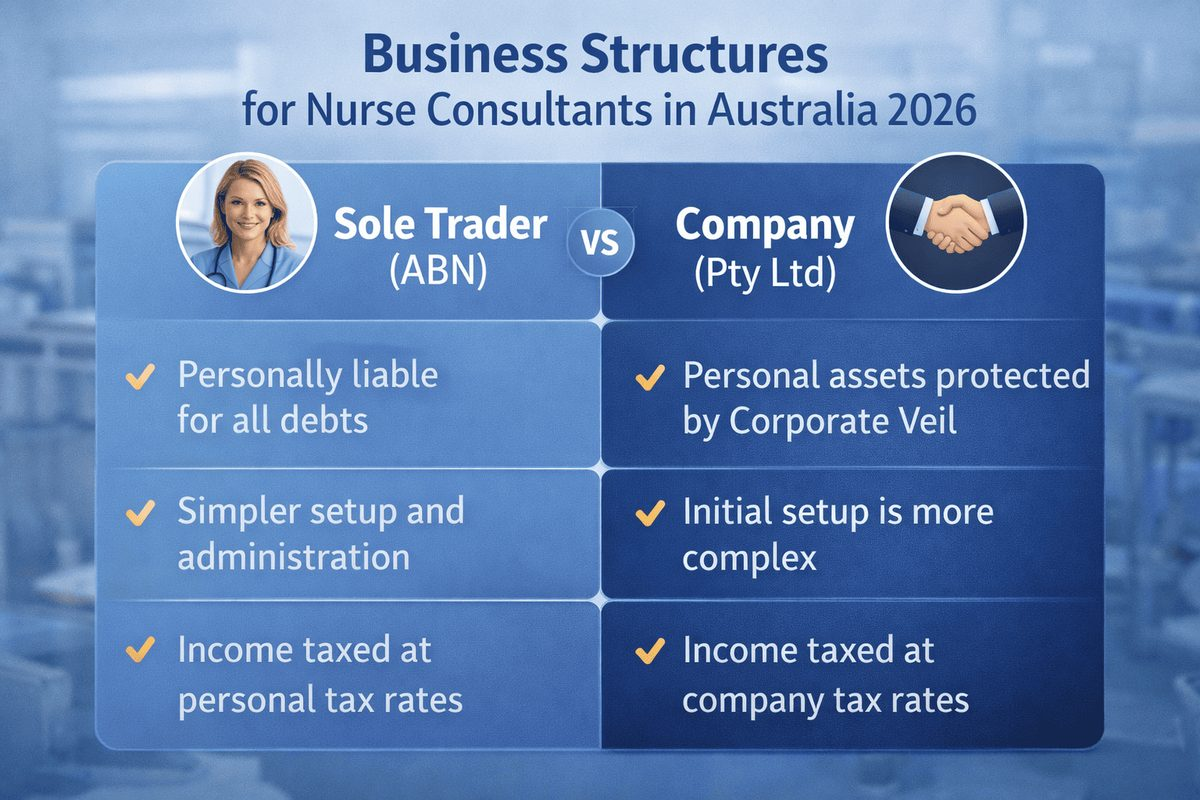
Beyond clinical risk, you have the legal obligations of a business owner. Most Nurse Consultants in Australia operate under an Australian Business Number (ABN) as either a Sole Trader or a Proprietary Limited (Pty Ltd) company. Each has different legal implications. A Sole Trader is personally liable for the business's debts, whereas a Company provides a "Corporate Veil" that separates your personal assets from the business. In 2026, many consultants are choosing the Pty Ltd structure to better manage tax and reduce personal financial risk.
[Image showing a comparison chart between Sole Trader (ABN) and Company (ACN) structures]
In addition to PII, you almost certainly need Public Liability (PL) Insurance. While PII covers your "Advice," Public Liability covers "Accidents." If you are conducting an on-site audit at a clinic and someone trips over your laptop cable, or if you accidentally damage a piece of expensive medical equipment during a training session, Public Liability covers the costs. Most government contracts and private healthcare facilities in 2026 will require you to show a certificate of currency for at least $20 million in Public Liability before you are allowed to step onto their premises.
4. Data Privacy, Cyber Insurance, and the My Health Record Act
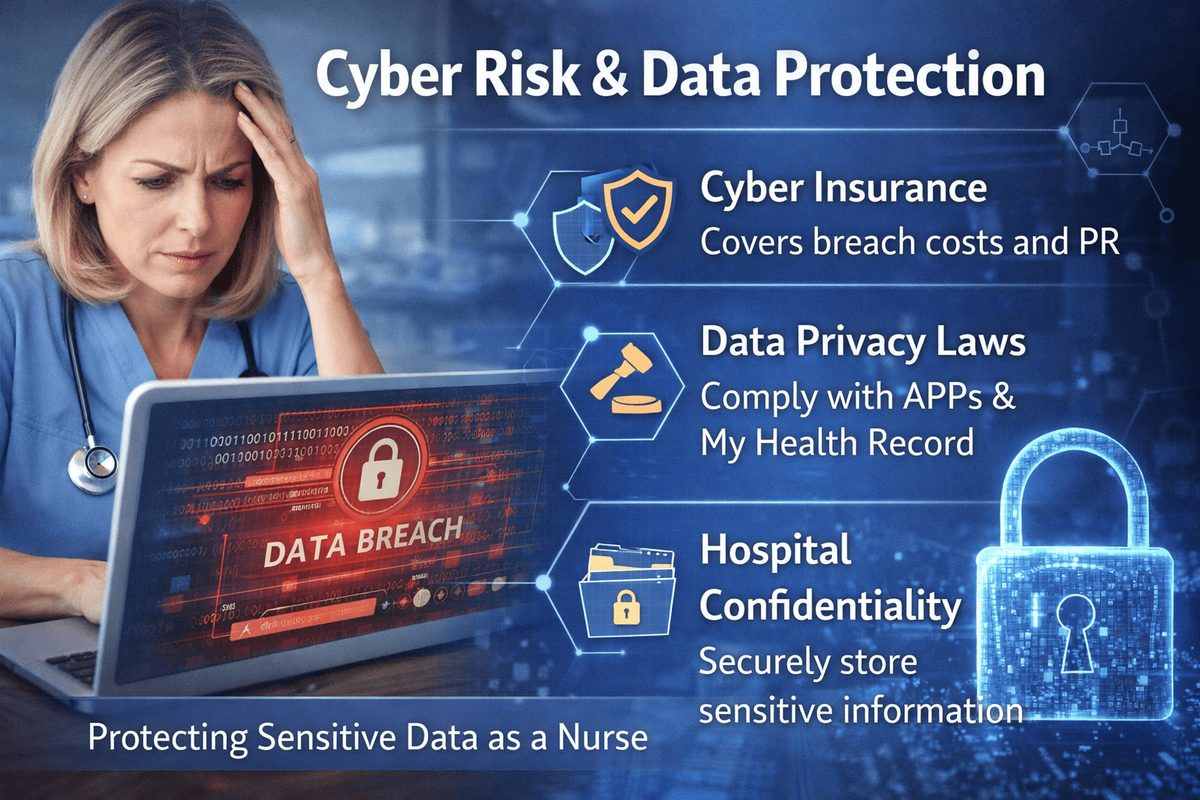
As a consultant, you are often handling sensitive patient data or proprietary hospital information. In 2026, the Australian Privacy Principles (APPs) and the My Health Record Act impose strict penalties for data breaches. If you are storing client information on your laptop or in the cloud, you have a legal duty to ensure it is secure. A "Data Breach" is not just a tech problem; it is a legal catastrophe. If a hacker accesses your files and leaks patient data, you could be liable for massive fines and a devastating loss of professional reputation.
This is why Cyber Insurance has become a "must-have" for Nurse Consultants in 2026. This insurance helps pay for the costs of notifying victims, conducting forensic investigations to find the source of the hack, and even "Reputation Repair" through PR consultants. Many insurance brokers now offer "Combined Malpractice and Cyber" policies specifically tailored for independent healthcare consultants. Protecting your "Digital Footprint" is now just as important as protecting your clinical license.
5. Service Agreements and Contractual Protections
The final piece of the legal puzzle is the Service Agreement. You should never start a consulting project without a signed contract. This document defines exactly what you are doing (and, more importantly, what you are not doing). A well-drafted agreement in 2026 includes a Limitation of Liability clause, which caps the amount of money a client can sue you for, usually to the value of the fees paid for the project.
Your contract should also address Intellectual Property (IP). If you create a new training manual or a policy document for a clinic, who owns it? Without a clear contract, the clinic might claim ownership of your hard work, preventing you from using those templates for other clients. In the age of "Workplace Health and Safety" (WHS) laws, your agreement should also clarify who is responsible for safety during your consultancy. Taking the time to have a lawyer review your "Standard Terms of Business" is an upfront cost that can save you hundreds of thousands of dollars in the long run.
Frequently Asked Questions
Q: Can I use my union's insurance for my private consultancy work?
A: Often, no. Many union-provided policies (like those from the ANMF) are designed for "Employees" and may specifically exclude independent contractors or business owners. You must check the "Product Disclosure Statement" (PDS) to ensure your specific ABN activities are covered.
Q: Do I need to be a Nurse Practitioner to be a "Nurse Consultant"?
A: No. "Nurse Consultant" is a professional role, whereas "Nurse Practitioner" is a protected legal endorsement. However, you must be careful not to use protected titles you aren't entitled to and ensure your advice doesn't exceed the scope of an RN if you aren't an NP.
Q: How much does a basic insurance package for a Nurse Consultant cost?
A: In 2026, a combined PII and Public Liability policy for a part-time consultant starts at roughly $650 to $900 per year. If you are doing high-risk work (like surgical consulting or advanced clinical education), premiums can exceed $1,500.
Q: What is "Statutory Liability" insurance?
A: This is an optional add-on that covers fines and penalties imposed by a government body or regulator for "unintentional" breaches of laws, such as WHS or environmental regulations. It can be a valuable addition for consultants working in heavy compliance environments.
Q: Is "Income Protection" insurance required by law?
A: No, but it is highly recommended. As a self-employed consultant, if you get sick or injured and can't work, you have no "Sick Leave." Income protection ensures you can still pay your bills while you recover.