

The cosmetic and aesthetics industry in Australia is booming, but with great opportunity comes significant professional risk. In 2026, the Nursing and Midwifery Board of Australia (NMBA) and AHPRA have implemented even stricter guidelines for non-surgical cosmetic procedures, making comprehensive insurance a non-negotiable requirement for every practicing nurse. Whether you are a Registered Nurse (RN) or an Enrolled Nurse (EN) working with anti-wrinkle injections, dermal fillers, or laser therapies, you must have Professional Indemnity Insurance (PII) that specifically covers your scope of practice.
The cost of this insurance is not a "one-size-fits-all" figure. It is a variable expense that depends on the complexity of the treatments you offer, your employment status, and the level of financial protection you choose. For many nurses entering the field, the price of insurance can be a surprise, often sitting much higher than standard hospital indemnity cover. This article breaks down the 2026 pricing landscape for cosmetic nursing insurance, helping you budget for your career while ensuring you are fully protected against legal and clinical claims.
1. Estimated Premium Tiers: From Basic to Advanced
In 2026, insurance providers in Australia typically categorize cosmetic nursing into "Risk Tiers." The more invasive or "high-risk" the procedure, the higher the premium. For a sole trader or an independent contractor, the starting cost for a Basic Cosmetic Nursing Policy—which usually covers standard neurotoxins (anti-wrinkle) and simple dermal fillers—begins at approximately $385 to $450 per year. This basic tier is designed for nurses who stick to the most common, lower-risk injectables and non-ablative skin treatments.
As you expand your skills, the costs increase. If your practice includes Fat Dissolving Injections, PRP (Platelet-Rich Plasma), or PDO Mono Threads, premiums generally jump to a mid-tier range of $750 to $850 per year. The highest premiums are reserved for nurses performing High-Intensity treatments like Laser/IPL, lifting threads, or advanced chemical peels (over 60%). These comprehensive policies often start at $950 and can exceed $1,500 per year. These prices usually provide a minimum of $1 million in Professional Indemnity and $10 million in Public Liability, though many professionals opt for higher limits ($10M/$20M) to meet clinic requirements or for extra peace of mind.
2. Professional Indemnity vs. Public Liability: Why You Need Both
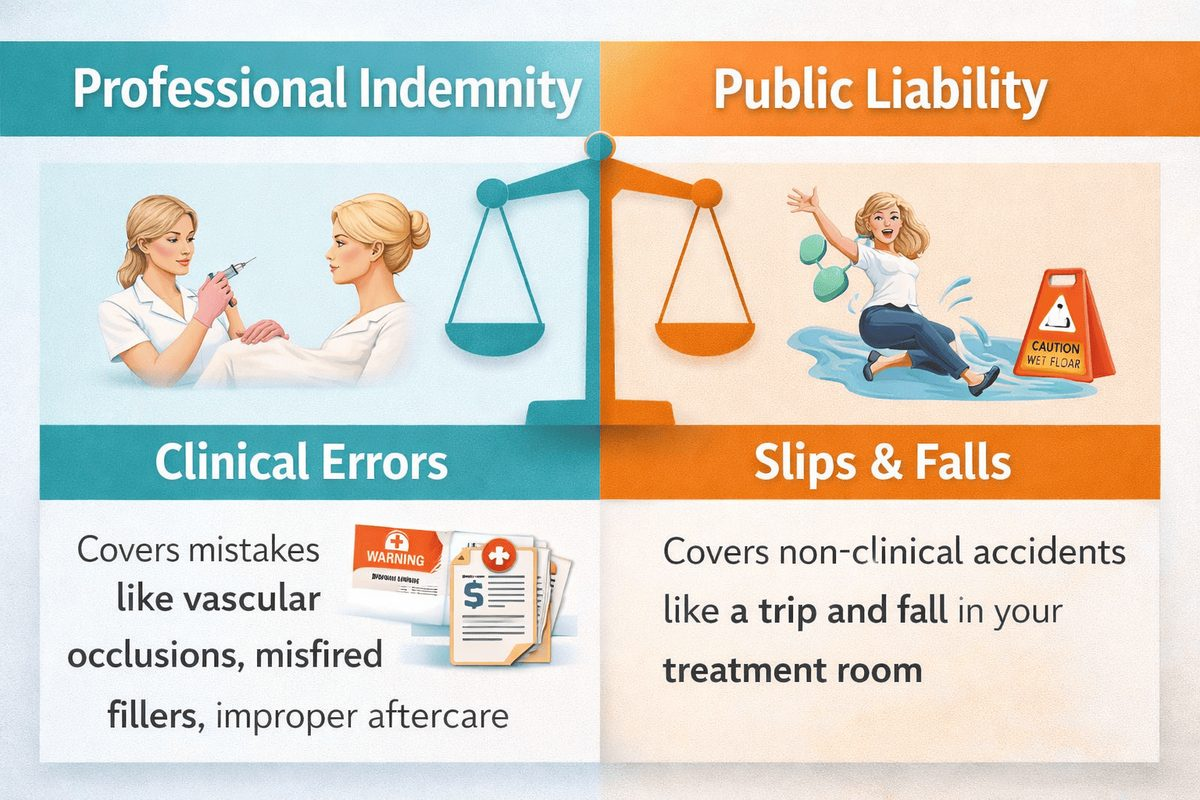
Understanding what you are paying for is essential. Your insurance package is almost always a "combined" policy. Professional Indemnity (PI) is the core of your coverage; it protects you if a patient alleges that you made a clinical error, such as causing a vascular occlusion with a filler or failing to provide proper aftercare instructions. It covers your legal defense costs and any compensation you are ordered to pay. Given that a single legal battle in the aesthetics industry can cost tens of thousands of dollars, PI is your most vital financial shield.
[Image explaining the difference between Professional Indemnity (Clinical errors) and Public Liability (Slips and falls)]
Public Liability (PL), on the other hand, covers non-clinical accidents. If a client trips over a power cord in your treatment room or a heavy piece of equipment falls and injures them, Public Liability steps in. In 2026, most Australian clinics will not allow a contractor to step foot on their premises without proof of at least $10 million in Public Liability. While you might be the most skilled injector in the country, a simple "slip and fall" lawsuit can be just as financially devastating as a clinical mistake. A combined policy ensures that no matter how an injury occurs, your personal and professional assets are protected.
3. Key Factors That Influence Your Personal Quote
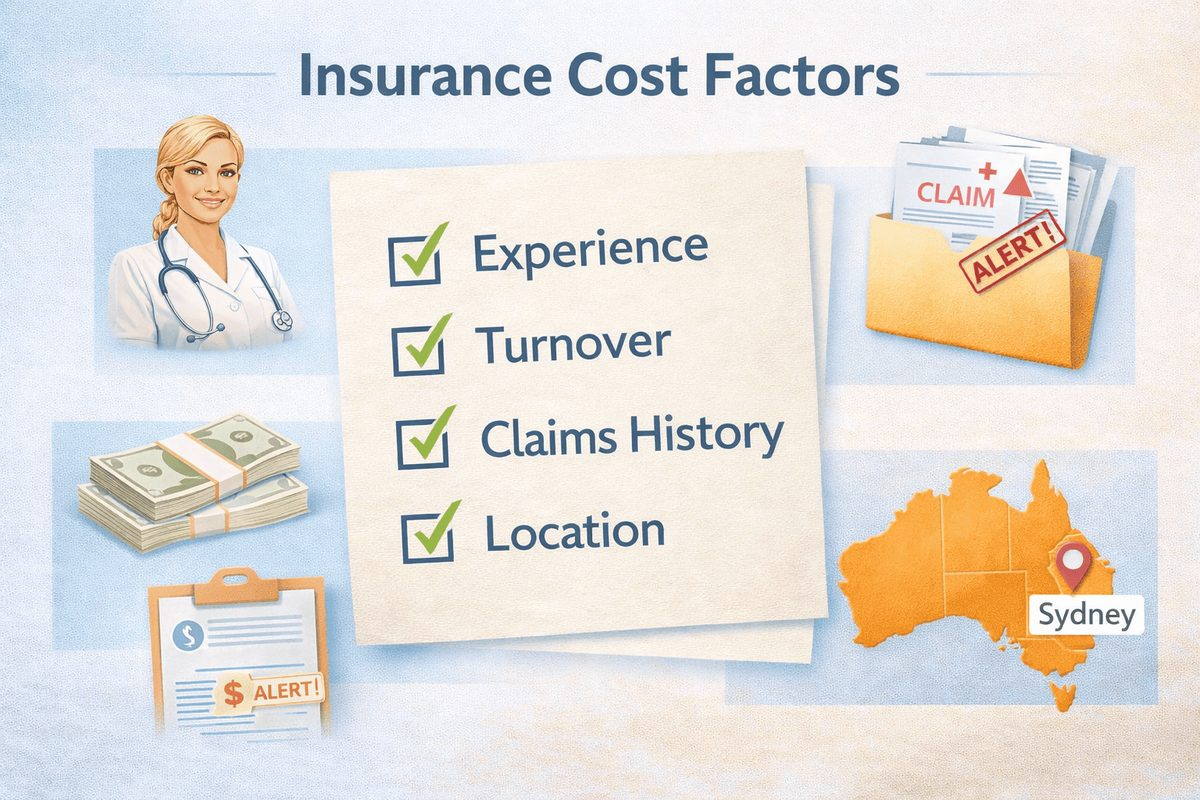
Insurance underwriters in 2026 use complex algorithms to determine your specific risk profile. One of the biggest factors is your Claims History. If you have had previous legal issues or "notifications" made against your registration, your premiums will likely be "loaded" (increased) by 25% to 150%. Conversely, staying claim-free for several years can lead to "No Claims Discounts." Your Total Turnover (Revenue) also matters; a nurse performing 50 treatments a week is statistically more likely to face a claim than a nurse performing five, so high-volume injectors may pay higher premiums.
[Image showing a checklist of factors: Years of experience, turnover, claims history, and location]
Your Experience and Education play a role too. Under the 2026 AHPRA guidelines, nurses must have a minimum amount of general nursing experience before moving into cosmetics. Insurers favor nurses who can show they have completed accredited, hands-on training for the specific devices or products they use. Finally, Geographic Location can have a minor impact. In highly litigious urban centers like Sydney or Melbourne, some insurers may apply a slight "metro loading" compared to regional practitioners, reflecting the higher average cost of legal settlements in major cities.
4. Employed vs. Self-Employed: The Insurance Gap
A common mistake among cosmetic nurses is assuming they are fully covered by their employer's policy. If you are a Permanent Employee, your clinic’s insurance should cover you for the work you do during your shift. However, in 2026, the NMBA places the "onus of proof" on the individual nurse. You must ensure your employer’s policy meets the AHPRA standard and specifically covers "Cosmetic Procedures." Many standard hospital or general practice policies actually exclude cosmetic injectables unless a specific "rider" has been added.
[Image showing a warning icon: "Check your employer's policy for cosmetic exclusions"]
If you are an Independent Contractor or work at multiple clinics under your own ABN, you must have your own insurance policy. An employer's policy will never cover you for "side work" or treatments you perform outside of their facility. Furthermore, if you are a member of a union like the ANMF, you must be careful; some union-provided insurance specifically excludes botox, dermal fillers, and laser therapy. In 2026, the safest path for any cosmetic nurse—even those who are employed—is to hold a "top-up" or individual policy to ensure there are no gaps in coverage that could leave them personally liable.
5. The Hidden Cost of "Run-Off" Cover
One insurance expense that many nurses forget to budget for is Run-Off Cover. Professional Indemnity insurance in Australia is usually "Claims-Made." This means you must have an active policy at the time a claim is made, not just when the treatment was performed. If you decide to stop nursing, go on maternity leave, or retire in 2026, you cannot simply cancel your insurance. A client could potentially sue you two years later for a treatment you did today.
Run-off cover protects you for those past treatments after you have stopped practicing. The good news is that many high-quality 2026 policies now include "Automatic Run-Off" cover if you retire or leave the profession permanently. However, if you are just taking a break (like a gap year or parental leave), you may need to pay a "reduced premium" to keep your past work protected. Failing to account for run-off cover is a major risk; without it, you could be left to pay for a legal defense out of your own pocket years after you've hung up your scrubs.
Frequently Asked Questions
Q: Does APNA or the ANMF cover cosmetic nursing?
A: It depends. As of 2026, APNA has secured deals that do include some cosmetic injectables for members, often at very competitive rates (starting around $149-$169 for some members). However, the ANMF (Vic Branch) and others often have specific exclusions for Botox and fillers. Always read the "Exclusions" section of your membership policy.
Q: Can I get insurance if I am an Enrolled Nurse (EN)?
A: Yes, but you must be working under the supervision of a Registered Nurse (RN) as per NMBA guidelines. Your insurance policy will usually require you to declare that you are practicing within your legal scope and under appropriate supervision to remain valid.
Q: How much excess do I have to pay if I make a claim?
A: This varies by provider. Some "premium" policies have Zero Excess, meaning you pay nothing when you make a claim. Others might have an excess of $500 to $2,500. A higher excess usually results in a lower annual premium, but you must ensure you have the cash saved in case an incident occurs.
Q: Does my insurance cover me if I use "off-label" products?
A: This is a grey area. Most insurers require you to follow TGA guidelines and manufacturer instructions. If you are using products in a way that is considered "experimental" or "unsafe" by the industry standards of 2026, your insurer may deny your claim.
Q: What is "Retroactive Cover"?
A: This is a feature of your policy that covers you for incidents that happened before you started the current policy, provided you had insurance in place at that time. When switching insurers, always check that your "Retroactive Date" is set to when you first started practicing as a cosmetic nurse.