

Summary
Artificial Intelligence (AI) is becoming more common in healthcare systems around the world. Hospitals now use AI to support patient monitoring, documentation, risk alerts, and decision-making. While AI brings many benefits, it also creates real challenges for the nursing profession, especially for nursing students and early-career nurses.
Many discussions focus only on how helpful AI can be. However, understanding the challenges of Artificial Intelligence in nursing is just as important. Nurses are the largest group of healthcare professionals, and they are often the main users of AI-based systems in daily practice. If these systems are not used carefully, they can create stress, confusion, ethical problems, and safety risks.
This article explains the main challenges of Artificial Intelligence in the nursing profession in a clear and simple way. It is written for nursing students, helping them understand both the risks and responsibilities that come with AI in modern nursing practice.
Understanding Artificial Intelligence in the Nursing Profession
Before discussing challenges, it is important to understand what AI means in nursing practice. Artificial Intelligence refers to computer systems that analyse large amounts of data and provide suggestions, alerts, or predictions. In nursing, AI is often built into electronic health records, monitoring systems, medication management tools, and scheduling software.
AI does not replace nurses, but it influences how nurses work. Nurses rely on AI-generated alerts, risk scores, and reminders throughout their shifts. Because of this close interaction, any weakness in AI systems directly affects nursing practice.
For nursing students, learning how AI worksand where it can failis essential for safe and professional practice.
Over-Reliance on AI and Reduced Clinical Judgment
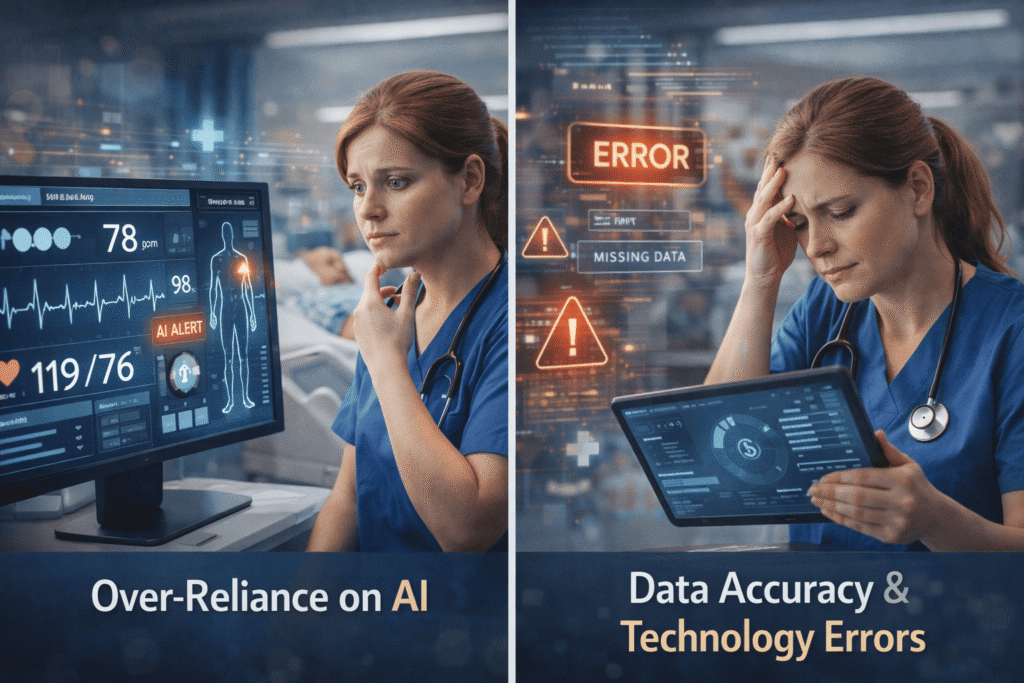
One of the biggest challenges of Artificial Intelligence in the nursing profession is over-reliance on technology. When nurses trust AI systems too much, they may rely less on their own clinical judgment.
AI systems are designed to support decision-making, not replace it. However, busy clinical environments can encourage nurses to follow AI alerts automatically, even when something does not feel right. This can be dangerous if the system is incorrect or incomplete.
For nursing students, this challenge is even greater. Students may assume that AI-generated alerts are always correct and may hesitate to question them. This can slow the development of independent clinical reasoning skills.
Nursing education emphasises critical thinking. AI should support this process, not weaken it. Nurses must always combine AI information with patient assessment, communication, and professional judgment.
Data Accuracy Problems and Technology Errors
Artificial Intelligence systems depend heavily on data quality. If the data entered into the system is incorrect, incomplete, or outdated, the AI output will also be inaccurate.
In nursing practice, documentation errors, delayed charting, or missing information can lead to incorrect alerts or risk predictions. This can confuse nurses and lead to inappropriate care decisions.
For nursing students, data accuracy is a major challenge. Students are still learning documentation standards, and small mistakes can have larger consequences when AI systems use that data for analysis.
Technology failures are another concern. System crashes, software glitches, or delayed updates can interrupt workflow and increase stress. When nurses rely on AI systems that suddenly stop working, patient care can be affected.
Ethical and Legal Challenges for Nurses
Artificial Intelligence introduces complex ethical and legal challenges in nursing. Nurses are responsible for patient care, even when AI tools are involved. This raises important questions about accountability.
If an AI system provides incorrect advice and harm occurs, who is responsible the nurse, the hospital, or the software provider? Nurses may feel uncertain about their legal responsibilities when using AI-supported systems.
Privacy is another major ethical concern. AI systems collect and analyse large amounts of patient data. Protecting patient confidentiality is a core nursing responsibility, and any data breach can have serious consequences.
For nursing students, understanding these ethical challenges is essential. Students must learn to use AI responsibly while maintaining professional standards and patient trust.
Impact on the Nurse Patient Relationship
Nursing is a human centred profession built on empathy, communication, and trust. One challenge of Artificial Intelligence in nursing is the risk of reducing meaningful nurse–patient interaction.
When nurses spend more time interacting with screens, devices, and alerts, there is less time for face-to-face communication. Patients may feel ignored or treated as data rather than people.
For nursing students, this challenge can affect learning. Developing communication skills is a key part of nursing education. Over-reliance on technology may reduce opportunities to practise therapeutic communication.
AI should support patient care, not replace human connection. Nurses must consciously protect the nurse–patient relationship in technology-rich environments.
Increased Workload and Alert Fatigue
Although AI is designed to reduce workload, it can sometimes have the opposite effect. Many AI systems generate frequent alerts, reminders, and notifications. When too many alerts appear, nurses may experience alert fatigue.
Alert fatigue occurs when nurses become overwhelmed and start ignoring or dismissing alerts, including important ones. This creates safety risks for patients.
For nursing students, constant alerts can be confusing and stressful. Students may struggle to prioritise which alerts require immediate action and which are less urgent.
Managing alert fatigue requires system design improvements and strong clinical judgment from nurses.
Skill Gaps and Learning Challenges for Nursing Students
Another challenge of Artificial Intelligence in the nursing profession is the skill gap between technology and nursing education. Not all nursing programs provide adequate training on AI systems used in clinical settings.
Students may encounter advanced AI tools on placement without proper preparation. This can lead to anxiety, mistakes, or lack of confidence.
Some students may also feel pressure to adapt quickly without understanding how the system works. This creates a learning gap that can affect patient safety and student performance.
Nursing education needs to evolve to include digital literacy and AI awareness, ensuring students feel confident using technology responsibly.
Bias and Inequality in AI Systems
AI systems learn from existing data. If that data contains bias, the AI system can reproduce or even worsen inequality. This is a serious challenge in healthcare.
For example, AI systems may not perform equally well across different cultural, ethnic, or age groups if the training data is limited. This can lead to inaccurate risk assessments or treatment recommendations.
Nurses are advocates for equity and patient-centered care. They must be aware of potential bias in AI tools and question recommendations that do not align with patient needs.
For nursing students, understanding bias in AI is essential for ethical and culturally safe practice.
Emotional Impact and Job Security Concerns
Some nurses worry that AI will replace jobs or reduce professional value. While AI is not designed to replace nurses, these fears can affect morale and job satisfaction.
Nursing students may feel uncertain about their future roles in a highly automated healthcare system. This emotional impact should not be ignored.
In reality, AI changes nursing roles rather than removing them. However, adapting to change requires support, education, and reassurance from healthcare organizations.
The Role of Nurses in Managing AI Challenges
Despite these challenges, nurses play a crucial role in shaping how AI is used in healthcare. Nurses are the link between technology and patient care.
By understanding AI limitations, questioning outputs, protecting patient safety, and advocating for ethical use, nurses ensure AI supports not harms care quality.
For nursing students, learning about these challenges prepares them to be thoughtful, responsible professionals in modern healthcare environments.
Conclusion: Why Understanding AI Challenges Is Essential for Future Nurses
Artificial Intelligence offers many benefits, but it also creates serious challenges for the nursing profession. Over-reliance on technology, ethical concerns, data accuracy issues, and impacts on patient relationships are all real risks.
For nursing students, understanding these challenges builds awareness, confidence, and professional responsibility. AI is a tool, not a replacement for nursing judgment, compassion, or ethics.
By learning to balance technology with human care, future nurses can ensure that AI improves healthcare rather than complicating it.
People Also Ask
What are the main challenges of AI in nursing?
Over-reliance, ethical concerns, data errors, and reduced human interaction.
Can AI replace nurses in the future?
No, AI supports nurses but cannot replace human care.
Is AI always accurate in healthcare?
No, AI depends on data quality and can make errors.
Do nursing students need to learn about AI challenges?
Yes, understanding risks is essential for safe practice.
Does AI affect patient trust?
It can, if not used carefully and ethically.
Useful Documents for every Nursing Student
CV Section Template for Nursing students
AHPRA – NMBA Registration Document Checklist (International Students-Graduates)
Clinical Placement Reflection Template (NMBA-aligned)
Cover Letter Template for Nursing Students
Disclaimer: “I researched this information on the internet; please use it as a guide and also reach out to a professional for assistance and advice.This information is not medical advice, so seek your medical professional’s assistance.”