
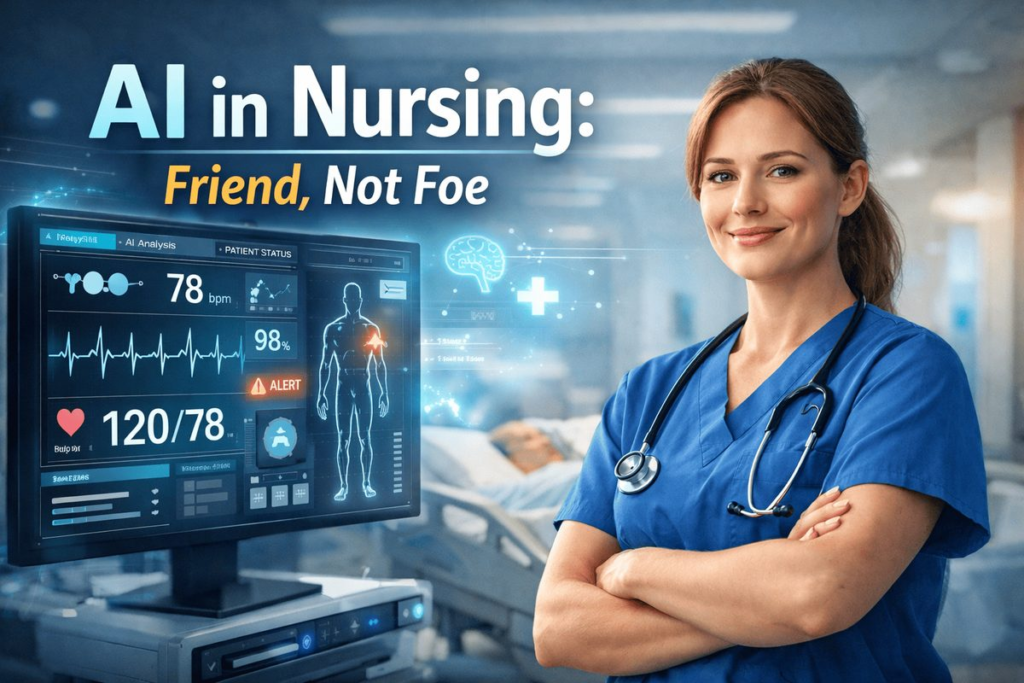
Artificial Intelligence (AI) is rapidly changing the way healthcare works around the world. In nursing practice, AI is no longer just a future idea—it is already being used in hospitals, clinics, aged-care facilities, and community health settings. From electronic health records to patient monitoring systems, AI tools are quietly supporting nurses every day.
For nursing students, understanding the benefits of Artificial Intelligence in nursing practice is becoming increasingly important. Many students worry that AI might replace nurses, but in reality, AI is designed to support nurses, not replace them. It helps reduce workload, improve patient safety, and allow nurses to focus more on direct patient care.
This article explains the key benefits of Artificial Intelligence in nursing practice in a clear and simple way. It is written especially for nursing students and new graduates, with real-world explanations rather than technical language.
What Is Artificial Intelligence in Nursing Practice?
Artificial Intelligence refers to computer systems that can analyse data, recognise patterns, and support decision-making. In nursing practice, AI usually works in the background through software and digital tools that assist with everyday tasks.
For example, when a hospital system alerts a nurse that a patient’s vital signs are changing, that alert is often powered by AI. When electronic records suggest medication timings or flag potential risks, AI is helping behind the scenes.
AI in nursing does not make decisions independently. Instead, it provides supportive information that nurses use alongside their professional judgment. Understanding this helps students see AI as a helpful tool rather than a threat.
How Artificial Intelligence Improves Patient Safety

One of the biggest benefits of Artificial Intelligence in nursing practice is improved patient safety. Nurses manage many patients, medications, and clinical tasks at the same time. AI systems help reduce human error by providing early warnings and reminders.
AI-powered monitoring systems can detect subtle changes in vital signs, such as heart rate, oxygen levels, or blood pressure, before they become critical. This allows nurses to intervene earlier and prevent complications.
Medication safety is another key area. AI systems can alert nurses to potential drug interactions, allergies, or incorrect dosages. For nursing students, this extra layer of safety is especially valuable while learning medication administration.
Overall, AI supports safer care by acting as a second set of eyes, helping nurses catch issues early.
Reducing Nursing Workload and Saving Time
Nursing is physically and mentally demanding. Documentation, charting, and administrative tasks take up a large portion of a nurse’s shift. Artificial Intelligence helps reduce this workload by automating repetitive tasks.
For example, voice-to-text documentation allows nurses to record notes more quickly. Smart charting systems can auto-fill routine information, reducing the time spent on paperwork.
By saving time on administrative duties, nurses can spend more time with patients. For nursing students, this means better learning experiences and more opportunities to practise clinical skills instead of being overwhelmed by documentation.
AI does not remove responsibility from nurses, but it helps manage time more effectively and reduce burnout.
Supporting Clinical Decision-Making for Nurses
Another major benefit of Artificial Intelligence in nursing practice is support with clinical decision-making. AI systems analyse large amounts of patient data and highlight patterns that may not be immediately obvious.
For example, AI can help identify patients at risk of falls, pressure injuries, or deterioration based on their medical history and current condition. Nurses still make the final decision, but AI provides useful insights to guide care planning.
For nursing students, this is especially helpful during placements. AI tools can support learning by reinforcing clinical reasoning and helping students understand why certain interventions are recommended.
AI acts as a learning partner, not a replacement for nursing judgment.
Enhancing Personalised and Patient-Centred Care

Artificial Intelligence allows healthcare providers to move towards more personalised care. By analysing patient data such as age, medical history, lifestyle, and response to treatments, AI can support care plans tailored to individual needs.
In nursing practice, this means care is not “one-size-fits-all.” AI can suggest personalised monitoring plans, education needs, or follow-up schedules.
For nursing students, this reinforces the importance of holistic, patient-centred care. AI supports nurses in seeing the full picture of the patient rather than focusing only on symptoms.
Personalised care improves patient satisfaction and outcomes, which benefits both patients and healthcare teams.
Improving Communication and Care Coordination
Good communication is essential in nursing practice, and AI helps improve communication between healthcare teams. AI-powered systems ensure that patient information is updated in real time and accessible to all relevant staff.
This reduces miscommunication during handovers, transfers, and shift changes. For example, AI-assisted handover tools can highlight critical information that should not be missed.
For nursing students, clear communication systems reduce confusion and support safer learning environments. Students can better understand patient priorities and follow care plans accurately.
Improved communication leads to smoother workflows and better teamwork.
AI in Nursing Education and Skill Development
Artificial Intelligence is also transforming nursing education. Simulation labs now use AI to create realistic patient scenarios that respond to student actions in real time.
AI-based learning platforms can identify areas where students struggle and provide personalised study recommendations. This helps students focus on their weaknesses and improve more efficiently.
For nursing students, AI-enhanced education builds confidence and prepares them better for real-world clinical practice.
Ethical Considerations and the Human Role in AI-Supported Nursing
While AI offers many benefits, it also raises ethical considerations. Nurses must ensure patient privacy, data security, and informed consent when using AI-supported systems.
Importantly, AI cannot replace human compassion, empathy, and ethical judgment. Nursing remains a human-centred profession. AI is a tool that supports nurses, not one that replaces the nurse-patient relationship.
For students, learning to balance technology with compassion is an essential skill for modern nursing practice.
What Nursing Students Should Know About the Future of AI in Nursing
AI will continue to grow in healthcare, and future nurses will work alongside more advanced systems. Nursing students who understand AI will be better prepared for modern workplaces.
Learning how to use AI responsibly, question its recommendations, and combine it with clinical judgment will be key skills for future nurses.
Rather than fearing AI, students should see it as a tool that can make nursing safer, more efficient, and more patient-focused.
Conclusion: Why Artificial Intelligence Is a Benefit, Not a Threat, to Nursing
Artificial Intelligence brings many benefits to nursing practice, including improved patient safety, reduced workload, better decision-making, and enhanced patient-centred care. For nursing students, AI provides extra support during learning and clinical placements.
Nursing will always require human care, empathy, and ethical judgment. AI simply strengthens the nurse’s ability to deliver high-quality care in complex healthcare environments.
Understanding the benefits of Artificial Intelligence in nursing practice helps students feel confident and prepared for the future of healthcare.
Frequently Asked Questions
How is AI used in nursing practice today?
AI supports monitoring, documentation, medication safety, and decision-making.
Will Artificial Intelligence replace nurses?
No, AI supports nurses but cannot replace human care and judgment.
Is AI safe to use in healthcare?
When used responsibly with privacy protections, AI improves safety.
Do nursing students need to learn about AI?
Yes, understanding AI prepares students for modern healthcare systems.
Does AI improve patient outcomes?
Yes, by supporting early detection, personalised care, and safer practices.