

Summary
Discovering the best study tips for nursing students is the ultimate key to navigating a high-stakes medical curriculum that demands far more than a standard undergraduate degree. In 2026, students must balance intense hospital rotations with the rigorous academic mastery of advanced anatomy, complex pathophysiology, and sophisticated pharmacokinetics. When patient safety and evidence-based clinical education are on the line, traditional ‘cramming’ methods fail; instead, utilizing adaptive learning platforms and high-fidelity clinical simulation is vital for long-term clinical intuition.
Having mentored countless healthcare students from overwhelmed to organized, I know that success relies on spaced repetition systems (SRS) and predictive NCLEX analytics to build exam confidence. This comprehensive guide delivers the ultimate, high-yield strategies for achieving NCLEX-RN exam readiness, passing difficult pharmacology assessments, and mastering your practical objective structured clinical examinations (OSCEs).
Master “Active Recall” Instead of Passive Reading
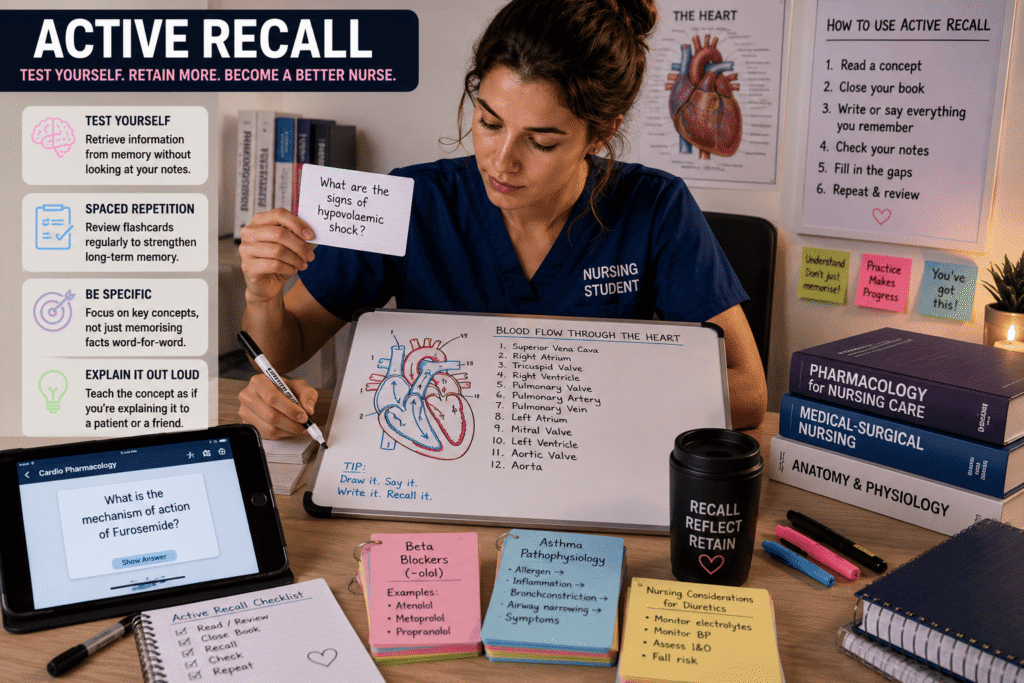
Spending hours underlining textbooks or rereading notes is one of the most common blunders made by nursing students. Educational research in 2026 makes it abundantly evident that this is “passive” learning, which is generally unproductive. Active Recall is essential for learning nursing ideas. This entails putting yourself to the test before you’re ready.
Close the book and attempt to sketch the flow of blood through the heart from memory rather than reading a chapter on the cardiovascular system. Make digital pharmacology flashcards using programs like Anki or Quizlet. You improve the neural networks by making your brain “retrieve” the knowledge. You don’t know an idea well enough if you can’t simply describe it to a buddy who isn’t a nurse.
Use the “Pomodoro Technique” to Beat Burnout
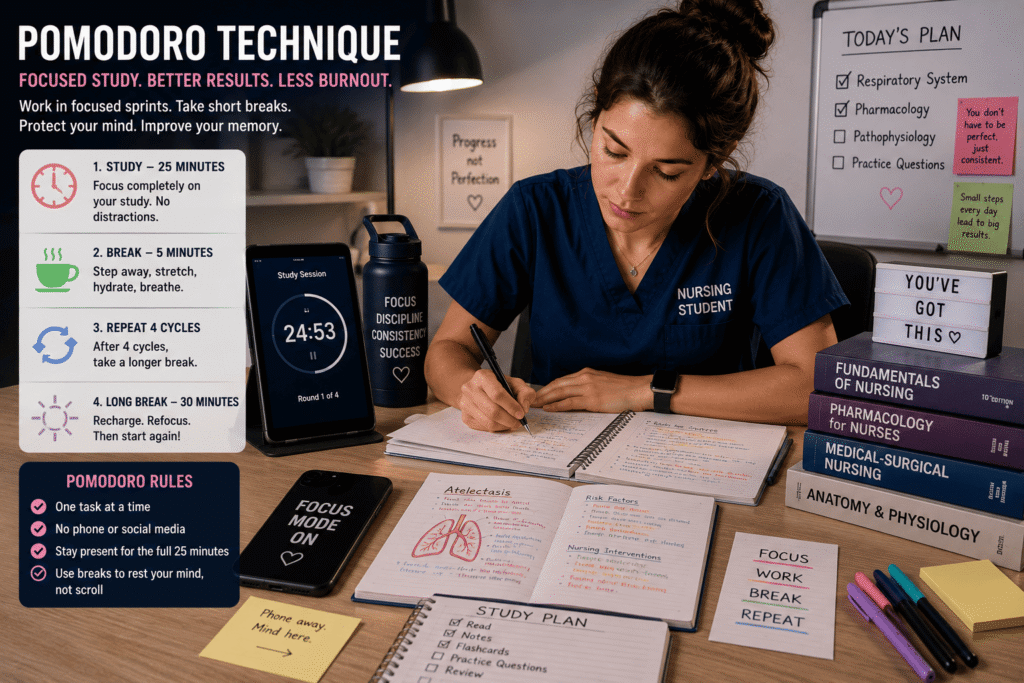
Because nursing texts are so dense, attempting to read for four hours in a row will result in “Cognitive Overload.” For nursing students, the Pomodoro Technique is a lifesaver. It entails studying with intense concentration for 25 minutes, then taking a 5-minute rest. Take a lengthier 30-minute pause after four cycles.
This approach is effective because it honors the normal attention span of your brain. Your phone should be in a different room during those twenty-five minutes. Digital distractions are the biggest threat to academic achievement in 2026. Instead of using your breaks to browse social media, stretch, drink water, or go outside. This keeps your mind active and avoids the “brain fog” that frequently develops during extended study sessions.
Study by “Body Systems,” Not by Chapters
Just as the human body doesn’t function in a vacuum, neither should your studies. Instead than merely learning a list of drugs by heart, study them in conjunction with the pertinent anatomy and physiology. Learn about the anatomy of the lungs and the pathophysiology of asthma concurrently if you are studying respiratory medications (such as salbutamol).
This “Integrative Approach” aids in your comprehension of the treatment’s rationale. During clinical placements, your preceptors will ask you why a medication is being administered to a particular patient rather than asking you to define it. Compared to isolated memory, the material retains considerably better when you make the connection between the illness and the treatment.
Leverage Clinical Placement as “Living Study”
Your clinical placements are your most effective study tool, not merely a place to practice washing your hands and making beds. Each patient under your care is a “Living Case Study.” Pay special attention to a patient’s pathology results, prescription schedule, and symptoms when they have a condition you have examined in class, such as Type 2 Diabetes.
Spend ten minutes researching anything you noticed but didn’t fully comprehend after your shift. This “Contextual Learning” is really effective. The patient who showed you what a “Hypoglycaemic episode” really looks like is someone you will never forget, even if you forget a paragraph from a textbook. Students who approach the ward as an extension of themselves will be the most successful in 2026.
Form a “High-Quality” Study Group
Studying can be a collaborative endeavor, much like nursing. But pick your group carefully. A small study group with three to four members should concentrate on collaborative testing. During your time together, practice “Mock Clinical Scenarios” or test one another on “Drug Calculations.”
One of the finest ways to reinforce your own understanding is to explain a subject to a peer (this is called the Feynman Technique). It’s time to move on if your group is more interested in chatting than studying. Finding a few “study buddies” who share your dedication might help you get through the most challenging courses, like bioscience, both academically and emotionally during your first year.
People Also Ask (FAQ)
Q: How many hours a day should a nursing student study?
Quality matters more than quantity. Most successful students aim for 2-3 hours of focused study on non-placement days. On placement days, even 20 minutes of reflection is enough to keep your momentum going.
Q: What is the best way to memorize pharmacology?
Don’t memorize individual drugs; memorize Drug Classes and their common suffixes (e.g., “-olol” for beta-blockers). Once you know how the class works, you can predict the side effects and nursing considerations for almost any drug in that group.
Q: How do I pass “Drug Calc” exams without failing?
Practice every single day. Use the “Formula Method” or “Dimensional Analysis” whichever your university prefers and do five practice questions a morning with your coffee. It’s a “mechanical” skill that requires repetition to build confidence.
Q: Should I buy all the recommended textbooks?
No. In 2026, many resources are available digitally through your university library. Buy the core Anatomy and Pharmacology texts, but for everything else, check the e-book versions first to save money.
Disclaimer: “I researched this information on the internet; please use it as a guide and also reach out to a professional for assistance and advice.This information is not medical advice, so seek your medical professional’s assistance.”