

If you are currently enrolled in a nursing degree, you already know that the workload is unlike any other course. In 2026, nursing students in Australia are expected to master high-level clinical skills, complex pharmacology, and a massive volume of anatomy—all while balancing intense hospital placements. The "cramming" method that might have worked in high school simply won't cut it when people’s lives are eventually in your hands.
As a midwife and mentor, I have watched many students move from being "overwhelmed" to "organized." The secret isn't just studying harder; it’s studying smarter by using evidence-based techniques that move information from your short-term memory into your long-term clinical intuition. This guide provides the most effective, grounded strategies for surviving your nursing exams and clinical assessments.
1. Master "Active Recall" Instead of Passive Reading
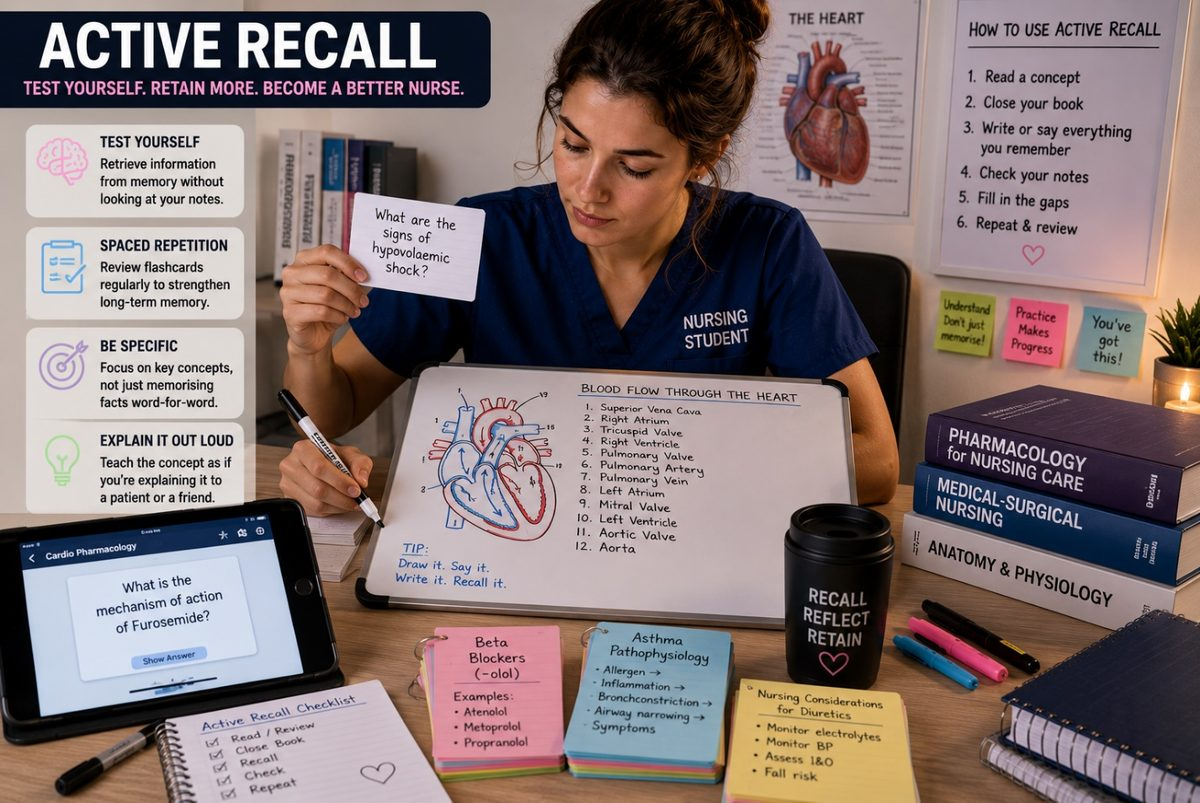
One of the biggest mistakes nursing students make is spending hours highlighting textbooks or re-reading notes. In 2026, educational research is clear: this is "passive" learning and it is largely ineffective. To truly learn nursing concepts, you must use Active Recall. This involves testing yourself before you feel ready.
Instead of reading a chapter on the Cardiovascular System, close the book and try to draw the flow of blood through the heart from memory. Use tools like Anki or Quizlet to create digital flashcards for pharmacology. By forcing your brain to "retrieve" the information, you strengthen the neural pathways. If you can’t explain a concept simply to a non-nursing friend, you don't know it well enough yet.
2. Use the "Pomodoro Technique" to Beat Burnout
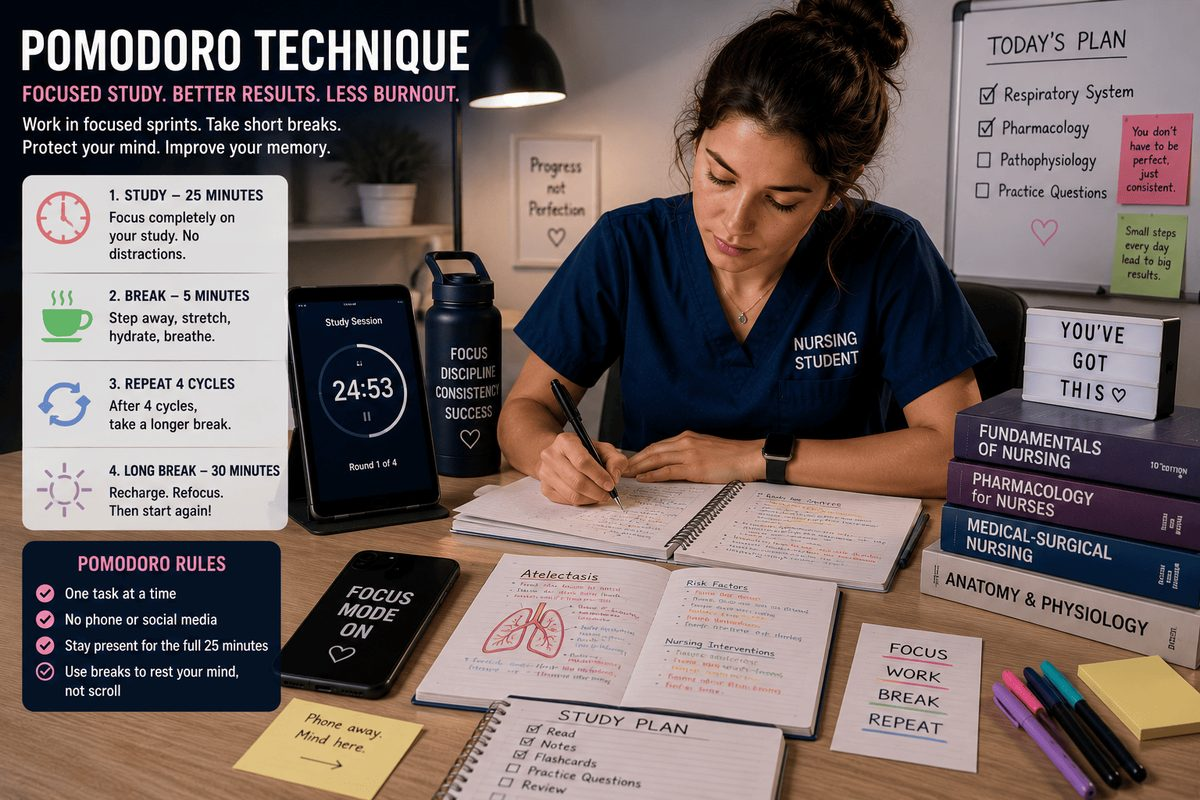
Nursing textbooks are dense, and trying to read for four hours straight will lead to "Cognitive
Overload." The Pomodoro Technique is a life-saver for nursing students. It involves studying for 25 minutes of high-intensity focus, followed by a 5-minute break. After four cycles, take a longer 30-minute break.
This method works because it respects your brain’s natural attention span. During those 25 minutes, your phone should be in another room. In 2026, digital distractions are the #1 enemy of academic success. Use your breaks to stretch, hydrate, or step outside—not to scroll social media. This keeps your mind fresh and prevents the "brain fog" that often sets in during long study sessions.
3. Study by "Body Systems," Not by Chapters
The human body doesn't work in isolation, and your studying shouldn't either. Rather than just memorizing a list of medications, study them alongside the relevant Anatomy and Physiology. If you are learning about Respiratory drugs (like Salbutamol), study the anatomy of the lungs and the pathophysiology of Asthma at the same time.
This "Integrative Approach" helps you understand the why behind the treatment. In clinical placements, your preceptors won't ask you to define a drug; they will ask you why it’s being given to this specific patient. When you connect the dots between the disease and the treatment, the information sticks much better than isolated memorization.
4. Leverage Clinical Placement as "Living Study"
Your clinical placements are not just for practicing hand-washing and making beds; they are the most powerful study tool you have. Every patient you care for is a "Living Case Study." When you see a patient with a condition you’ve studied in class, like Type 2 Diabetes, pay close attention to their pathology results, their medication chart, and their symptoms.
After your shift, spend 10 minutes looking up one thing you saw that you didn't fully understand. This "Contextual Learning" is incredibly powerful. You might forget a paragraph in a textbook, but you will never forget the patient who taught you what a "Hypoglycaemic episode" actually looks like. In 2026, the most successful students are those who treat the ward as an extension of the library.
5. Form a "High-Quality" Study Group
Nursing is a team profession, and studying can be too. However, choose your group wisely. A good study group should be small (3-4 people) and focused on Collaborative Testing. Use your time together to run through "Mock Clinical Scenarios" or to quiz each other on "Drug Calculations."
Explaining a concept to a peer is one of the best ways to solidify your own knowledge (this is known as the Feynman Technique). If your group spends more time gossiping than studying, it’s time to move on. In your first year, finding a few "study buddies" who are as committed as you are can provide the emotional and academic support needed to get through the most difficult subjects like Bioscience.
Frequently Asked Questions
Q: How many hours a day should a nursing student study? A: Quality matters more than quantity. Most successful students aim for 2-3 hours of focused study on non-placement days. On placement days, even 20 minutes of reflection is enough to keep your momentum going.
Q: What is the best way to memorize pharmacology? A: Don't memorize individual drugs; memorize Drug Classes and their common suffixes (e.g., "-olol" for beta-blockers). Once you know how the class works, you can predict the side effects and nursing considerations for almost any drug in that group.
Q: How do I pass "Drug Calc" exams without failing? A: Practice every single day. Use the "Formula Method" or "Dimensional Analysis"—whichever your university prefers—and do five practice questions a morning with your coffee. It’s a "mechanical" skill that requires repetition to build confidence.
Q: Should I buy all the recommended textbooks? A: No. In 2026, many resources are available digitally through your university library. Buy the core Anatomy and Pharmacology texts, but for everything else, check the e-book versions first to save money.