

Summary
One of the most difficult situations a healthcare worker might encounter is moving from a tranquil hospital setting to a high-intensity war zone. The “standard of care” shifts from luxury and plenty to survival and ingenuity in times of war or armed conflict. Emergency preparedness is the difference between pandemonium and life-saving accuracy for both seasoned RNs and nursing students. A nurse’s manual talents and mental toughness become the building’s most precious assets when the power goes out, the supply system collapses, and the wounded arrive in waves.
A modern, tech-heavy curriculum may not necessarily highlight the particular toolset of practical skills needed for wartime nursing. You need to learn how to handle trauma under intense psychological pressure, trust your physical evaluations without a monitor, and work with your hands. This essay delves deeply into the clinical and survival skills that every nurse needs acquire in order to be ready for the unexpected nature of contemporary warfare.
Master of Hemorrhage Control: The “Stop the Bleed” Protocol
Exsanguination, or bleeding to death, is the main avoidable cause of death in a battle zone. A nurse must be able to halt significant bleeding in a matter of seconds, frequently in the dark or under fire, whether from shrapnel, bullet wounds, or explosion injuries. The most important practical skill in your emergency preparedness toolbox is this one. The nurse is the first line of defense against hemorrhagic shock, thus you can’t wait for a doctor.
Learning how to use Combat Application Tourniquets (CAT) is a necessary part of practical preparedness. In less than sixty seconds, a nurse should be able to apply a tourniquet to oneself or a patient with just one hand. You need to learn “Wound Packing” procedures employing hemostatic gauze (gauze treated with chemicals that coagulate blood) in addition to mechanical equipment. When a tourniquet cannot be applied to junctional wounds (neck, armpit, or groin), deep packing and manual pressure can save lives. During a conflict, a nurse should always carry a “Personal Trauma Kit” that includes pressure dressings, two tourniquets, and high-quality shears.
Physical Assessment Without Technology: “Back-to-Basics” Nursing
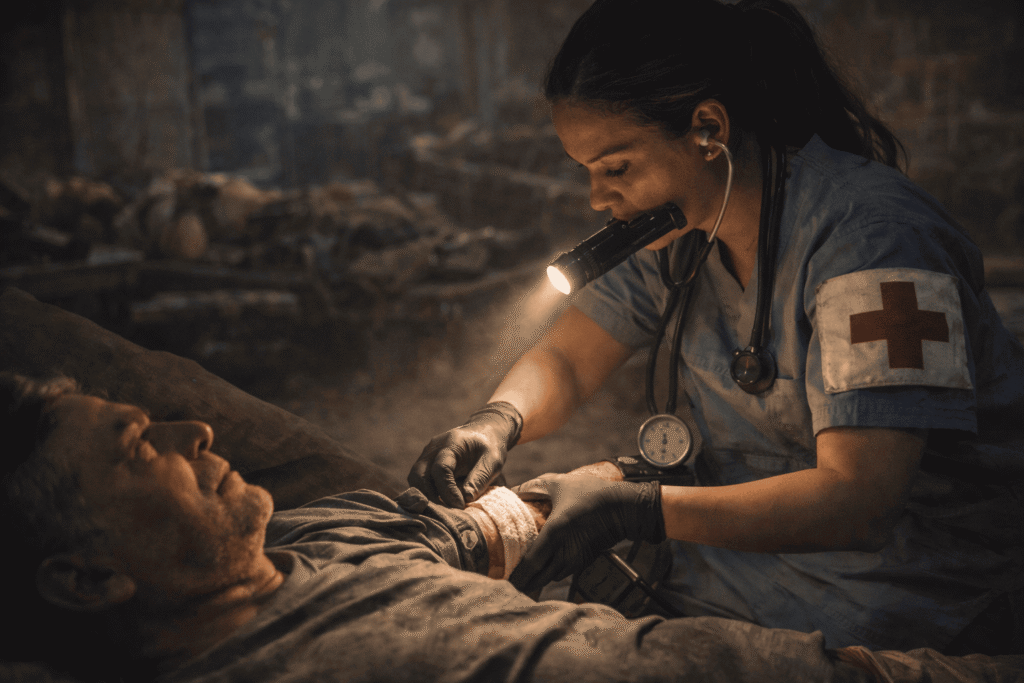
Electronic blood pressure, oxygen saturation, and heart rate monitors play a major role in modern nursing. But electricity is a luxury in a conflict zone. High-tech devices may become ineffective due to physical damage to the electrical grid or cyberattacks. Being ready for emergencies requires a return to the “Art of Physical Assessment.” Using only their senses, a nurse must be able to determine a patient’s condition with accuracy.
The “MARCH” protocol (Massive Hemorrhage, Airway, Respiration, Circulation, Head/Hypothermia) must be practiced by nurses. By feeling for pulses, you should be able to determine your systolic blood pressure. If you feel a radial pulse, your blood pressure is probably higher than 80 mmHg; if you only feel a carotid pulse, your blood pressure is probably much lower. For the purpose of triaging patients when the monitors go dark, it is essential to learn how to count respirations by seeing chest rise and measuring “Capillary Refill” (pressing a fingernail to see how quickly color returns). Even when the hospital is using manual blood pressure cuffs and flashlights, you can maintain your clinical judgment by mastering these manual abilities.
Resourcefulness and “Improvised Medicine”
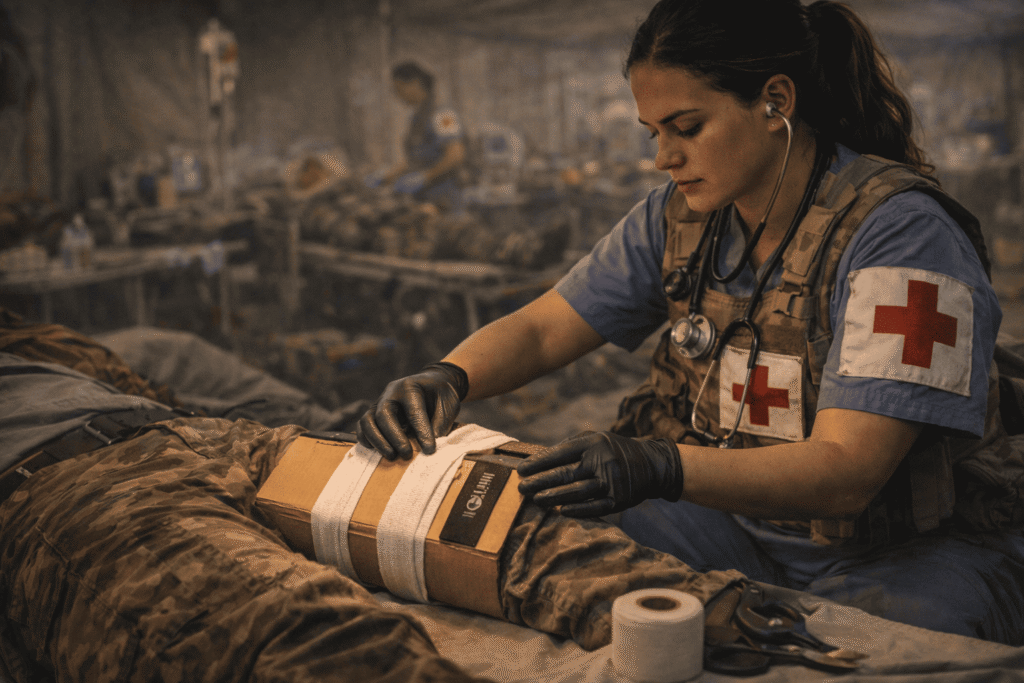
Lack of supplies is one of the most difficult aspects of nursing during a conflict. You might run out of clean water, splints, or sterile bandages. A resourceful nurse is one who is well-prepared. The ability to successfully carry out clinical tasks with commonplace objects is known as improvised medicine. When the supply truck doesn’t show up, this isn’t about being “messy”; rather, it’s about applying engineering principles to save lives.
Making “Improvised Splints” out of cardboard, rolled-up newspapers, or sticks to support injured limbs and stop additional nerve damage is one practical skill. Using the plastic packaging from a gauze pad and some tape, nurses can learn how to make “Occult Dressings” (airtight sealing) for sucking chest wounds. In severe situations, you might have to learn how to reuse and re-sterilize equipment using chemical soaks or high-heat boiling, or how to filter water using simple sand and charcoal techniques. During a complete blockade or siege, this “MacGyver” style to nursing keeps the ward running.
Psychological First Aid and Crisis Communication
Being ready for emergencies involves more than just physical preparation. Patients are not just physically injured during a war; they are frequently afraid, mourning, and under extreme stress. A nurse needs to be an expert in crisis communication. Giving calm, precise instructions can keep the medical staff focused and avert a riot in a busy, noisy trauma center.
Psychological First Aid (PFA) should be taught to nurses. “The 3 Ls” Look, Listen, and Link are involved in this. You search for disturbed individuals and safety concerns; you listen to their needs without passing judgment; and you connect them to basic information and needs. During uncomfortable treatments, a patient’s heart rate can be lowered and their cooperation increased by using practical “Grounding Techniques” such as asking them to list five items they can see. “Peer Support” is another ability. To keep the entire team from crumbling under the emotional strain of the fight, you must be able to recognize symptoms of “Combat Fatigue” in your colleagues nurses and promote short “Micro-Rest” intervals.
Triage Leadership and “The Black Tag” Ethics
The nurse frequently serves as the Triage Officer during a wartime mass casualty event. This is a significant responsibility that calls for quick decision-making. Patients must be categorized not just according to the severity of their injuries but also according to their likelihood of survival. A “Cold-Head, Warm-Heart” strategy is needed for this. Prior to a crisis, emergency planning entails learning about triage methods such as SALT (Sort, Assess, Lifesaving Interventions, Treatment/Transport).
The most challenging ability to acquire is the “Ethical Shift.” In a typical hospital, we go above and beyond for each patient. You cannot spend two hours caring for one patient with a 5% chance of life while ten other “Red Tag” patients, who have an 80% chance, perish in the waiting room if you have fifty patients and two nurses. In order to save resources for patients who can be saved, nurses must be ready for the reality of “Palliative Triage”—offering consolation and dignity to “Black Tag” (expectant) patients who cannot be saved. The hospital will continue to be a location of “The Greatest Good” rather than complete anarchy because to this leadership ability.
People Also Ask (FAQ)
Q: What should be in a nurse’s “Go-Bag” during a war?
A stethoscope, trauma shears, two CAT tourniquets, hemostatic gauze, a headlamp with additional batteries, a permanent marker (for writing on skin or tags), a personal water filter, high-calorie protein bars, and a brief guide on medication dosages and triage procedures should all be included in a nurse’s emergency pack.
Q: Is it safe to use “expired” medications during a war?
If there are no other options, some pharmaceuticals may be taken over their expiration date in a combat zone, although this is a risky choice. While liquids and antibiotics (such as tetracycline) can become poisonous or lose their effectiveness, most pills stay stable for a number of years. Always seek advice from a senior doctor or pharmacist if one is available.
Q: How do I handle a “Chemical Attack” as a nurse?
Prioritize safety! Before handling the patient, you must put on personal protective equipment (PPE). Prioritize decontamination by taking off the patient’s clothes and giving them a thorough wash with lots of water and soap. A polluted patient should never be brought into a “clean” ward since the smells can render the entire nursing staff incapacitated.
Q: How can I help patients with chronic diseases (Diabetes/Asthma) when the pharmacy is closed?
This falls under the category of “Continuity of Care.” In addition to helping the community set up “Medicine Pools” where neighbors share supplies, nurses should teach patients “Rationing Strategies” when it is safe to do so. If insulin or inhalers are not available, you may also need to teach patients how to manage their diseases with “Low-Resource” meals.
Q: What is the best way to handle “Burnout” during a month of continuous conflict?
Make use of the “Buddy System.” Decide to keep an eye on each other’s backs by pairing up with another nurse. Every six hours, make sure your friend eats, drinks water, and naps for ten minutes. The most effective strategy for preventing “Combat Fatigue” in healthcare professionals is social support.
Useful Documents for every Nursing Student
CV Section Template for Nursing students
AHPRA – NMBA Registration Document Checklist (International Students-Graduates)
Clinical Placement Reflection Template (NMBA-aligned)
Cover Letter Template for Nursing Students
Disclaimer: “I researched this information on the internet; please use it as a guide and also reach out to a professional for assistance and advice.This information is not medical advice, so seek your medical professional’s assistance.”