

Summary
One of the most important procedures for international nursing students who wish to work as nurses in Australia is registering with AHPRA (Australian Health Practitioner Regulation Agency). Because they are unclear about the paperwork, steps, deadlines, and requirements, many students believe that the AHPRA process is difficult, stressful, and slow. In actuality, though, managing AHPRA registration gets lot simpler once you fully comprehend the roadmap. To help overseas nursing students follow each step with confidence, this article outlines the complete procedure in straightforward English. This guide will assist you in avoiding typical errors and creating a comprehensive, compelling application, regardless of whether you are still in school, about to graduate, or applying for the first time.
Before permitting you to work as an Enrolled Nurse (EN) or Registered Nurse (RN), AHPRA verifies your identity, credentials, English proficiency, suitability to practice, and legal documentation. This procedure guarantees that patients are protected and that the Australian healthcare system upholds high standards. Due to their lack of preparation, many overseas students struggle or put things off. Your transition from student to nurse will go more smoothly the earlier you grasp AHPRA. This roadmap outlines precisely what has to be prepared, when it should be submitted, how long it will take, and what mistakes should be avoided.
1. Understanding AHPRA: What It Is and Why It Matters for International Students
The national body that oversees healthcare occupations in Australia, such as nursing and midwifery, is called AHPRA. Prior to being able to work lawfully, all nurses must be registered with AHPRA. Everyone must register, regardless of whether they studied in Australia or abroad. Understanding AHPRA early on is crucial for nursing students since it affects their career trajectory, visa preparation, and job applications. Until you have submitted your AHPRA paperwork or at the very least gotten notice that your application is pending, many hospitals will not hire you or even take your application into consideration.
The Nursing and Midwifery Board of Australia (NMBA) has established stringent national standards that AHPRA adheres to. They assess your compliance with all academic, professional, and safety criteria for practicing in Australia. Because AHPRA wants official documentation, sealed transcripts, identity evidence, English test scores, and statements of service, international students frequently find the process daunting. However, the process becomes manageable once you understand the prerequisites.
Numerous chances are also made possible by AHPRA registration. After registering, you can apply for jobs in hospitals, community nursing, elderly care, state health, and graduate nursing schools. Completing this step early increases your chances of being employed because employers prefer candidates who have already registered. You have a significant advantage over other pupils who begin preparing too late if you comprehend the plan.
2. AHPRA Registration Documents Checklist (Step-by-Step Guide for International Students)
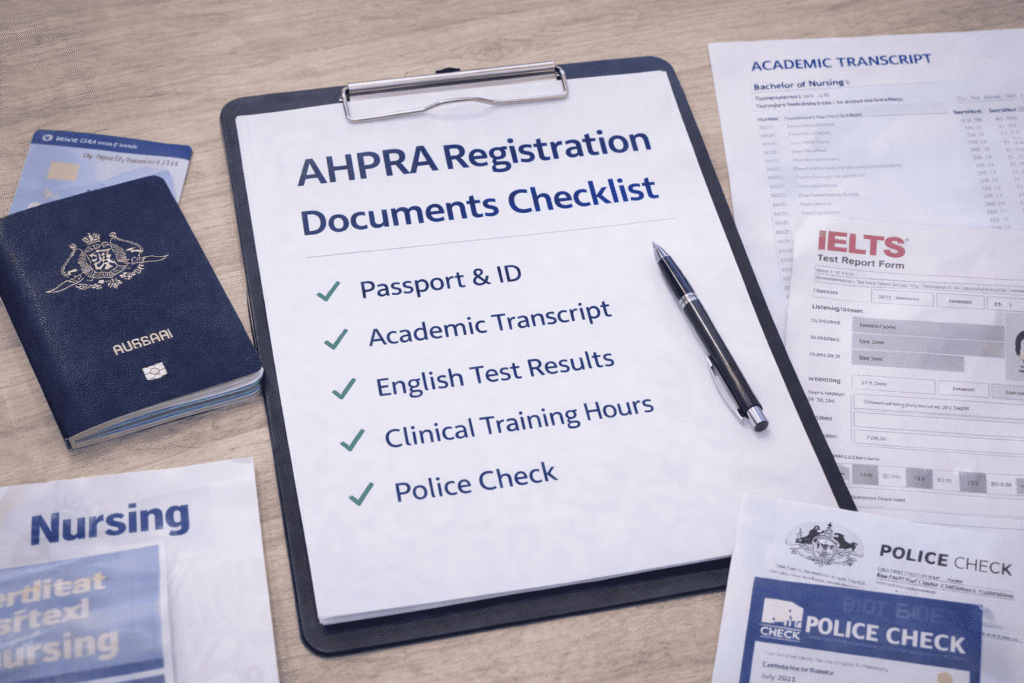
Getting the right paperwork is the most crucial step in the AHPRA procedure. Due to insufficient or non-compliant documentation, many candidates experience delays. Only authentic, verified documents are accepted by AHPRA, and each document must precisely match your identifying details. Months of waiting can be avoided by preparing your paperwork in advance.
AHPRA usually requires the following documents from international students:
Identity Documents:
A combination of your passport, birth certificate, driver’s license, or national ID card is required. Your name must seem exactly the same in every document. A marriage certificate or other official name-change paperwork is required if your name has changed. Your registration may be delayed by a minor spelling error.
Proof of Qualification:
This includes your diploma or bachelor’s degree transcript, a letter of completion, and occasionally a qualification statement from your TAFE or institution. The completion letter attests to your completion of the course and your compliance with Australian requirements. Your clinical hours must be listed on your transcripts.
Clinical Placement Evidence:
A comprehensive placement log or a summary of your total clinical hours may be requested by AHPRA. The 800-hour minimum is typically met by Australian nursing programs, although official documentation is required.
English Language Requirements:
Valid IELTS, PTE, or OET scores must be submitted by international students. Minimum results for AHPRA include IELTS 7.0 in every band, PTE 65 in every component, or OET Grade B in every section. Depending on the test regulations, scores must come from one or two sittings.
Passport-Style Photo:
You must submit a recent passport-sized photo signed by an authorised professional who confirms your identity. AHPRA is strict about photo format and signatures.
Criminal History Check:
AHPRA conducts both an Australian police check and an international check if you lived overseas for six or more months. Any issues must be explained honestly.
Professional Declarations:
You must answer questions about health conditions, previous registrations, disciplinary actions, or legal issues. These questions must be answered truthfully.
Preparing these documents in advance ensures your application is complete when you submit it. Many students begin collecting documents halfway through their final semester to avoid delays after graduation.
3. AHPRA Registration Timeline: How Long It Takes and When to Apply
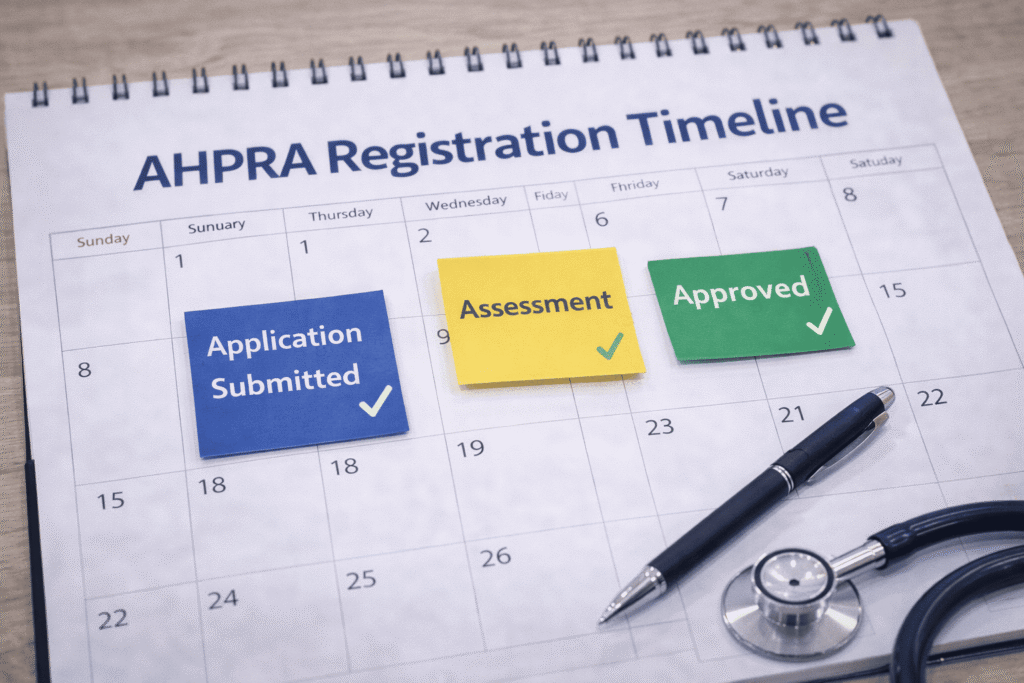
For the majority of international students, the timeline is the most perplexing aspect. Since each application is unique, AHPRA does not offer a set processing time; nonetheless, there are recurring trends. Planning your visa, job search, and graduate program applications is made easier when you are aware of the typical timeline.
In the last semester of their course, the majority of students start preparing paperwork. You can formally apply as soon as you have your completion letter. You still need to submit your own application even though some universities send results straight to AHPRA.
Typically, the first evaluation takes four to six weeks. AHPRA examines your identity documents, transcripts, English proficiency, and clinical hours throughout this time. AHPRA may email you for more proof if anything is unclear or missing. A thorough application is crucial because each request for extra papers adds time.
The entire process takes six to twelve weeks for the majority of international students. If your paperwork are well-prepared, it can be quicker. Because so many graduates apply at the same time during peak seasons, like December to March, students may have to wait longer.
AHPRA will provide your registration number as soon as your registration is accepted. You can lawfully work as a nurse in Australia with this number. Everything is digital; you don’t get a paper certificate. Additionally, the registration will be visible to the public via the AHPRA online register.
It’s crucial to schedule your job applications around this deadline. Only after receiving registration confirmation do many hospitals engage recent RN graduates. You can avoid missing work deadlines if you begin the procedure early.
4. Common AHPRA Mistakes to Avoid (Most Students Make These Errors)
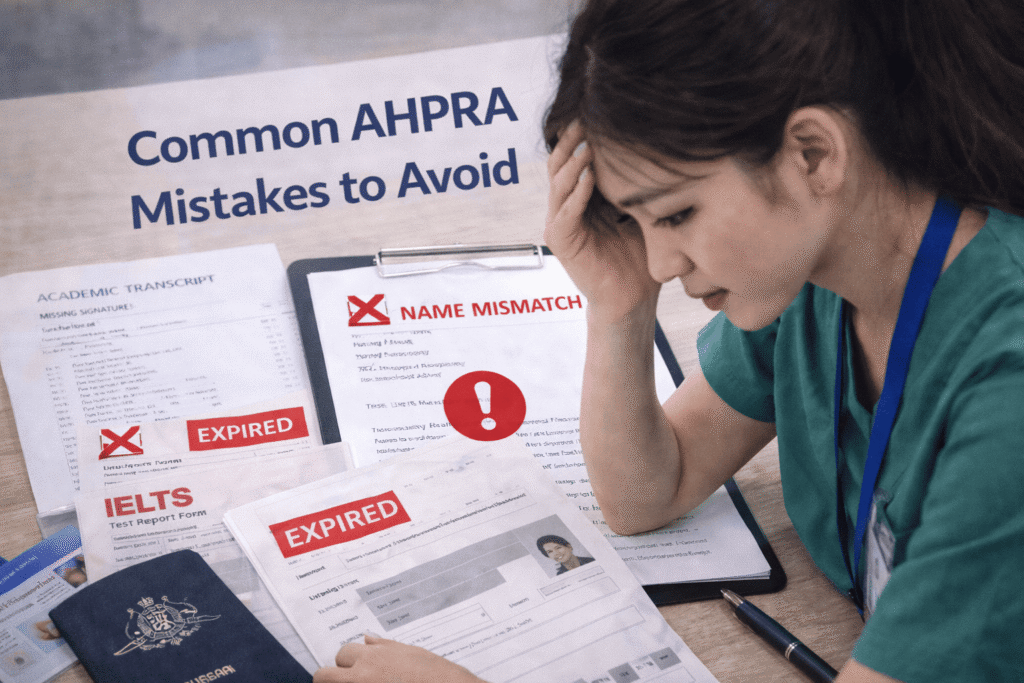
Every year, thousands of applications are denied or postponed by AHPRA due to students’ avoidable errors. You can save needless anxiety and waiting by being aware of these errors.
Submitting incomplete paperwork is one of the most common errors. Certified copies, signatures, and matching identifying details are frequently forgotten by students. Even a tiny discrepancy can halt development since AHPRA needs precise formatting. Providing transcripts or completion letters that are not sealed or official is another frequent error. Only documentation certified by authorized witnesses or directly from the institution are accepted by AHPRA.
Test problems in English are also frequent. Unaware that AHPRA only accepts scores within a two-year validity window, many students submit test results that have expired. Students occasionally attempt to submit screenshots of their PTE or IELTS results rather than actual reports, which AHPRA does not accept.
Submitting the incorrect passport photo is another error—AHPRA has very stringent photo requirements. Delays may result from unclear photographs, out-of-date photos, or incorrect signatures.
Additionally, students misinterpret the declaration section. They believe that small problems like health difficulties, prior visa denials, or academic warnings should be kept a secret. However, AHPRA demands complete transparency and honesty. Information concealment can later lead to even more serious issues.
Finally, many students apply too late. They wait months after graduation, which delays job offers and graduate program applications. Applying early helps you stay ahead of deadlines and reduces stress.
5. Tips for a Smooth AHPRA Registration and Strong Start to Your Nursing Career
If you follow the right plan, registering for AHPRA shouldn’t be burdensome. Start early, organize your paperwork, and be aware of the precise criteria. You can keep on track by organizing all of your academic, English, and identity documents into a folder. To keep track of your progress, you can also make a checklist.
Getting in touch with your university is another useful piece of advice. The majority of colleges have official staff members who are familiar with AHPRA regulations and can help you navigate documentation like completion letters and placement summaries. Early questioning helps avoid confusion later.
Additionally, it’s critical to have your English exam results ready well in advance of graduation. There is needless pressure because a lot of students wait until the very last minute. You can prevent delays by taking the test while you’re studying.
It’s also critical to stay informed via the AHPRA website. The most recent rules are always available on the official website, and requirements can occasionally change. Inaccurate information may result from relying solely on social media or the experiences of other students.
Lastly, update your LinkedIn profile, résumé, and job applications as soon as you obtain registration. Your AHPRA registration number is what employers want to see. You have a significant edge when applying for RN jobs, hospital posts, and graduate nurse programs around Australia if you register early.
People Also Ask
1. How long does AHPRA registration take for international nursing students?
Most applications take 6–12 weeks depending on document completeness and season.
2. What documents do I need for AHPRA?
You need identity documents, academic transcripts, English test results, clinical hours, police checks, and a passport-style photo.
3. Do I need an English test for AHPRA registration?
Yes, unless you meet strict exemptions. IELTS, PTE, and OET are accepted.
4. Can I apply for jobs before AHPRA registration?
You can apply, but most employers require at least proof of application or confirmation letter.
5. What happens if AHPRA delays my application?
You may need to submit additional documents; responding quickly helps speed up processing.
Useful Documents for every Nursing Student
CV Section Template for Nursing students
AHPRA – NMBA Registration Document Checklist (International Students-Graduates)
Clinical Placement Reflection Template (NMBA-aligned)
Cover Letter Template for Nursing Students
Disclaimer: “I researched this information on the internet; please use it as a guide and also reach out to a professional for assistance and advice.This information is not medical advice, so seek your medical professional’s assistance.”