

Table of Contents
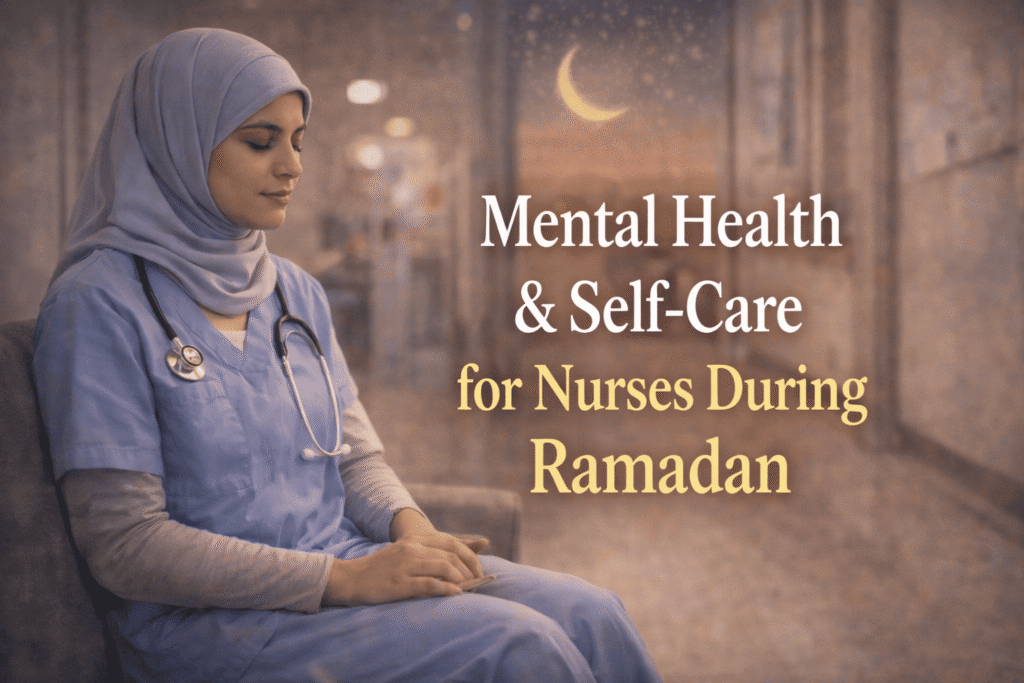
The healthcare industry is a great but demanding field to work in. Managing high-stress situations, seeing patients suffer, and standing for extended periods of time on the ward are all part of the everyday routine for nurses and nursing students. The mental strain might increase when you include the physical and spiritual responsibilities of Ramadan, such as fasting from sunrise to sunset and praying every night. Maintaining your mental well-being is a professional requirement, not merely a personal indulgence. Burnout and clinical errors are more likely to occur in a nurse who is mentally worn out
How healthcare professionals can safeguard their mental health during the holy month is examined in this guide. We’ll examine the relationship between physical fasting and mental clarity, coping mechanisms for “compassion fatigue,” and doable self-care techniques in the midst of a hectic hospital schedule. You may serve your patients and your faith with a full, not depleted, heart if you put your mind first.
The Connection Between Fasting and Cognitive Resilience

Many fear that fasting may cause them to become “brain fogged” or agitated at work. Cognitive resilience is an intriguing psychological aspect of fasting, even if the first few days of Ramadan might be difficult as the body gets used to a new metabolic rhythm. Fasting offers many nurses a sense of self-discipline and mental “cleansing.” But how you control your blood sugar and hydration throughout the non-fasting hours is crucial to preserving this mental acuity. The “amygdala” the area of the brain responsible for managing emotions may become more reactive when your brain lacks consistent nutrition, which might cause you to feel “hangry” or irritable around coworkers and patients.
Concentrate on “brain foods” at Suhoor to preserve your mental clarity. Slow-release carbs like oats and omega-3 fatty acids, which are included in walnuts and seeds, stabilize your mood. You can steer clear of the emotional “rollercoaster” that frequently results in workplace stress by avoiding abrupt rises and dips in blood sugar. You can also engage in mindfulness by admitting that you may be feeling more exhausted than normal. Your nervous system can be reset by practicing deep breathing for just sixty seconds in between patient visits. This will help you return from a “fight or flight” state to a calm, professional focus.
Managing “Compassion Fatigue” on the Ward
Patients’ main source of emotional support is their nurses. “Compassion fatigue” is a condition where you feel emotionally numb or overpowered by other people’s pain as a result of playing this role. Because you are physically exhausted throughout Ramadan, your emotional reserves could feel lower. Offering the same degree of empathy to a challenging patient or a bereaved family may be more difficult. It’s critical to realize that this is a physiological reaction to the increased demands on your body and soul rather than an indication that you are a “bad nurse.”
In order to counteract this, nurses and midwives should exercise “emotional boundaries.” This entails acknowledging that you cannot bear your patients’ troubles on your own while still being there for them. Try to utilize your spiritual practice as a shield during the month of Ramadan. Offering a silent prayer for patients throughout the day gives many nurses a sense of connection and purpose without depleting their own emotional reserves. Taking care of your own heart ensures that you have the power to continue being a source of mercy for those under your care. Keep in mind that self-care is a type of “stewardship.”
The Power of “Micro-Self-Care” for Busy Students

Many nursing students believe they don’t have enough time for self-care. The concept of a “spa day” or a lengthy walk seems unattainable with all of the lectures, clinical hours, and test preparation. Micro-self-care can help in this situation. These quick, five-minute steps can help you manage your stress levels all day. For a student who is fasting, this could mean utilizing a cooling face mist in a quiet break room or listening to a soothing podcast or recitation on the way to the hospital.
A crucial component of self-care is developing the ability to say “no.” There are several social invitations for sizable Iftar gatherings during Ramadan. A nursing student on a 12-hour rotation must prioritize sleep and quiet time even though community is an important part of the month. Refusing to attend social engagements if doing so will allow you to sleep for an additional two hours is totally acceptable. Maintaining your mental well-being is crucial for both your clinical and academic success. Real self-care is more about “doing” less so that your mind can recuperate from the stressful atmosphere of the hospital than it is about “doing” more.
Navigating Workplace Stress and Communication

The atmosphere in the hospital is rarely calm, and during emergencies or shift changes, tension can run high. A demanding supervisor or the sound of a monitor alert can seem twice as loud to a starving nurse. Your best tool for lowering workplace stress is effective communication. Telling your team that you are fasting is nothing to be ashamed of. The majority of coworkers are encouraging and may even volunteer to take on heavier, more physically demanding duties in the late afternoon when they notice that your energy levels may be dropping.
If you sense a disagreement developing with a coworker, use the “Ramadan Pause.” This is the practice of holding off on answering a difficult comment for three seconds. Fasting helps you achieve both your spiritual objectives and your professional reputation since it is as much about “fasting from anger” as it is about eating. Talk to your mentor or supervisor about “shift-splitting” or taking breaks at times that correspond with your lowest energy points if the tension gets too much for you. Being open and honest about your needs helps avoid the accumulation of worry and resentment, which is the foundation of a healthy work environment.
Spiritual Fulfillment as a Buffer Against Burnout
Being able to see clinical practice as a kind of Ibadah (worship) is one of the distinctive characteristics of being a Muslim nurse. The “work” becomes less of a hardship and more of a blessing when you understand that every pillow you fluff, every medication you administer, and every hand you hold is an act of charity. This change in viewpoint serves as a potent preventative measure against burnout. Finding purpose in your work dramatically lowers your chances of sadness and chronic stress, according to positive psychology research.
Remind yourself of the benefits of helping the ill during the long hours of the fast. When you are feeling physically worn out, this spiritual “reframing” can help you feel more energized. Consider the privilege of being the person someone turns to in their hour of need rather than the hunger or thirst. You can achieve inner peace by relating your work responsibilities to your spiritual principles. This does not imply that the work is not difficult; rather, it indicates that the difficulty serves a purpose. The best kind of self-care is having a sense of purpose, which gives you a reservoir of mental fortitude that lasts long after Ramadan is over.
The Mindful Nursing Journal: Ramadan Edition
Part 1: The Morning Intention (Pre-Shift / Suhoor)
Before the chaos begins, set the “tone” for your nervous system.
- Today’s Purpose: Aside from clinical tasks, what is one quality I want to show my patients today? (e.g., patience, gentleness, active listening).
- My quality for today is: ___________________________
- The “Act of Worship” Reminder: Remind yourself: “Every step I take for a patient is a step of charity.”
- Physical Check: How does my body feel right now? (Scan from head to toe). Where am I holding tension? (Release your jaw, drop your shoulders).
Part 2: The Mid-Shift “Reset” (The 60-Second Pause)
Do this during a handoff, after a difficult patient interaction, or while washing your hands.
- Breath Prayer: Inhale for 4 seconds, hold for 4, exhale for 4.
- Silent Phrase: (Inhale) “I am calm…” (Exhale) “I am capable.”
- Grounding (5-4-3-2-1): * Name 5 things you see (The monitor, the IV bag, the floor tile…)
- Name 4 things you can touch (Your scrub fabric, the pen, the cold sink…)
- Name 3 things you hear (The hum of the AC, footsteps, a distant beep…)
- Name 2 things you smell (Sanitizer, coffee in the distance…)
- Name 1 thing you are grateful for right now.
Part 3: The Iftar/Post-Shift Reflection
Decompressing and letting go of the hospital’s weight.
- The “Handoff” of Burdens: As you leave the hospital, mentally “leave” the patient’s worries at the door. You have done your best; the rest is out of your hands.
- Today’s Small Win: What is one thing that went well today? Even if it was just successfully inserting a difficult IV or a patient saying “thank you.”
- My win: ___________________________
- Compassion Check: Was I kind to myself today? If I was tired or made a minor mistake, do I forgive myself?
- Evening Gratitude: Name one blessing you noticed today that had nothing to do with work.
Weekly Mental Health Check-In
Every Friday (or your day off), answer these two questions honestly:
- Am I “Emptying the Cup”? Am I talking to someone (friend, spouse, or mentor) about the emotional things I saw this week, or am I bottling them up?
- The Burnout Gauge: On a scale of 1–10, how heavy does my heart feel?
- If above 7: It is time to prioritize 8 hours of sleep and perhaps skip a social gathering to rest.
A Note for the Fasting Midwife:
“Even if you feel ’empty’ of energy, your heart is doing a great job. Your hands are the ones that comfort people when they are at their weakest.” You’re doing enough, so be kind to yourself.
People Also Ask (FAQ)
Q: I feel guilty because I’m too tired to pray Taraweeh after a long shift. What should I do?
It’s critical to keep in mind that your job as a nurse is a service. Prioritize your required prayers and your sleep if your physical exhaustion prevents you from performing more prayers in a safe manner. Islam is a balanced faith. While working or traveling, you can practice “Dhikr” (remembrance), which has significant benefits and doesn’t require additional standing.
Q: How can I handle the “brain fog” during afternoon clinicals?
A drop in blood sugar or hydration is frequently the cause of brain fog. If you are unable to eat, consider doing a “sensory reset.” To awaken your senses, splash cold water on your face or, if permitted by your place of employment, use a fragrance like citrus or peppermint. Additionally, to keep your brain powered for longer, make sure you are consuming “slow-burn” carbohydrates at Suhoor, such as sweet potatoes or oats.
Q: What if I feel like crying or I’m extra emotional during my shift?
This is quite typical. When you fast, your feelings may become more “on the surface.” Locate a quiet area, such as a bathroom or supply closet, and give yourself two minutes to relax if you’re feeling overburdened. Recognize the emotion without passing judgment. Being human is acceptable. See a professional counselor or a close friend if the emotion doesn’t go away.
Q: How do I deal with non-Muslim colleagues who don’t understand why I’m fasting?
Instead than passing judgment, most individuals are inquisitive. Take use of the chance to give a straightforward, amiable explanation. “I’m fasting for Ramadan to practice self-discipline and gratitude,” you might say. Although it can be a little difficult, I find it to be really significant. Once they know the “why” behind your commitment, most people will appreciate it.
Q: Is it okay to take a mental health day during Ramadan?
Of course. You should take a sick day in accordance with your hospital’s policy if you believe that your mental health is declining and that this is impairing your capacity to safely care for patients. One day of rest and “reset” can help you avoid a much lengthier burnout period later on.
Useful Documents for every Nursing Student
CV Section Template for Nursing students
AHPRA – NMBA Registration Document Checklist (International Students-Graduates)
Clinical Placement Reflection Template (NMBA-aligned)
Cover Letter Template for Nursing Students
Disclaimer: “I researched this information on the internet; please use it as a guide and also reach out to a professional for assistance and advice.This information is not medical advice, so seek your medical professional’s assistance.”