
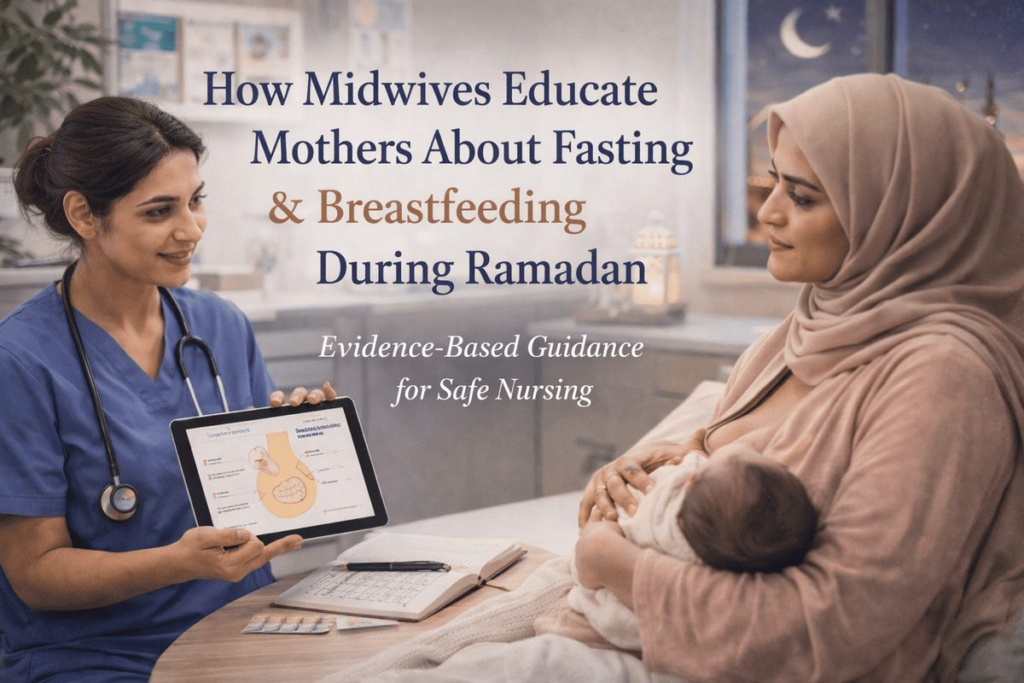
Breastfeeding During Ramadan
For many Muslim mothers, the arrival of Ramadan brings a desire to participate in the spiritual tradition of fasting. However, when a mother is breastfeeding, this desire is often met with a wave of questions: Will my milk dry up? Will my baby be hungry? Is it safe for my own health? Midwives serve as the essential educators and clinical guides in this scenario. Their role is to provide evidence-based information that balances the mother’s religious commitment with the biological needs of both the mother and the infant.
Education from a midwife isn't just about "yes" or "no." it is about providing a roadmap for safety. Midwives help mothers understand the physiology of lactation—how the body produces milk even when food intake is limited—and how to recognize the specific signs of dehydration. By empowering mothers with knowledge, midwives ensure that the journey through Ramadan is one of spiritual fulfillment rather than medical anxiety.
1. Explaining the Physiology of Lactation and Fasting

The first step in a midwife’s educational toolkit is explaining how the female body produces milk. Many mothers fear that if they do not eat for 12 to 15 hours, their breasts will simply stop producing milk. Midwives educate mothers on the fact that the body is incredibly resilient. Breast milk is produced from the mother’s blood and fat stores. In the short term, the nutritional quality of breast milk—the fats, proteins, and vitamins—remains remarkably stable even during a fast. The body will prioritize the baby, pulling nutrients from the mother’s own reserves to ensure the milk remains life-sustaining.
However, midwives also teach that while the quality remains high, the quantity (volume) of milk can be affected by the mother's hydration levels. If a mother is severely dehydrated, her blood volume may drop, which can lead to a slower "let-down" reflex or a decrease in total milk output. Midwives use this scientific explanation to help mothers understand that the "success" of fasting while breastfeeding depends almost entirely on what they consume during the hours between Iftar and Suhoor. By understanding that their body is a reservoir, mothers can focus on "filling the tank" during the night to sustain the "output" during the day.
2. Identifying "Red Flags" for Maternal and Infant Health

A critical part of a midwife's education is teaching mothers how to be their own "clinical monitors." Because a midwife cannot be with the mother 24/7, the mother must know exactly when a fast needs to be broken. Midwives provide a checklist of symptoms for the mother to watch for in herself. These include extreme thirst, dark-colored urine, a pounding headache, dizziness that doesn't go away with rest, or feeling unusually faint. These are signs that the mother’s blood pressure or electrolyte balance is shifting dangerously.
Even more importantly, midwives teach mothers how to monitor their babies. Since a baby cannot tell you they are dehydrated, the mother must look for physical cues. Midwives educate on the "Wet Diaper Test." A healthy, hydrated baby should have at least 6 to 8 heavy, wet diapers in a 24-hour period. Other signs the midwife teaches include the baby’s behavior: is the baby alert and active, or unusually lethargic and "floppy"? Is the baby's mouth moist, or does the tongue look dry? By giving mothers these specific clinical markers, the midwife moves the conversation from "guesswork" to "observation," ensuring the baby’s safety is never compromised.
3. Strategic Nutrition and Hydration Education

Hydration education is equally detailed. Midwives often teach the "Sip and Cycle" method. Rather than chugging a liter of water at the dawn prayer (which the body will just flush out), mothers are taught to sip 200ml of water every hour they are awake during the night. Midwives also suggest "liquid foods" like soups, stews, and smoothies, which provide both calories and hydration. They emphasize avoiding caffeine, as it can act as a diuretic and even pass into the breast milk, making the baby fussy or unable to sleep. This nutritional coaching is designed to keep the mother’s energy stable throughout the long fasting hours.
4. Navigating the Religious Exemptions with Compassion
One of the most valuable things a midwife does is offer "permission." Many mothers feel a deep sense of guilt if they cannot fast, feeling as though they are failing their religious duties. Midwives, often working alongside religious scholars or using culturally sensitive materials, remind mothers that Islam provides a clear exemption for breastfeeding women if they fear for their health or the baby's health. The midwife's role is to validate the mother's decision to not fast if the medical evidence suggests it is risky.
Midwives educate mothers on the concept that "taking the exemption is an act of worship." By protecting the life and health of the child, the mother is fulfilling a primary Islamic principle. This emotional and spiritual education is just as important as the clinical advice. It reduces the mother’s stress levels—and high stress is a known "milk killer" because it inhibits the hormone oxytocin, which is responsible for the milk let-down. When a mother feels supported and at peace with her decision, whether she fasts or not, her breastfeeding journey is much more likely to be successful.
5. Transitioning to "Intermittent Fasting" Models
For mothers who are determined to fast but are worried about their milk supply, midwives sometimes suggest a "gradual" or "intermittent" approach. This is an educational strategy where the mother doesn't fast every single day but perhaps every other day, or only on weekends when she has more help at home and can rest more. This allows the mother's body a "recovery day" to fully rehydrate and replenish its glycogen and fluid stores.
Midwives also educate on "Time-Shifting." If a baby is older and eating some solid foods, the midwife might suggest the mother fasts during the day but ensures the baby gets their most calorie-heavy "solid" meals during the daylight hours, while saving the most intense breastfeeding sessions for the night when the mother is hydrated. This tactical approach to the breastfeeding schedule helps maintain the bond and the supply without putting undue strain on the mother’s fasted body. This level of personalized education ensures that the mother doesn't feel it is an "all or nothing" situation, but a flexible path that prioritizes safety.
Frequently Asked Questions
Q: Does fasting make breast milk "thin" or less nutritious? A: Midwives explain that the basic composition of breast milk stays very consistent. Your body will take what it needs from your stores to keep the milk nutritious. However, if you are very dehydrated, the amount of milk might decrease, even if the quality is still good.
Q: Can I take lactation supplements while fasting? A: Yes, but timing is everything. Midwives recommend taking any herbal supplements (like fenugreek or blessed thistle) at Iftar or Suhoor with plenty of water. Taking them during the day without water can cause stomach upset and won't be as effective.
Q: My baby is 3 months old and exclusively breastfed. Should I fast? A: Most midwives suggest being very cautious in the first 6 months of a baby's life, as they rely 100% on your milk. In the early months, your supply is still "regulating." It is often safer to use the religious exemption during this critical growth phase and make up the fasts later.
Q: What is the best way to break my fast if I am nursing? A: Start with dates and a large glass of water or coconut water. Dates give you an immediate energy boost, and coconut water provides the electrolytes (potassium and magnesium) that help your body rehydrate your milk supply quickly.
Q: Will fasting cause me to lose my milk supply permanently? A: Usually, no. If you notice a dip in supply, it is almost always temporary and due to dehydration. Once you start drinking and eating normally again, your supply should return to its previous level within 24 to 48 hours.