

For Australian nursing students, the first week of their clinical placement is one of the most trying times. When they enter a ward for the first time, even self-assured students frequently experience anxiety, silence, and self-doubt. Your mind goes blank, your heart accelerates, and all of a sudden you can’t remember how to ask for assistance, introduce yourself, or describe your restrictions. Although this worry is common, many students suffer in silence because they are unsure of how or what to say.
Few universities teach genuine ward communication—the precise phrases students can use when they feel uneasy, uncomfortable, or uncertain—while the majority emphasize clinical skills. That gap is the main topic of this article. In order to lower anxiety, ensure patient safety, and demonstrate professionalism, it provides you with clear, courteous, and professional scripts that you can really use on placement.
This handbook, which was created specifically for Australian nursing students, including those from other countries, is intended to help you get through and thrive during your first week of placement.
1. Why the First Week of Placement Feels So Overwhelming

Because everything is new at once, placement anxiety occurs during the first week. While attempting to avoid making mistakes, you are learning the ward’s structure, routines, staff personalities, documentation systems, and patient expectations. Many students experience pressure to “prove themselves” fast, which can make them reluctant to ask questions or speak up.
Fear of being judged is a significant contributing factor to anxiety. Students fear that asking for assistance will make them appear sluggish, unintelligent, or obnoxious. Concerns regarding their accent, communication style, or cultural differences may also be present for international students. Because of this dread, students frequently remain mute, nod in agreement, or consent to duties for which they are unprepared, all of which can be dangerous.
It’s critical to realize that a clinical placement is an educational setting rather than a performance evaluation. It is not required of you to learn everything during your first week. The most important thing is to communicate in a professional and safe manner. Using the appropriate language can instantly lower anxiety and foster staff trust.
2. How to Introduce Yourself Confidently on the Ward (Exact Scripts)
Your first day’s introduction sets the tone for the rest of your placement. Staff members are better able to comprehend your level and are more inclined to assist you if you make a clear, confident, and kind introduction.
Staff may be unclear of how to engage pupils because many of them freeze and say very little. Rather, a straightforward, well-organized introduction is most effective.
When meeting with ward personnel, you can follow this identical script:
“Hello, I’m ___, a nursing student at ___ University. I’m eager to learn in this ___ year/semester. Tell me how I can securely assist, please.
This introduction accomplishes three key goals. First of all, it makes it obvious that you are a student. Secondly, it displays zeal without conceit. Thirdly, it serves as a reminder to employees that safety is important.
You could say the following to your buddy nurse or preceptor while introducing yourself:
“Hello ___, I will be working with you today. I’ve studied fundamental skills like paperwork, hygiene maintenance, and observations, but I’m still learning and would value advice.
This statement demonstrates professionalism and honesty. It encourages support rather than condemnation and establishes reasonable expectations.
“Hello, my name is ___, I’m a student nurse working with the team today,” is a polite way to greet people. Can I assist with your care under supervision?
Patients are reassured, and you are ethically and legally protected.
3. How to Ask for Help Without Feeling Embarrassed or Weak
Many nursing students think that seeking assistance makes them appear inept. Asking for assistance is actually an indication of safe behavior. Particularly during the first week, registered nurses anticipate that students will have questions.
The way you ask is crucial. Use calm, courteous language rather than continuously apologizing or coming out as hesitant.
If you have doubts about a task, you could say:
“I want to be sure that this is done appropriately. Would you kindly walk me through this step?
This demonstrates accountability and a commitment to patient safety.
Try saying something like, “When you have a moment, could I please check something with you to make sure I’m doing it safely?” if a nurse appears busy and you don’t want to interrupt.
This shows them that you value their time while still standing up for yourself.
You may ask, “Just to confirm, you’d like me to ___ first and then ___, is that correct?” if you didn’t comprehend the instructions.
This prevents errors and demonstrates effective communication.
Seeking assistance early on keeps minor mistakes from growing into major issues. The majority of nurses would prefer to respond to a query than correct an error afterwards.
4. How to Safely Say “I’m Not Competent Yet” (Without Fear)
“I’m not competent yet” is one of the most difficult statements for nursing students to make. Many pupils are concerned that this statement may make them appear incompetent or result in unfavorable comments. But it’s more riskier to act competent when you’re not.
According to Australian nursing guidelines, students must only carry out duties that are appropriate for their level of supervision and ability. It is okay to say that you are not yet competent; it is not a sign of failure.
You can use these secure, expert scripts:
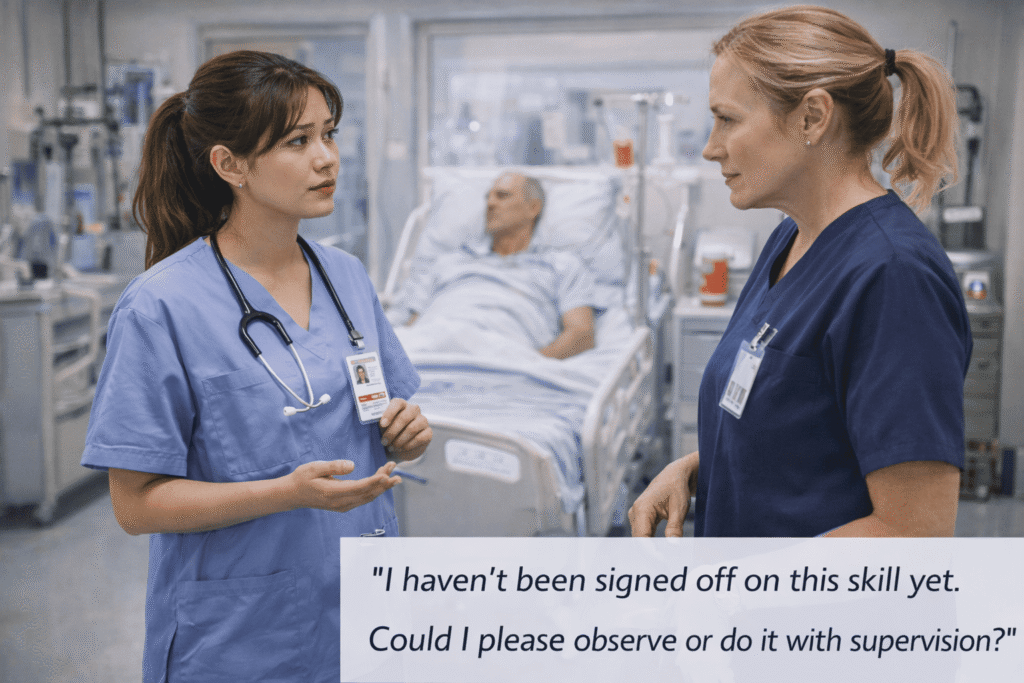
“This skill hasn’t been approved yet. Would it be possible for me to watch or work under supervision?
This demonstrates integrity and a desire to learn.
You can respond, “I haven’t performed this skill independently yet,” if you are asked to do something you have never done before. I’m glad to help or study under supervision.
Remain composed and firm in the face of pressure: “I’m not comfortable doing this without guidance for patient safety.” Could we work together on it?
You, the patient, and the nurse are all protected by this phrase.
Recall that competency takes time to develop. A first-week student is not expected to perform the duties of a registered nurse.
5. What to Say When You Make a Mistake (Because It Happens)
Errors might occur, particularly throughout the learning process. The way you react is what counts. Error concealment raises danger and anxiety.
Speak up right away if you realize you made a mistake or are unsure if something was done correctly.
You may state:
“I want to let you know that I’m not sure if I finished this correctly. Would you mind going over it with me?
This demonstrates professionalism and accountability.
If you overlook anything minor, like paperwork:
“I realized that I neglected to document ___. I wanted to inform you so that it may be fixed.
Honesty is significantly more respected by nurses than silence. Early admission of error fosters confidence and safeguards patients.
6. Managing Anxiety Internally During the First Week
Anxiety can still feel overwhelming even when the proper words are used. Your body may respond by trembling, perspiring, or going blank. This indicates that you are concerned, not that you are weak.
During placement, basic techniques can assist control anxiety. Before you talk, take a few deep breathes. Remember that you are a student. Instead than attempting to please everyone, concentrate on one task at a time.
Consider what went well rather than just what went wrong after every shift. It takes time for confidence to grow.
Consult your clinical facilitator or the university’s support services if your anxiety becomes severe or persistent. Burnout is avoided with early help.
7. Final Words: Confidence Comes From Communication, Not Perfection
Being flawless is not the goal of your first week of placement. It is about being honest, safe, and open to learning. You have power when you know what to say. You, your patients, and your future career are all protected by effective communication.
You are deserving of respect, assistance, and direction. Instead of viewing these scripts as a sign of weakness, use them as tools to demonstrate your professional growth.
People Also Ask (FAQ)
1. Is it normal to feel anxious in the first week of placement?
Yes. Almost all nursing students experience anxiety in their first week.
2. Will I fail placement if I say I’m not competent yet?
No. Saying this shows safe practice and professionalism.
3. What if nurses think I’m slow or annoying?
Asking questions safely is expected and respected in nursing education.
4. Can international students use these scripts?
Yes. These scripts are especially helpful for international students.
5. What if my anxiety feels overwhelming?
Speak to your facilitator or university support services early.
Useful Documents for every Nursing Student
CV Section Template for Nursing students
AHPRA – NMBA Registration Document Checklist (International Students-Graduates)
Clinical Placement Reflection Template (NMBA-aligned)
Cover Letter Template for Nursing Students
Disclaimer: “I researched this information on the internet; please use it as a guide and also reach out to a professional for assistance and advice.This information is not medical advice, so seek your medical professional’s assistance.”