

Summary
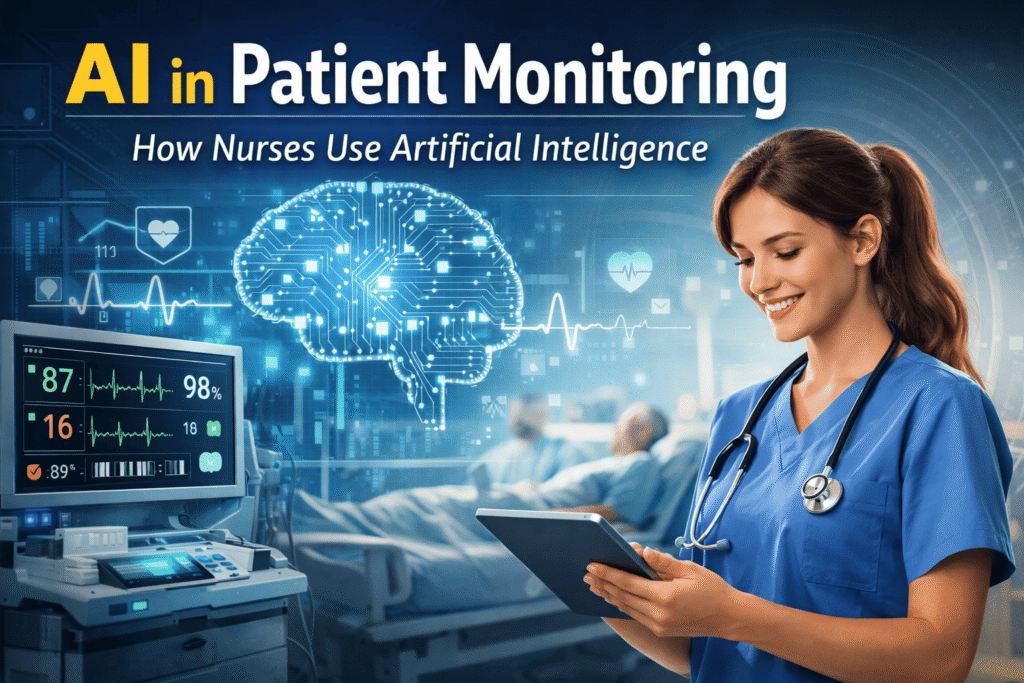
Patient monitoring is one of the major areas of healthcare that is rapidly changing due to artificial intelligence (AI). AI technologies are currently used to track patient symptoms in real time in modern hospitals, assisted living institutions, and even home care settings. For nurses, this technology is about assistance, safety, and improved decision-making, not replacement.
Words like AI monitoring, smart alarms, or predictive systems make a lot of nursing students nervous. Some fear that nursing duties may be replaced by technology. Some people are perplexed by how AI integrates into their regular nursing practice. In actuality, nurses already use AI on a daily basis, frequently without even realizing it.
This article describes artificial intelligence (AI) in patient monitoring, emphasizing how nurses apply AI, why it is important for patient safety, and what future nursing students should know. To make it easy for pupils to comprehend and implement the concepts, the language is maintained straightforward, understandable, and useful.
What Is AI in Patient Monitoring?
Computer programs that automatically gather, examine, and interpret patient data in order to assist with clinical treatment are referred to as artificial intelligence (AI) in patient monitoring. These technologies identify patterns that humans would overlook by using machine learning and algorithms.
Nurses manually examine vital signs and record data in traditional monitoring. AI enables machines to:· Constantly keep an eye on patients at all times
· Look for early indications of decline • Notify nurses in advance of emergencies.
AI cannot take the role of human judgment. Rather, it serves as an additional safety measure that enables nurses to react more quickly and precisely.
Typical instances of AI-monitored patient data include:
• Heart rate
• Blood pressure
• Saturation of oxygen
• The rate of breathing
• The temperature
• Levels of exercise and movement
These systems are now widely used in emergency rooms, critical care units, medical-surgical wards, and senior living homes, and remote monitoring programs.
Why Patient Monitoring Is So Important in Nursing
One of the main duties of a nurse is patient monitoring. When a patient’s condition changes, nurses are frequently the first to notice. Life can be saved by early detection.
Inadequate or postponed monitoring may cause:
• Cardiac arrest
• The inability to breathe
• Drops
• Severity of infections
• Neglected sepsis symptoms
AI assists nurses by facilitating round-the-clock monitoring, particularly in situations with heavy workloads and personnel shortages.
AI enables nurses to concentrate more on the following rather than replacing them:
• Provide direct patient care
• Interaction with relatives and patients
• Clinical judgments and critical thinking
This improves patient-centeredness and safety in nursing care.
How AI Patient Monitoring Systems Work
AI patient monitoring systems work by collecting large amounts of data and analysing it in real time. Understanding this process helps nurses trust and use the technology correctly.
1. Data Collection
Sensors and devices collect patient information such as heart rate, oxygen levels, and movement. These can include:
- Bedside monitors
- Wearable devices
- Smart beds
- Remote monitoring tools
2. Data Analysis
AI systems analyse patterns and compare them to thousands of similar cases. This allows them to identify early warning signs.
3. Alerts and Notifications
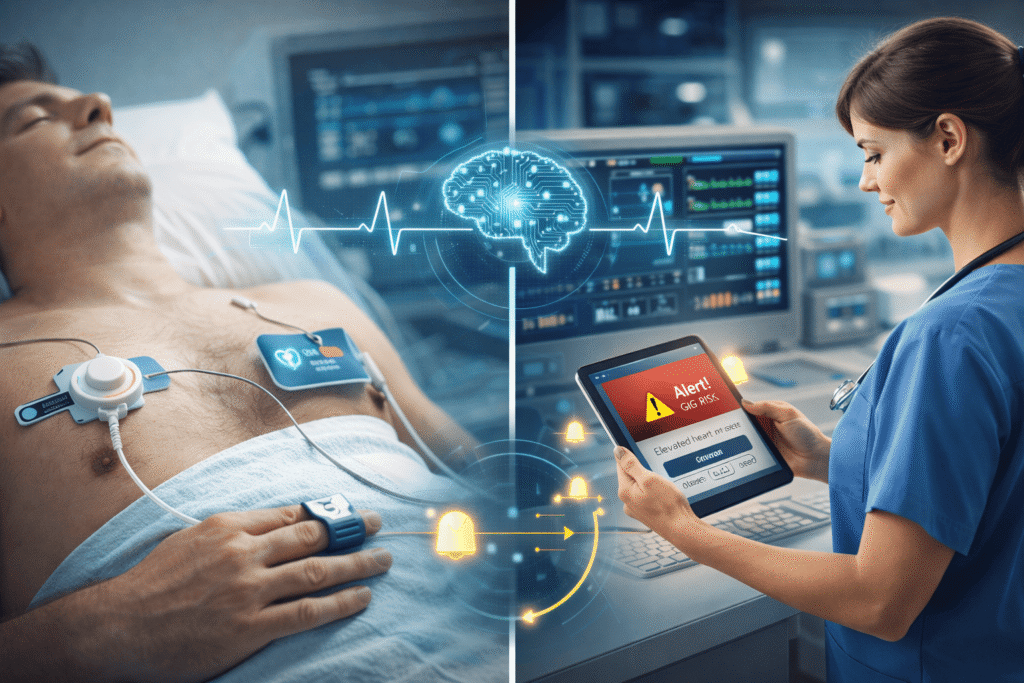
If the system detects a risk, it sends alerts to nurses through:
- Monitor alarms
- Mobile devices
- Central nursing stations
4. Nurse Assessment
Nurses assess the patient, confirm findings, and take action. AI never acts independently—it supports nursing decisions.
This partnership between AI and nurses improves safety without removing human responsibility.
Common AI Monitoring Tools Used by Nurses
AI monitoring tools are already part of everyday nursing practice. Many nurses use them without realising they are AI-powered.
Early Warning Score Systems
AI improves traditional early warning scores by analysing trends rather than single readings. These systems help identify patient deterioration earlier.
Smart Alarm Systems
AI reduces alarm fatigue by filtering false alarms and prioritising urgent ones. This helps nurses focus on real emergencies.
Remote Patient Monitoring
Patients can be monitored from home using AI devices that send data to healthcare teams. Nurses review this data and intervene when needed.
Fall Detection Systems
AI systems detect unusual movements or falls, especially in aged-care and rehabilitation settings.
ICU Predictive Monitoring
In intensive care, AI can predict complications hours before visible symptoms appear, allowing nurses to act early.
How Nurses Use AI in Daily Patient Care
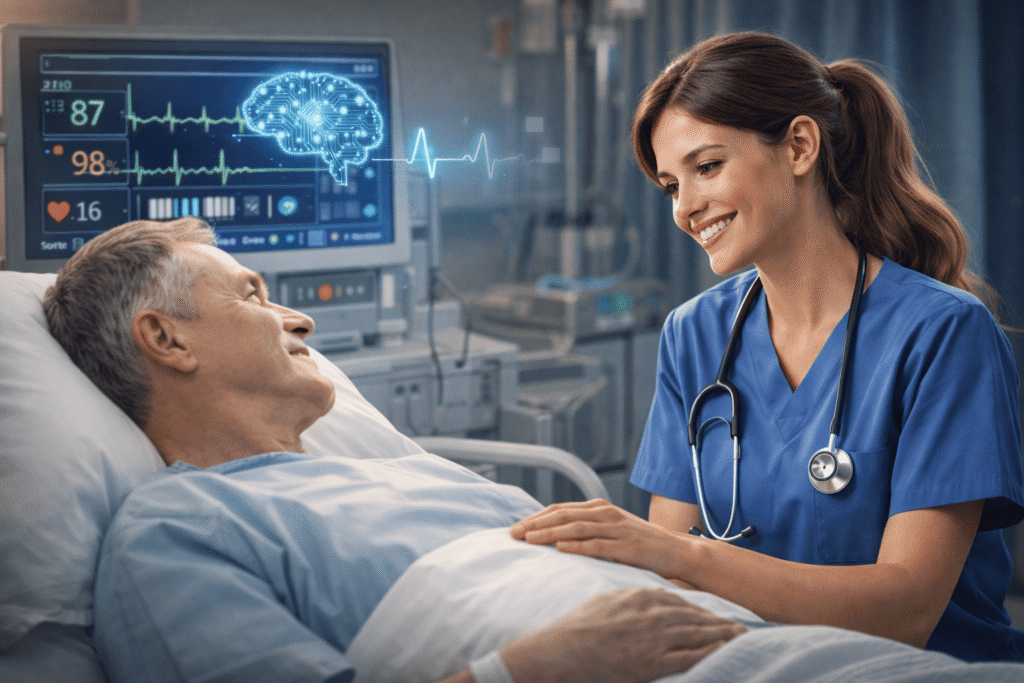
AI does not change the core values of nursing. Instead, it enhances daily nursing tasks in practical ways.
Supporting Clinical Judgment
AI provides data and trends, but nurses decide what action to take. Nurses use their knowledge to interpret alerts in context.
Improving Time Management
By automating monitoring, AI gives nurses more time for patient interaction and education.
Enhancing Patient Safety
AI catches early warning signs that may be missed during busy shifts.
Strengthening Communication
AI data helps nurses communicate clearly with doctors and multidisciplinary teams using objective information.
Nurses remain the decision-makers, advocates, and caregivers.
Benefits of AI in Patient Monitoring for Nurses
AI offers many benefits when used correctly and ethically.
Early Detection of Deterioration
AI can recognise subtle changes that humans may miss.
Reduced Workload
Less manual monitoring means less documentation pressure.
Improved Patient Outcomes
Early interventions lead to fewer complications.
Better Resource Allocation
Nurses can prioritise high-risk patients.
Increased Confidence
Data-driven insights support nursing decisions.
These benefits are strongest when nurses are trained and involved in AI use.
Limitations and Risks Nurses Must Understand
While AI is helpful, it is not perfect. Nurses must understand its limitations.
False Alarms
AI systems may still produce unnecessary alerts.
Data Bias
If data is incomplete or biased, AI predictions may be inaccurate.
Over-Reliance on Technology
Nurses must never ignore patient assessment in favour of screens.
Technical Failures
Systems can malfunction or lose connectivity.
This is why human judgment remains essential.
Ethical and Legal Responsibilities of Nurses Using AI
Even when AI is involved, nurses remain legally and ethically accountable.
Nurses must:
- Verify AI alerts with patient assessment
- Protect patient privacy and confidentiality
- Use technology according to policy
- Advocate for patient safety
AI does not hold responsibility nurses do.
Understanding this helps students prepare for professional practice.
What Nursing Students Need to Know About AI Monitoring
Nursing students should not fear AI. Instead, they should learn how to work with it.
Students should focus on:
- Understanding how monitoring systems work
- Practising critical thinking
- Asking questions during placements
- Learning ethical use of technology
AI skills will be part of future nursing competency, just like documentation and medication safety.
The Future of AI in Patient Monitoring and Nursing
AI will continue to evolve, but nursing will remain human-centred.
Future developments may include:
- More accurate predictive systems
- Better integration with nursing workflows
- Increased use in community and home care
Nurses will lead safe and ethical use of AI, not be replaced by it.
Conclusion: AI Supports Nurses, It Does Not Replace Them
AI in patient monitoring is a powerful tool that helps nurses provide safer, faster, and more effective care. However, it cannot replace the human qualities of nursing compassion, judgment, advocacy, and communication.
Nurses use Artificial Intelligence as a support system, not a substitute. The future of healthcare depends on nurses who understand technology while maintaining the heart of nursing practice.
People Also Ask
How is AI used in patient monitoring?
AI tracks vital signs, detects patterns, and alerts nurses early.
Do nurses need AI training?
Yes, basic understanding helps nurses use systems safely.
Can AI replace bedside monitoring by nurses?
No, AI supports but does not replace nurse assessment.
Is AI patient monitoring safe?
Yes, when combined with human oversight.
Will AI change nursing roles?
Yes, it will enhance roles, not eliminate them.
Useful Documents for every Nursing Student
CV Section Template for Nursing students
AHPRA – NMBA Registration Document Checklist (International Students-Graduates)
Clinical Placement Reflection Template (NMBA-aligned)
Cover Letter Template for Nursing Students
Disclaimer: “I researched this information on the internet; please use it as a guide and also reach out to a professional for assistance and advice.This information is not medical advice, so seek your medical professional’s assistance.”