
In 2026, Australia’s healthcare landscape is more focused than ever on supporting our aging population. As a nursing student or a professional looking to specialize, you likely find yourself at a crossroads: Should you work in Home Care Nursing, visiting patients in their own residences, or should you pursue a career within a Residential Aged Care Facility (RACF)? Both paths are essential, yet they offer very different daily experiences, salary structures, and career trajectories.
The choice between these two sectors often comes down to your preferred work environment and long-term financial goals. While an aged care facility offers a structured, team-based setting, home care provides a level of independence and one-on-one patient connection that is hard to find elsewhere. This article provides a comprehensive comparison of salaries, responsibilities, and growth opportunities in 2026 to help you decide which path aligns best with your nursing ambitions.
1. Salary Breakdown: Who Earns More in 2026?
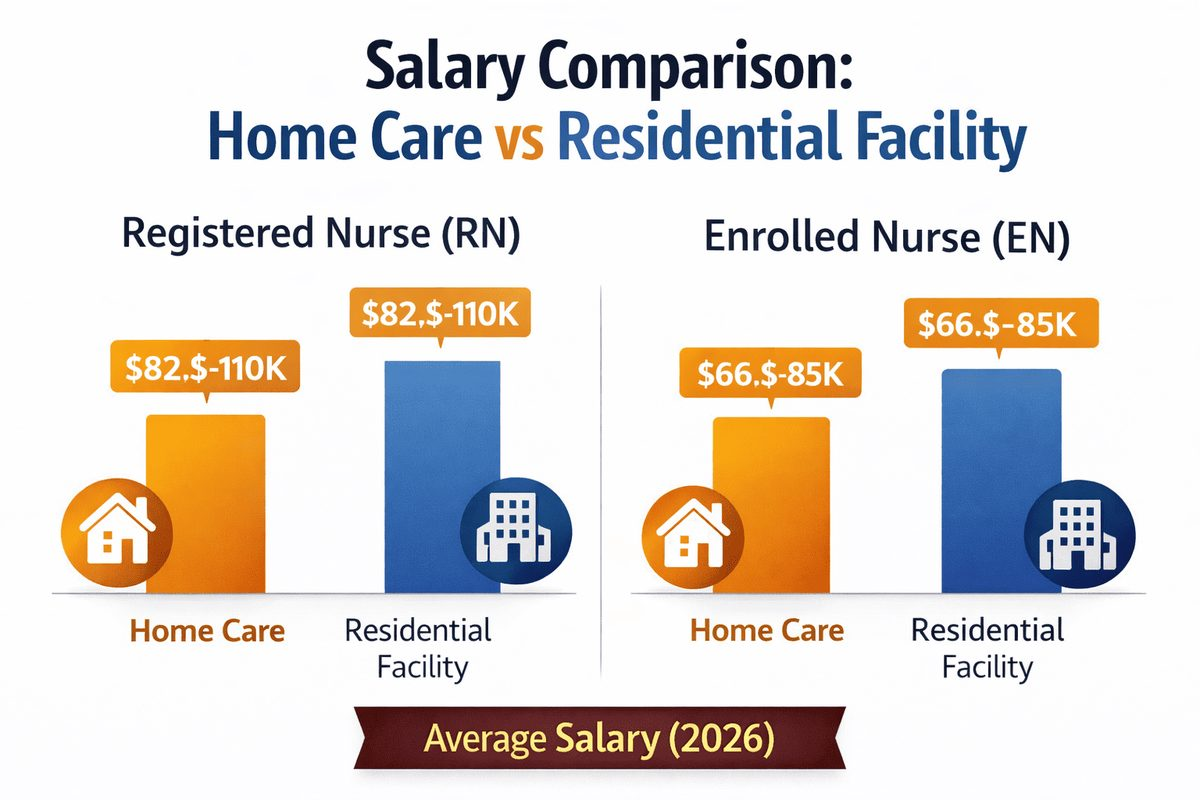
One of the most common questions for nurses is where the better paycheck lies. In 2026, the gap between Home Care and Residential Aged Care salaries has narrowed due to significant government investment and updated Aged Care Award rates. For a Registered Nurse (RN), the average market salary in either sector generally ranges from $82,000 to $110,000 per year, depending on experience and location. However, the way you earn that money differs.
[Image showing a bar chart comparing average RN and EN salaries in Home Care vs. Residential Facilities]
In Residential Aged Care, nurses often benefit from a more "predictable" salary structure. Because facilities operate 24/7, there are abundant opportunities to earn Shift Penalties for nights, weekends, and public holidays, which can boost a base salary by 20% or more. Conversely, Home Care Nurses often have higher base hourly rates to compensate for the autonomous nature of the work. According to 2026 data, specialized Home Health Nurses can earn upwards of $53 to $65 per hour as locums or senior practitioners. While home care may offer fewer "midnight shifts," many providers now offer "Travel Allowances" and flexible "KMP" (Kilometre) reimbursements that add extra value to the total package.
2. Daily Responsibilities: Autonomy vs. Teamwork
The daily life of a nurse in these two settings is worlds apart. In a Residential Aged Care Facility, you are part of a large, multidisciplinary team. You work alongside other RNs, Enrolled Nurses (ENs), Assistants in Nursing (AINs), and allied health professionals like physiotherapists. Your day is highly structured, involving medication rounds, wound care, and coordinating care plans for dozens of residents. The environment is fast-paced, and you always have a colleague nearby if a "Second Opinion" or emergency assistance is needed.
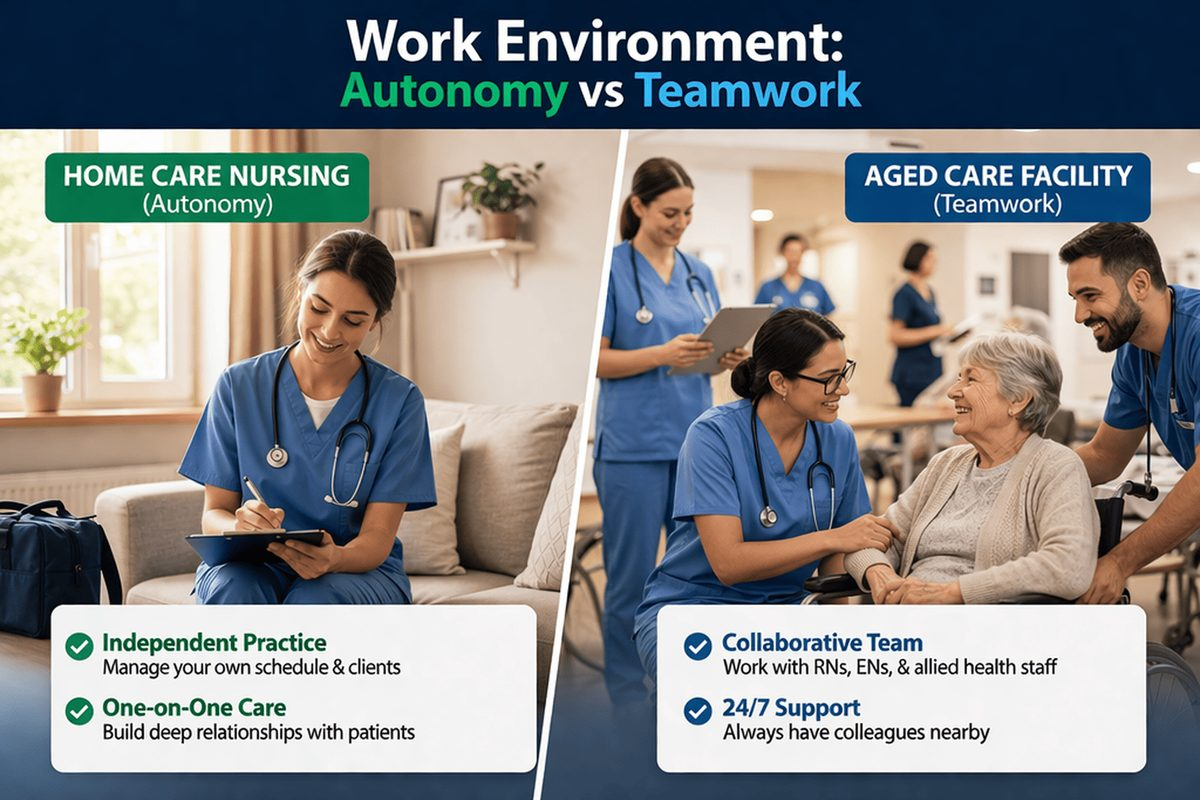
Home Care Nursing, by contrast, is the pinnacle of Clinical Autonomy. You are often the only clinician on-site, traveling to various homes to provide personalized care. Your tasks might include complex wound management, chronic disease monitoring, and post-hospital support. You spend more one-on-one time with each patient, allowing for a deeper "Person-Centred" approach. However, this requires high levels of confidence and critical thinking; you must be comfortable making decisions on your own and managing your time effectively as you navigate between appointments. For many, the "Freedom of the Road" is a major perk that prevents the burnout sometimes felt in a busy facility ward.
3. Career Progression and Specialized Pathways
Both sectors offer excellent room for growth, but the "Ladder" looks different in each. In an Aged Care Facility, the career path is often hierarchical and management-focused. You might start as an RN, move into a Clinical Nurse Specialist (CNS) role, and eventually become a Nurse Unit Manager (NUM) or a Facility Manager. These leadership roles in 2026 come with significant salary jumps, with Facility Managers often earning over $140,000. If you enjoy mentoring staff and overseeing the operations of a large healthcare community, the facility route is ideal.
In Home Care, progression is often more "Specialized" or "Consultative." You might transition into a Case Manager role, where you coordinate the entire "Home Care Package" for a portfolio of clients, or become a Clinical Nurse Consultant (CNC) specializing in areas like Palliative Care or Dementia Support. There is also a growing field in Nursing Informatics within home care, as providers use more remote monitoring tech to track patients. For those who want to be "Subject Matter Experts" rather than "General Managers," home care offers a pathway that keeps you closer to clinical practice while still increasing your earning potential.
4. Work-Life Balance and Flexibility
Flexibility has become a top priority for the 2026 workforce. Residential Aged Care is the king of "Shift Variety." If you are a night owl or prefer working long "Double Shifts" to have more days off during the week, a facility can accommodate that. The 24/7 nature of the work means there is usually a shift that fits almost any lifestyle. However, the downside is that you may be required to work on major holidays or weekends as part of a rotating roster.
Home Care Nursing typically aligns more closely with "Business Hours," though evening and weekend visits are becoming more common. Many home care nurses enjoy a "Monday to Friday" lifestyle, making it a popular choice for those with school-aged children. The 2026 "Support at Home" program also allows for more Casual and Gig-Economy styles of nursing. Some nurses choose to work as "Independent Contractors" through platforms, setting their own rates and choosing only the clients they want to see. This level of "Work-Life Integration" is a significant draw for nurses who want to escape the rigid "Clock-In, Clock-Out" culture of a traditional hospital or facility.
5. The "Emotional Impact": Connection vs. Community
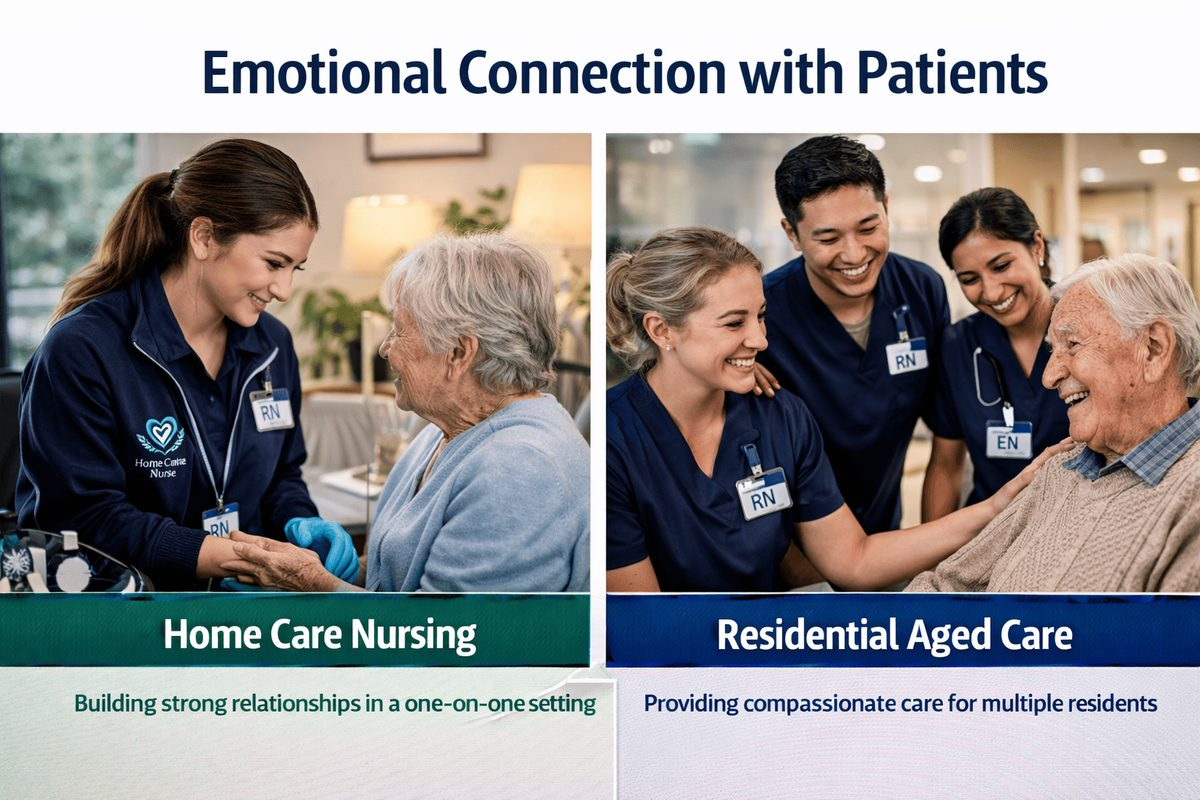
Finally, the emotional rewards of each role are distinct. In a Facility, you become part of a community. You see the same residents every day, get to know their families, and participate in social events and "Leisure and Lifestyle" programs. There is a sense of "Shared Purpose" with your coworkers that can be very supportive during difficult shifts. You are helping to create a "Home" for people in their final years, which can be deeply fulfilling.
[Image showing a nurse sharing a smile and a conversation with an elderly resident in a garden]
In Home Care, the connection is more "Intimate." You are a guest in someone’s home, often helping them maintain the independence they value most—staying out of a facility. You witness their life in their own environment, which fosters a unique level of trust and friendship. You aren't just a nurse; you are a vital link that allows them to remain connected to their pets, their garden, and their memories. For many nurses, the "Thank You" they receive at a kitchen table feels more personal than the "Thank You" received in a hospital corridor.
Frequently Asked Questions
Q: Is it harder to get a job in Home Care or an Aged Care Facility?
A: In 2026, there are critical shortages in both sectors. However, facilities often have more "Entry-Level" positions for new graduates, while home care providers sometimes prefer nurses with 1–2 years of experience due to the high level of autonomy required.
Q: Do Home Care nurses get paid for travel time?
A: Yes, usually. Most reputable home care providers in 2026 pay for the time spent driving between clients, as well as a "Cents-Per-Kilometre" allowance if you use your own car. Some larger providers even offer "Company Cars" for full-time staff.
Q: Which role is less physically demanding?
A: Home Care is often considered less physically "heavy" because you are usually caring for people who have at least some level of independence. In a Facility, you may be caring for many high-needs residents who require full assistance with hoisting and mobility, which can be harder on your back over a long shift.
Q: Can I switch between the two easily?
A: Absolutely. The clinical skills (medication, wound care, assessment) are very similar. Many nurses spend a few years in a facility to "sharpen their skills" in a team environment before moving into the more independent world of home care.
Q: What is a "Home Care Package" (HCP) manager?
A: This is a common career move for nurses. An HCP Case Manager doesn't always do the clinical work themselves; instead, they manage the government funding (the "package") for a client, deciding which services (nursing, cleaning, physio) the client needs to stay safe at home.