
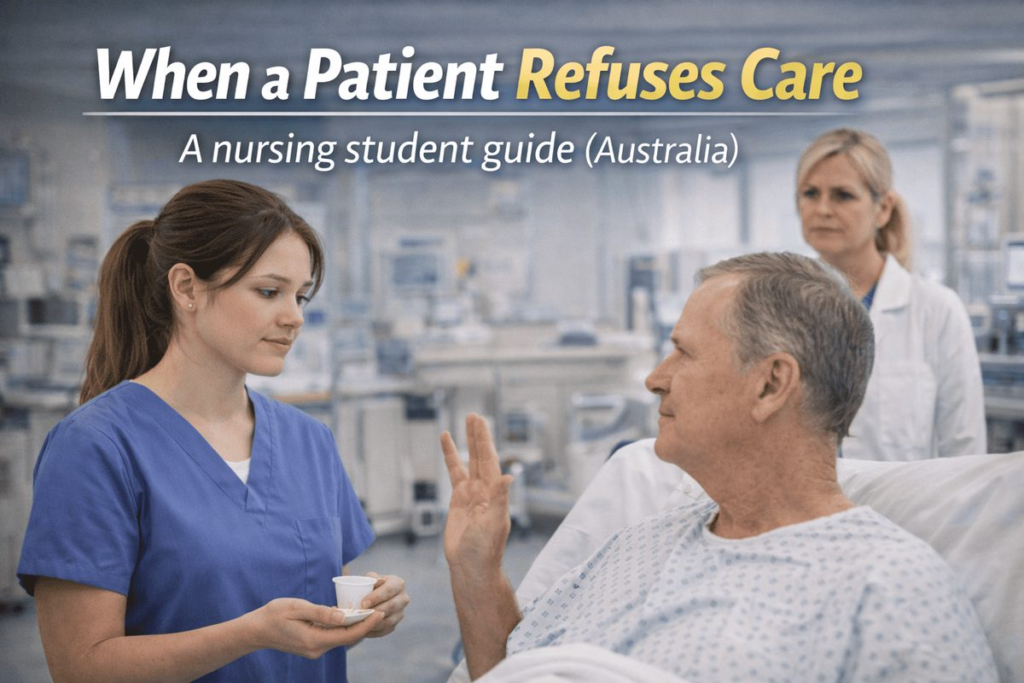
Patient refusal of care is something many nursing students experience during clinical placement, often earlier than expected. It can feel confusing, stressful, and even frightening — especially when you are still learning your role, your scope of practice, and your responsibilities. Students often worry about whether refusal means they have done something wrong or whether patient safety is at risk.
In Australia, patient refusal of care is not uncommon and is protected by law when the patient has decision-making capacity. From a nursing student perspective, the goal is not to force care, but to understand consent, practice cultural safety, communicate respectfully, and follow the correct escalation pathway. This article explains exactly what nursing students should do when a patient refuses care, step by step, in clear and simple language.
Understanding Patient Refusal of Care in Australian Healthcare
Patient refusal means that a patient chooses not to accept a recommended treatment, procedure, or nursing intervention. This can include refusing medication, vital signs, wound care, hygiene assistance, assessments, or even conversations. In Australia, adults who have decision-making capacity have the legal right to refuse care, even if healthcare professionals believe the care is necessary.
For nursing students, this situation can feel uncomfortable because you are taught that providing care is essential. However, respecting patient autonomy is just as important as providing treatment. A refusal does not mean the student has failed. It means the student must pause, assess, communicate, and escalate appropriately.
Understanding that refusal is a patient right helps reduce panic and supports calm, professional behaviour on the ward.
Consent: What Nursing Students Must Understand

Consent is the foundation of all healthcare practice in Australia. For consent to be valid, it must be voluntary, informed, and given by a patient who has capacity. If any of these elements are missing, care cannot legally proceed.
From a nursing student perspective, you must never assume consent. Even routine tasks such as taking blood pressure or assisting with personal hygiene require consent. When a patient refuses, the first step is to ensure they understand what is being offered. Sometimes refusal happens because the patient is confused, tired, in pain, or anxious.
Students should calmly explain what the care involves and why it is being offered, using simple language. If the patient still refuses after understanding, their decision must be respected unless there is an immediate life-threatening situation and you are instructed otherwise by a registered nurse.
Cultural Safety and Patient Refusal
Cultural safety is especially important when a patient refuses care. In Australia’s multicultural healthcare system, refusal may be influenced by cultural beliefs, past experiences, language barriers, religious practices, or trauma. Nursing students must be careful not to interpret refusal as “non-compliance” or “difficult behaviour.”
For example, some patients may refuse care from a provider of a certain gender, may not be comfortable with physical touch, or may require family involvement before agreeing to care. Others may have cultural beliefs about pain, illness, or privacy that affect their decisions.
Students should approach refusal with curiosity, not judgement. Asking respectful questions such as, “Is there something that makes you uncomfortable about this care?” allows patients to explain their concerns. Cultural safety means listening, acknowledging, and adapting care when possible, while involving senior staff to guide appropriate next steps.
Communication: What Nursing Students Should Say (and Avoid)
Clear, calm communication is essential when a patient refuses care. Students should avoid arguing, persuading aggressively, or making the patient feel guilty. Statements such as “You have to do this” or “It’s hospital policy” can increase distress and escalate conflict.
Instead, students should use respectful, neutral language. For example:
“I understand you don’t want this right now. Can you tell me what’s worrying you?”
or
“I want to make sure you’re comfortable. I’ll let the RN know and we can talk about next steps.”
These responses show respect while ensuring the situation is escalated appropriately. Students should also avoid making promises or decisions beyond their scope. Never reassure a patient that refusing care has “no consequences” — that is for the RN or doctor to explain.
Escalation Pathway: What to Do Step by Step

When a patient refuses care, nursing students must not handle the situation alone. Escalation is not punishment; it is a safety process. The first step is to inform the supervising RN or preceptor immediately. Clearly explain what care was offered, how the patient responded, and any reasons the patient gave.
If the refusal affects medication, treatment plans, or patient safety, the RN may involve the medical team or senior nursing staff. Students may also be asked to document the refusal under supervision. Documentation must be factual and objective, never emotional or judgemental.
If the patient becomes distressed, aggressive, or confused, escalation becomes urgent. Students should step back, ensure their own safety, and seek help immediately. Following the escalation pathway protects the patient, the student, and the healthcare team.
Documentation and Legal Awareness for Students
While students usually do not independently document refusals, they must understand what safe documentation looks like. Documentation should state what was offered, what the patient said, and who was informed. Avoid words like “refused because difficult” or “uncooperative.” Instead, objective language such as “Patient declined wound dressing change at this time” is appropriate.
Understanding documentation standards helps students support safe practice and prepares them for future professional roles.
Emotional Impact on Nursing Students
Patient refusal can make students feel rejected, embarrassed, or anxious. Some students worry they will be assessed poorly or blamed. It is important to remember that refusal is not a personal judgement on the student.
Talking to facilitators, reflecting on the situation, and understanding that refusal is part of real-world nursing can help students build resilience. Learning to handle refusal professionally is a key nursing skill that develops over time.
Learning Opportunities from Patient Refusal
Although challenging, patient refusal can be a powerful learning experience. It teaches communication, cultural awareness, ethical practice, and teamwork. Students who handle refusal respectfully demonstrate maturity and readiness for professional nursing practice.
Each experience helps students grow more confident and prepared for complex patient interactions.
Conclusion: Key Takeaways for Nursing Students
When a patient refuses care, the nursing student’s role is to remain calm, respectful, and safety-focused. Understanding consent, practicing cultural safety, communicating clearly, and escalating appropriately ensures both patient rights and student protection.
You are not expected to solve the situation alone. Asking for help is not weakness — it is professional practice.
📦 SUMMARY BOX (Linked to Headings)
Introduction Summary:
Explains why patient refusal is common and challenging for nursing students.
Consent Summary:
Covers legal consent principles and student responsibilities.
Cultural Safety Summary:
Explains how culture influences refusal and student responses.
Communication Summary:
Guides respectful language and what to avoid saying.
Escalation Pathway Summary:
Outlines step-by-step escalation for safety.
Documentation Summary:
Explains objective documentation and legal awareness.
Emotional Impact Summary:
Acknowledges student stress and confidence issues.
Conclusion Summary:
Reinforces safety, professionalism, and learning.
🔍 People Also Ask