
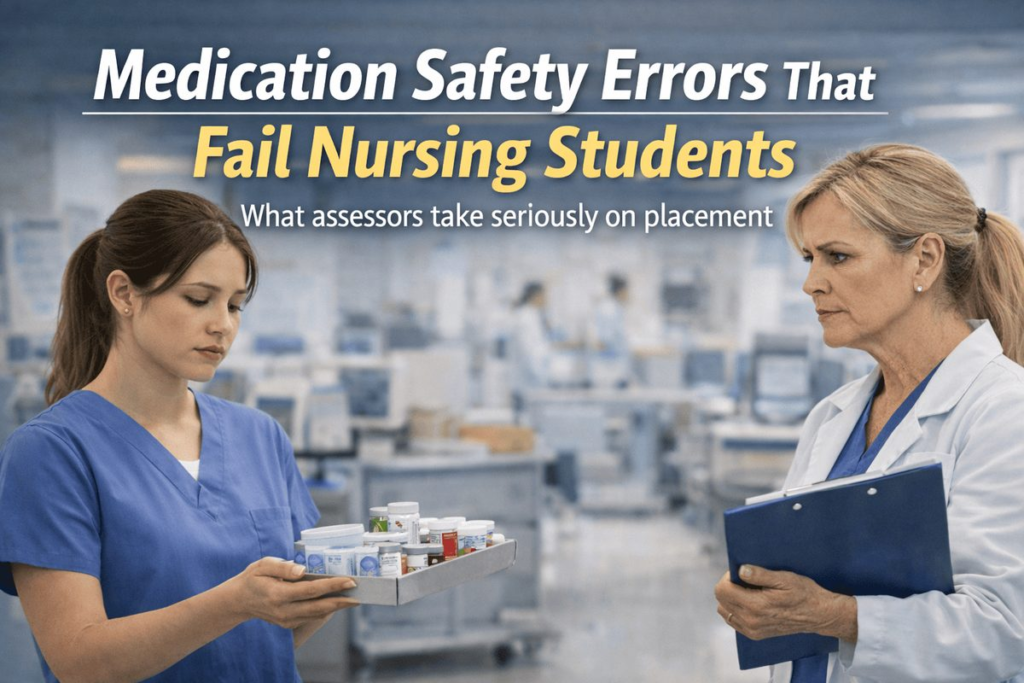
Medication administration is one of the highest-risk responsibilities in nursing practice. For nursing students, it is also one of the most common reasons for placement failure. Many students believe that failing placement only happens after a serious drug error. In reality, students often fail because of unsafe behaviour patterns, poor communication, and ignoring supervision rules — even when no patient harm occurs.
Clinical facilitators and registered nurses assess students not just on technical skills, but on judgement, honesty, safety awareness, and willingness to ask for help. A student who follows instructions quietly but makes assumptions is far more dangerous than a student who speaks up and double-checks.
This article explains the most common medication safety errors that fail nursing students on placement, why they are taken so seriously, and how you can avoid them. It is written in clear, simple language and reflects real placement expectations in Australian healthcare settings.
1. Why Medication Safety Is Treated Differently for Students
Medication safety is non-negotiable in nursing. For students, the expectations are even stricter because you are not licensed and must work under supervision at all times. Facilitators are not only checking whether you give the correct medication — they are assessing whether you understand your limits.
Students often fail placement not because they “didn’t know,” but because they acted independently when they should not have. Medication safety errors show assessors how you think under pressure. One unsafe decision can outweigh weeks of good performance.
Even near-misses are taken seriously. If a student almost administers the wrong medication but stops at the last second, the key question becomes: why did the student reach that point at all?
2. Communication Errors That Cause Medication Failures

Not Speaking Up When Unsure
One of the most common medication safety failures is staying silent. Many students worry about looking incompetent, slow, or annoying. As a result, they proceed without clarity.
Examples include:
Not asking what a medication is for
Not clarifying an unclear order
Not questioning a dose that seems unusual
Silence is interpreted as false confidence, not professionalism. Assessors expect students to ask questions — especially about medications they are unfamiliar with.
Using Vague or Incomplete Communication
Another common error is giving unclear information during medication rounds or handover. Saying things like “I think this is due now” or “I believe this is the correct dose” shows uncertainty without action.
Safe communication requires clarity:
What medication
What dose
What time
What supervision is present
Unclear communication creates risk and suggests poor safety awareness.
Failing to Escalate Medication Concerns
Students sometimes notice something wrong but assume the registered nurse already knows. This is a dangerous assumption. If you notice a discrepancy and do not escalate it, you are still accountable as a student.
Examples include:
Allergy listed but medication still charted
Medication chart unclear or incomplete
Patient questioning the medication
Failure to escalate is viewed as passive unsafe practice.
3. Supervision Rules Students Break (Without Realising It)
Administering Medications Without Direct Supervision
One of the fastest ways to fail placement is giving medication without appropriate supervision. Even if you have done the task before, even if the nurse “trusts you,” even if the ward is busy — students must follow supervision rules.
Common unsafe behaviours include:
Preparing medication alone
Giving oral medication without the RN present
Signing or initialling charts independently
This is not about skill level. It is about legal accountability.
Misunderstanding “Indirect” vs “Direct” Supervision
Many students misunderstand supervision language. If your facilitator or RN has not explicitly said you may perform a task independently, you should assume direct supervision is required.
Standing nearby is not always supervision. Being “on the ward” is not supervision. Supervision means the RN is aware, available, and actively overseeing the task.
Failing to clarify this can result in immediate placement failure.

Letting Staff Pressure You Into Unsafe Practice
Busy wards sometimes create unsafe expectations. A nurse may say, “You’ve done this before, just go ahead.” Students often comply because they don’t want to cause trouble.
Assessors do not accept pressure as an excuse. Students are expected to protect patient safety and their own scope — even if it feels uncomfortable.
4. “Assuming Instead of Confirming”: The Most Dangerous Student Habit
Assuming the Medication Is Correct
Students often trust that if a medication is charted, it must be correct. This assumption removes critical thinking. Medication charts can have errors, omissions, or outdated orders.
Students are expected to:
Read the chart carefully
Match the medication to the patient
Confirm allergies and indications
Blind trust is unsafe practice.
Assuming Someone Else Has Checked
A common student mistake is assuming another nurse has already verified the medication. Safety requires independent checking, especially for high-risk medications.
If you cannot confidently say you checked it yourself, you should not proceed.
Assuming the Patient Is Wrong
When a patient says, “I don’t usually take that,” students sometimes ignore it. Patients are often the last safety barrier. Dismissing patient concerns shows poor judgement and can lead to serious errors.
5. Documentation Errors Linked to Medication Safety Failures
Poor documentation often exposes unsafe medication practice. Common student errors include:
Documenting before administration
Forgetting to document refusals
Using vague language like “given as ordered”
Documentation must reflect what actually happened, not what was planned.
Incorrect documentation is considered a safety risk because it affects continuity of care.
6. How Assessors Decide a Medication Error Warrants Failure
Not all medication mistakes lead to failure. What matters is behaviour and response.
Students are more likely to fail if they:
Hide mistakes
Become defensive
Continue unsafe practice after feedback
Ignore supervision rules
Students are less likely to fail if they:
Speak up early
Stop when unsure
Ask for help
Reflect honestly
Assessors are looking for safe future nurses, not perfect students.
7. How to Protect Yourself and Pass Placement Safely
Medication safety success comes from slowing down and confirming everything. Ask questions even if you think you know the answer. State clearly when you are unsure. Never rush because others are busy.
Remember:
👉 You cannot fail for asking for help
👉 You can fail for pretending you don’t need it
8. Final Thoughts for Nursing Students
Medication safety is not about confidence — it is about caution. Students who fail placement rarely do so because they are careless. They fail because they try to act like registered nurses before they are ready.
Your role as a student is to learn safely, not independently. Confirming instead of assuming, communicating instead of staying silent, and respecting supervision rules will protect your patients and your future career.
📦 SUMMARY BOX (Section-Wise Explanation)
Introduction Summary:
Explains why medication safety errors commonly lead to placement failure.
Heading 1 Summary — Student Expectations:
Clarifies why medication rules are stricter for students.
Heading 2 Summary — Communication Errors:
Details how silence and unclear communication cause unsafe practice.
Heading 3 Summary — Supervision Rules:
Explains supervision violations that result in failure.
Heading 4 Summary — Assuming vs Confirming:
Highlights the most dangerous student habit.
Heading 5 Summary — Documentation Errors:
Shows how poor notes reveal unsafe medication practice.
Heading 6 Summary — Assessor Decisions:
Explains how facilitators decide when failure is necessary.
Conclusion Summary:
Reinforces safe behaviour over confidence.
🔍 People Also Ask (FAQ)