


Summary
The National Disability Insurance Scheme (NDIS) has significantly changed the Australian healthcare system. This has created a world of financial options for nurses, many of which are significantly higher than those found in typical hospital pay rates. It is crucial to comprehend the income possibilities within the NDIS if you are a Registered Nurse (RN) seeking a career transition or a nursing student. In contrast to a typical hospital ward, where compensation is determined only by “Years of Experience” or “Grade,” NDIS nursing pay is determined by the NDIS Pricing Guide, the complexity of the care given, and your decision to work as an employee or as a self-employed “Sole Trader.”
We shall examine the figures underlying NDIS nursing wages in this thorough guide. We’ll look at hourly wages, the distinction between “Agency” and “Independent” rates, and high-intensity abilities that can increase your earnings. This article offers the financial road map you need to thrive in the Australian disability industry, whether your goal is a steady paycheck or you want to build your own NDIS nursing business to optimize your hourly rate.
The NDIS Pricing Guide: The Foundation of Your Earnings
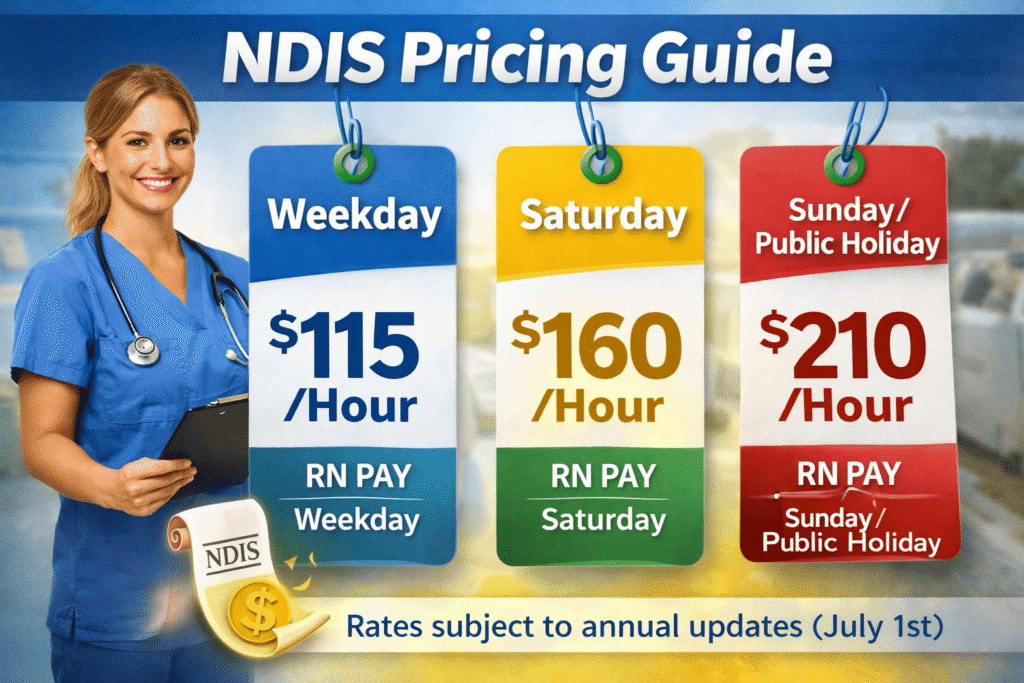
You must first comprehend the NDIS Pricing Arrangements and Price Limits (previously known as the Price Guide) in order to determine how much an NDIS nurse makes. A “price cap” or maximum hourly tariff for nursing services is determined by the National Disability Insurance Agency (NDIA). Every year, on July 1st, these rates are reassessed to reflect changes in the Fair Work Commission’s awards and inflation. The NDIS pricing cap for a typical weekday shift for a registered nurse is now between $115 and $120 per hour.
But it’s crucial to understand that $120 per hour is what the company gets, not necessarily the nurse’s net pay. If you work for a big NDIS provider, your insurance, superannuation, office staff, and profit are all covered by that money, leaving the nurse with an hourly rate of between $45 and $60. You can keep a lot more of that $120 if you are a self-employed nurse (Sole Trader), but you have to cover your own insurance and taxes. The first step in negotiating your pay or establishing your own business rates is to comprehend this “Price Cap.”
Salary Comparison: Hospital Nurses vs. NDIS Nurses
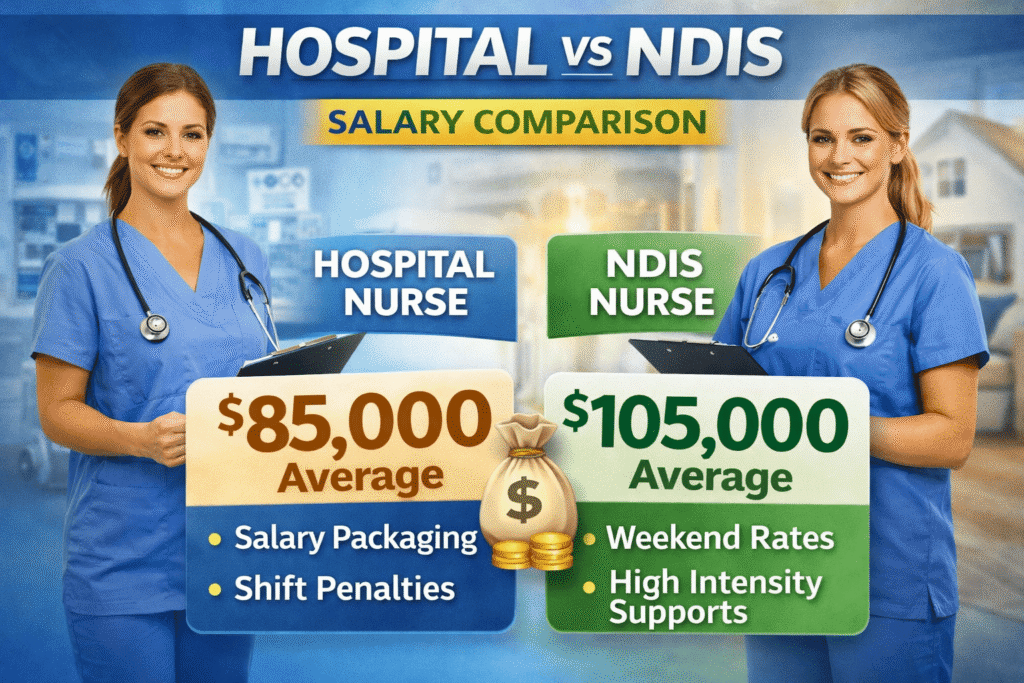
Hospital nurses in Australia often operate under a “Public Health Enterprise Agreement.” A highly senior nurse (Grade 8) would make between $55 and $60 per hour, whereas a normal Graduate Registered Nurse might start at about $35 to $38. Although hospitals provide excellent benefits including shift penalties and salary packaging, base pay is frequently set. On the other hand, because the work is done in the community and frequently involves more individual responsibility, NDIS nursing, particularly in the private sector, tends to provide higher base rates.
The typical yearly compensation for many NDIS nurses employed by private organizations is between $95,000 and $115,000, which is frequently more than the $85,000 average for a mid-level hospital nurse. The NDIS’s “Shift Penalties” are also important. The price cap rises to over $160 per hour if you labor on a Saturday, and it can reach over $200 per hour on Sundays or public holidays. The NDIS is one of the most profitable industries for Australian healthcare workers, with yearly earning potential easily exceeding $130,000 for nurses willing to work weekends or overnight “Active Sleepover” shifts.
Boosting Income Through High-Intensity Nursing Skills
Not every NDIS nurse task is compensated equally. Some forms of assistance are classified by the NDIS as “High Intensity Daily Personal Activities.” These are more risky clinical jobs that call for specific nursing skills. You are in significantly greater demand and may frequently negotiate a higher wage or charge the highest “High Intensity” price limitations permitted by the NDIA if you possess advanced expertise in these areas.
Tracheostomy management, ventilator care, complex wound management, and subcutaneous injections are examples of high-paying specialist skills. Many NDIS members require round-the-clock care from nurses who are knowledgeable about their unique needs because they have complicated neurological or physical disability. Investing in “Continuous Professional Development” (CPD) to acquire these skills frequently places nurses at the top of the wage scale. As a “Specialist NDIS Nurse,” you leave general support and enter a specialty where you can charge more for your knowledge.
The “Sole Trader” Advantage: Maximizing Your Hourly Rate
In the NDIS nursing field, self-employed sole traders are nearly invariably the highest incomes. You no longer provide a “cut” of your hourly wage to a middleman or big business when you work for yourself. As previously stated, as a sole proprietor, you get the whole $120 if the NDIS pays you $120 per hour for your services. The majority of independent nurses earn a “net profit” that is far greater than any hospital wage, even after deducting Professional Indemnity Insurance, NDIS audit costs, and taxes.
You can control your own “tax-deductible” expenses when you operate as a sole proprietor. You can reduce the amount of tax you pay at the end of the year by claiming your home office, medical supplies, car travel, and even your phone bill as business costs. The financial benefits of working for yourself are significant, even though it involves additional paperwork, such as handling your own ABN and billing. Many independent NDIS nurses who work 30 to 40 hours a week report earning between $150,000 and $200,000 annually, offering a degree of financial independence uncommon in typical nursing positions.
Factors That Influence Your Final Take-Home Pay
Despite the high hourly rates, a number of factors will affect your total “Take-Home Pay.” Your location is the first. The NDIS permits providers in “Remote” or “Very Remote” regions of Australia (such as portions of Western Australia or the Northern Territory) to charge a “Remote Loading.” This might raise the hourly rate by 20% to 25%, thus for the same work, a nurse in a rural area might be paid much more than a nurse in Sydney or Melbourne.
Your employment status is the second factor. Permanent employees receive “Superannuation” (currently 11.5%) and “Paid Leave” (annual and sick leave). You do not receive these perks if you opt to work as a “Casual” or “Contractor,” however your hourly rate is typically increased by 25% to make up for it. Lastly, “Travel Compensation” has a significant role. When traveling between participants, the NDIS permits nurses to bill for both travel time and distance (cents per kilometer). Your travel expenses can increase your yearly income by an additional $5,000 to $10,000 if you manage your schedule well, making your commute a lucrative aspect of your job.
People Also Ask (FAQ)
Q: Does the NDIS pay for a nurse’s travel time?
Indeed. Travel time (up to 30 minutes in urban areas and 60 minutes in rural areas) may be claimed by providers at the nurse’s hourly rate under the NDIS Pricing Arrangements. To compensate for the wear and tear on your car, you can additionally charge for “Provider Travel – Non-Labor Costs” (miles).
Q: Can Enrolled Nurses (ENs) earn as much as Registered Nurses (RNs) in the NDIS?
No. varying nursing levels are subject to varying price caps under the NDIS. Compared to a registered nurse, an enrolled nurse has a lower price cap, typically between $85 and $90 per hour. Nonetheless, ENs in the public hospital system usually make less than ENs in the NDIS.
Q: Do I need to pay for my own insurance if I work for an NDIS agency?
Generally, you are covered by the agency’s insurance if you are a Permanent or Casual Employee. However, you are legally obligated to obtain your own Public Liability and Professional Indemnity insurance if you work as an Independent Contractor (using your own ABN).
Q: Is NDIS nursing work stable?
Very much so. Due to the fact that many disability services are “long-term” or “lifelong,” NDIS nurses frequently work with the same patient for many years. Compared to traditional agency nursing, when you move to a different hospital every day, this offers a level of employment security and “income stability” that is far higher.
Q: How do I find out the current NDIS nurse rates?
The most recent “NDIS Pricing Arrangements and Price Limits” paper can be downloaded from the official NDIS website. It provides the precise monetary amounts you can charge for each kind of nursing support and is updated annually.
Useful Documents for every Nursing Student
CV Section Template for Nursing students
AHPRA – NMBA Registration Document Checklist (International Students-Graduates)
Clinical Placement Reflection Template (NMBA-aligned)
Cover Letter Template for Nursing Students
Disclaimer: “I researched this information on the internet; please use it as a guide and also reach out to a professional for assistance and advice.This information is not medical advice, so seek your medical professional’s assistance.”