

The Australian healthcare landscape has undergone a massive transformation with the rollout of the National Disability Insurance Scheme (NDIS). For nurses, this has opened up a world of financial opportunities that often far exceed traditional hospital pay scales. If you are a nursing student or a Registered Nurse (RN) looking for a career change, understanding the earning potential within the NDIS is essential. Unlike a standard hospital ward where pay is strictly dictated by "Years of Experience" or "Grade," NDIS nursing pay is influenced by the NDIS Pricing Guide, the complexity of the care provided, and whether you choose to work as an employee or a self-employed "Sole Trader."
In this comprehensive guide, we will break down the numbers behind NDIS nursing salaries. We will explore how much you can expect to earn per hour, the difference between "Agency" and "Independent" rates, and the high-intensity skills that can boost your income. Whether you are aiming for a stable salary or looking to maximize your hourly rate by starting your own NDIS nursing business, this article provides the financial roadmap you need to succeed in the Australian disability sector.
1. The NDIS Pricing Guide: The Foundation of Your Earnings
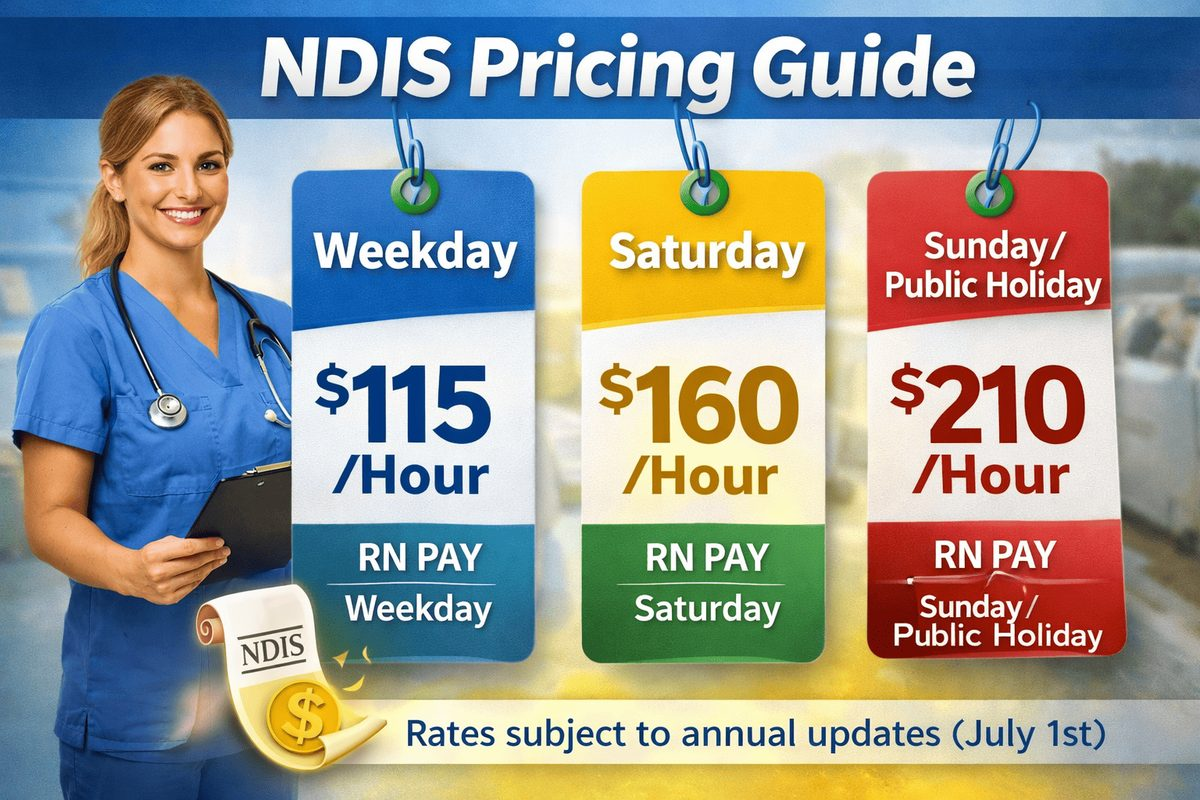
To understand how much an NDIS nurse earns, you must first understand the NDIS Pricing Arrangements and Price Limits (formerly known as the Price Guide). The National Disability Insurance Agency (NDIA) sets a "price cap" or a maximum hourly rate that a provider can charge for nursing services. These rates are reviewed every year (usually on July 1st) to account for inflation and changes in the Fair Work Commission’s awards. For a Registered Nurse, the NDIS price limit for a standard weekday shift is currently around $115 to $120 per hour.
However, it is important to realize that $120 per hour is what the business receives, not necessarily what the nurse takes home as a net wage. If you work for a large NDIS provider, they use that money to pay for your insurance, superannuation, office staff, and profit, usually leaving the nurse with a wage between $45 and $60 per hour. If you are a self-employed nurse (Sole Trader), you can keep a much larger portion of that $120, but you must pay for your own taxes and insurance. Understanding this "Price Cap" is the first step in negotiating your salary or setting your own business rates.
2. Salary Comparison: Hospital Nurses vs. NDIS Nurses
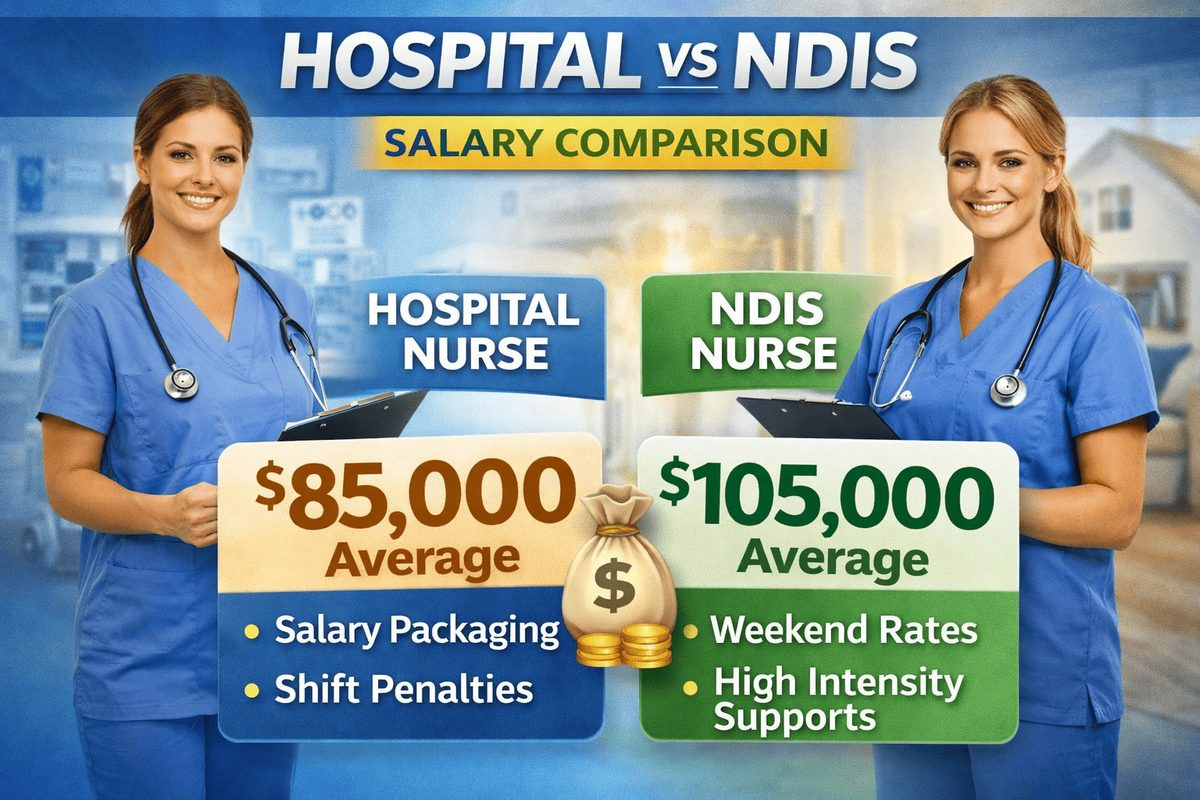
In Australia, hospital nurses usually work under a "Public Health Enterprise Agreement." A typical Graduate Registered Nurse might start at around $35 to $38 per hour, while a very senior nurse (Grade 8) might reach $55 to $60 per hour. While hospitals offer great benefits like salary packaging and shift penalties, the base pay is often fixed. In contrast, NDIS nursing—especially in the private sector—tends to offer higher base rates because the work is performed in the community, often with higher levels of individual responsibility.
Many NDIS nurses working for private agencies earn an average annual salary of $95,000 to $115,000, which is often higher than the $85,000 average for a mid-level hospital nurse. Furthermore, the "Shift Penalties" in the NDIS are significant. If you work on a Saturday, the price limit increases to roughly $160 per hour, and on Sundays or Public Holidays, it can climb over $200 per hour. For nurses willing to work weekends or overnight "Active Sleepover" shifts, the annual earning potential can easily surpass $130,000, making the NDIS one of the most lucrative sectors for Australian healthcare workers.
3. Boosting Income Through High-Intensity Nursing Skills
Not all NDIS nursing tasks are paid at the same rate. The NDIS categorizes certain supports as "High Intensity Daily Personal Activities." These are clinical tasks that require specialized nursing knowledge and carry a higher level of risk. If you have advanced skills in these areas, you are in much higher demand and can often negotiate a higher salary or charge the maximum "High Intensity" price limits allowed by the NDIA.
High-paying specialized skills include Tracheostomy Management, Ventilator Care, Complex Wound Management, and Subcutaneous Injections. Because many NDIS participants have complex neurological or physical disabilities, they require 24/7 care from nurses who understand these specific needs. Nurses who invest in "Continuous Professional Development" (CPD) to master these skills often find themselves at the top of the pay scale. By becoming a "Specialist NDIS Nurse," you move away from general support and into a niche where you can command premium rates for your expertise.
4. The "Sole Trader" Advantage: Maximizing Your Hourly Rate
The highest earners in the NDIS nursing world are almost always Self-Employed Sole Traders. When you work for yourself, you are no longer giving a "cut" of your hourly rate to a middleman or a large corporation. As we mentioned, if the NDIS pays $120 per hour for your services, as a sole trader, you receive the full $120. Even after you pay for your Professional Indemnity Insurance, your NDIS audit fees, and your tax, most independent nurses take home a "net profit" that is significantly higher than any hospital salary.
Working as a sole trader allows you to manage your own "tax-deductible" expenses. You can claim your car travel, your medical supplies, your home office, and even your phone bill as business expenses, which lowers the amount of tax you pay at the end of the year. While being self-employed requires more paperwork—such as managing your own ABN and invoicing—the financial rewards are substantial. Many independent NDIS nurses working 30 to 40 hours a week report grossing between $150,000 and $200,000 per year, providing a level of financial freedom that is rarely found in traditional nursing roles.
5. Factors That Influence Your Final Take-Home Pay
While the hourly rates look impressive, several factors will influence your final "Take-Home Pay." The first is your Location. In "Remote" or "Very Remote" areas of Australia (like parts of the Northern Territory or Western Australia), the NDIS allows providers to charge a "Remote Loading." This can increase the hourly rate by 20% to 25%, meaning a nurse in a remote area could be earning significantly more than a nurse in Sydney or Melbourne for the same work.
The second factor is your Employment Status. Permanent employees get "Paid Leave" (sick leave and annual leave) and "Superannuation" (currently 11.5%) paid by their employer. If you choose to work as a "Casual" or a "Contractor," you don't get these benefits, but your hourly rate is usually 25% higher to compensate. Finally, "Travel Compensation" is a huge factor. The NDIS allows nurses to charge for travel time and mileage (cents per kilometer) when traveling between participants. If you plan your schedule efficiently, your travel payments can add an extra $5,000 to $10,000 to your annual income, turning your commute into a profitable part of your workday.
Frequently Asked Questions
Q: Does the NDIS pay for a nurse's travel time?
A: Yes. Under the NDIS Pricing Arrangements, providers can claim travel time (up to 30 minutes in city areas and 60 minutes in regional areas) at the nurse's hourly rate. You can also charge for "Provider Travel – Non-Labor Costs" (mileage) to cover the wear and tear on your vehicle.
Q: Can Enrolled Nurses (ENs) earn as much as Registered Nurses (RNs) in the NDIS?
A: No. The NDIS has different price limits for different levels of nursing. An Enrolled Nurse has a lower price cap (usually around $85 to $90 per hour) compared to a Registered Nurse. However, ENs in the NDIS still typically earn more than ENs in the public hospital system.
Q: Do I need to pay for my own insurance if I work for an NDIS agency?
A: Usually, if you are a Permanent or Casual Employee, the agency’s insurance covers you. However, if you are working as an Independent Contractor (using your own ABN), you are legally required to have your own Professional Indemnity and Public Liability insurance.
Q: Is NDIS nursing work stable?
A: Extremely. Because many disability supports are "long-term" or "lifelong," NDIS nurses often stay with the same participant for years. This provides a level of job security and "income stability" that is much higher than traditional agency nursing where you move to a different hospital every day.
Q: How do I find out the current NDIS nurse rates?
A: You should download the latest "NDIS Pricing Arrangements and Price Limits" document from the official NDIS website. It is updated every year and lists the exact dollar amounts you can charge for every type of nursing support.