

Summary
For millions of individuals around the world, the holy month of Ramadan holds great spiritual significance. It also poses a difficult clinical challenge for nurses who provide care for patients with chronic illnesses. When fasting from sunrise to sunset, daily habits must be completely altered, which has an immediate effect on when and how drugs are taken. One of the main reasons for hospital admissions this month is “Medication Non-Adherence,” or taking medications at the wrong time. As a nurse, you have two responsibilities: you have to manage your own time and energy while making sure your patients don’t experience toxicity or a “rebound effect” from improperly transferred medication.
Moving a morning dose to the evening is only one aspect of safe medication scheduling; another is knowing the drug’s pharmacokinetics, or how it passes through the body, how long it remains in the blood, and whether it needs food to be absorbed. As educators and advocates, nurses are essential in guiding patients through the “gray areas” of what breaks a fast and what doesn’t. This page offers a thorough approach to understanding when to take medications, identifying potentially harmful drug-nutrient combinations, and making sure that the spiritual objectives of Ramadan are fulfilled without sacrificing clinical safety.
Understanding “Fast-Safe” vs. “Fast-Breaking” Medications
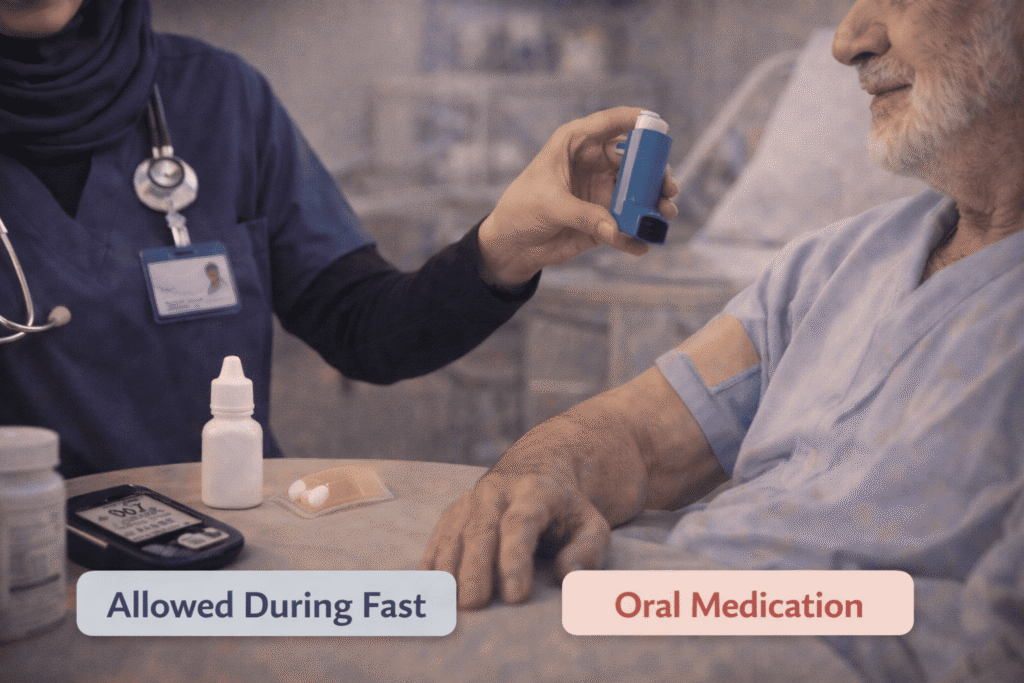
Fearing that taking medication may “break” their fast is one of the most frequent reasons patients avoid taking it during Ramadan. Teaching patients which administration routes are typically regarded as “fast-safe” by religious and medical authorities is the first step in providing culturally sensitive care as a nurse. The majority of Islamic scholars concur that drugs do not break the fast if they do not enter the stomach or gastrointestinal tract. This is a “game-changer” for patient compliance since it makes it possible for numerous life-saving therapies to continue uninterrupted during the day.
Asthma or COPD inhalers, eye and ear drops, topical creams or patches (such as nicotine or pain patches), and sublingual tablets (such as nitroglycerin for chest pain) are examples of “fast-safe” methods. As long as they are not used for nutritional objectives, even injections like heparin or insulin are typically allowed. Nevertheless, the fast will be broken by any oral treatment (pills, syrups, or water needed to drink them). By explaining these differences to your patients, you can keep them from quitting their cardiac patches or asthma inhalers, which greatly lowers the likelihood of a mid-fast ER visit.
Chronotherapy: Adjusting Oral Medications for the Fasting Cycle
Nurses must apply the concepts of chronotherapy the timing of medical treatment in accordance with the body’s internal clock and the fasting schedule for drugs that must be taken orally. “Dose Compression,” in which a patient who typically takes medication three times a day attempts to take it all at once at Iftar (sunset), is the greatest risk during Ramadan. This may result in a toxic concentration of the medication in the blood, which could have serious adverse consequences. On the other hand, if a patient completely skips a dose, the medication level may fall too low, resulting in a “breakthrough” of symptoms like seizures or elevated blood pressure.
Moving the dose to Iftar or Suhoor (pre-dawn) is typically an easy transition for people on “Once-a-Day” drugs. Doses for “Twice-a-Day” drugs, however, should be divided across these two meals. In order to determine whether “Modified-Release” or “Extended-Release” (XR/SR) forms of the medication are available, nurses should collaborate with physicians. These versions are far safer for individuals who are fasting because they remain in the blood for 24 hours. The nurse must arrange for more frequent blood tests during the month if the patient is taking a high-risk medication with a “Narrow Therapeutic Index” (such as lithium or warfarin) to make sure the levels stay within the safe “window” in spite of the dietary changes.
Managing Diabetes and Hypoglycemia Risks
Perhaps the most important thing a nurse can do during Ramadan is manage insulin and oral hypoglycemic medications. The danger of hypoglycemia, or low blood sugar, is greatly increased when a diabetic patient fasts, particularly in the late afternoon. A patient may experience confusion, fainting, or even a coma if they take their regular dosage of “Sulfonylurea” or “Insulin” in the morning but skip meals. “Dose Titration” requires nurses to be proactive in modifying the dosage of medication according to the fast.
Reducing the “morning” dose, which is now taken at Suhoor, and maintaining a reasonably stable “evening” dose, which is taken at Iftar, is the typical clinical recommendation. At least four times a day in the middle of the morning, in the middle of the afternoon, before Iftar, and two hours after Iftar nurses should instruct patients on how to check their blood sugar levels. Patients must be reminded by nurses that “Finger-prick testing does NOT break the fast.” Above all, nurses need to offer a “Rescue Protocol.” A patient must break their fast right away with a quick-acting sugar source if their blood sugar falls below 3.9 mmol/L (70 mg/dL). In the medical field, safety is the greatest form of worship.
The Impact of Dehydration on Drug Toxicity

During the lengthy hours of a Ramadan fast, dehydration is a continual risk, especially for patients who live in warm regions or have physically demanding jobs. For a nurse, dehydration affects not only thirst but also the kidneys’ and liver’s ability to metabolize medication. Dehydration causes the blood to become more concentrated, and the kidneys may slow down the “clearance” of medications. As a result, drugs may “build up” in the body and produce unintentional poisoning.
When using “Nephrotoxic” medications, such as NSAIDs (Ibuprofen/Naproxen) or some blood pressure medications (ACE Inhibitors), nurses should exercise extra caution because these treatments might harden the kidneys. “Acute Kidney Injury” (AKI) may result from a patient taking Ibuprofen for a headache while dehydrated. Because paracetamol (acetaminophen) is safer for the kidneys during a fast, nurses should counsel patients to use it instead for pain. Patients taking Digoxin or Lithium should also be cautioned that their levels might quickly become hazardous due to dehydration. Nurses should always advise patients to “hydrate aggressively with water and electrolytes between Iftar and Suhoor to protect your organs.”
Nurse Self-Care: Managing Your Own Medication and Energy
Even nurses are patients! Many medical professionals perform 12-hour shifts while managing their own chronic diseases, such as hypothyroidism, hypertension, or allergies. Keeping track of your personal medicine regimen is crucial to preserving your “Clinical Alertness.” The ideal time to take medication for a thyroid issue (such as levothyroxine), which needs to be taken on an empty stomach, is often four hours after Iftar or at least thirty minutes before Suhoor. Make careful to take any allergy medication that makes you sleepy just at night so that it doesn’t interfere with your ability to function on the ward.
Managing your “Biological Energy” is a kind of medication that goes beyond your own drugs. One of the adverse effects of fasting is fatigue, which can be controlled by “Nutritional Timing.” Steer clear of high-caffeine beverages just before you begin your fast at Suhoor. Because caffeine is a diuretic, it causes you to lose fluids more quickly, which can result in a “withdrawal headache” by noon. Instead, replenish with electrolytes during your Iftar. You can make sure you have the mental “bandwidth” to identify drug errors in your patients by maintaining your own health. The strongest safeguard against medical errors during the hectic month of Ramadan is a healthy nurse.
People Also Ask (FAQ)
Q: Does using an asthma pump break my fast?
The majority of religious and medical professionals disagree. Inhaled drugs provide life-saving breathing support by going to the lungs rather than the stomach. To prevent an emergency, you should keep using your inhaler as directed.
Q: What should I do if I forget to take my medication at Suhoor?
Avoid “double up” during Iftar. Get in touch with your doctor or nurse right away if the drug is life-sustaining (such as for heart rhythm or seizures). For the majority of other medications, take the dose at Iftar and go back to your routine; however, you should never take two doses at once without a doctor’s approval.
Q: Can I use a nicotine patch while fasting?
Indeed. Applying nicotine patches to the skin does not require consuming food or liquids. They are a great technique to control withdrawal symptoms while working so you can continue to concentrate on your patients.
Q: I have a patient who refuses to take their heart medication during the day. What can I do?
You should discuss the dangers of quitting the medicine as a nurse. Make alternate recommendations (such as patches) or ask the doctor to switch the medication to a “Long-Acting” kind that can be used during Iftar. Honor their decision, but make sure they are completely aware of the hazards to their safety.
Q: Does a Vitamin B12 injection break the fast?
The majority of academics concur that medical injections either intramuscularly (IM) or subcutaneously (Sub-Q) do not break the fast. However, because they include nourishment, “nutritional IV drips” or “glucose infusions” are typically seen as breaking the fast.
Useful Documents for every Nursing Student
CV Section Template for Nursing students
AHPRA – NMBA Registration Document Checklist (International Students-Graduates)
Clinical Placement Reflection Template (NMBA-aligned)
Cover Letter Template for Nursing Students
Disclaimer: “I researched this information on the internet; please use it as a guide and also reach out to a professional for assistance and advice.This information is not medical advice, so seek your medical professional’s assistance.”