
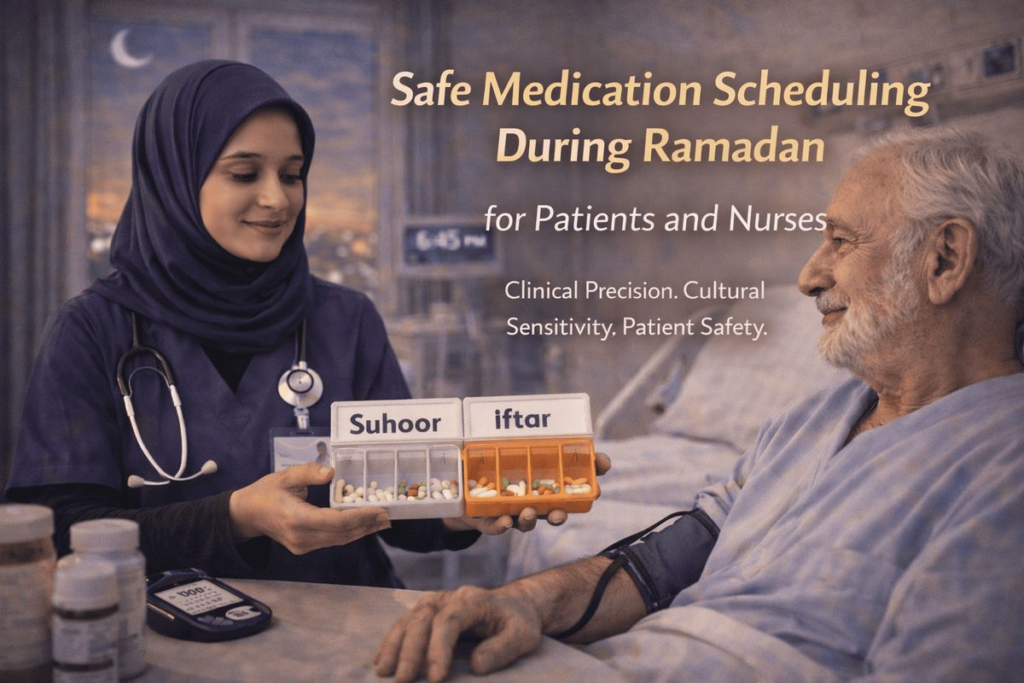
The holy month of Ramadan is a time of deep spiritual significance for millions of people worldwide. For patients with chronic illnesses and the nurses who care for them, it also presents a complex clinical challenge. Fasting from dawn to sunset requires a total change in daily routines, which directly impacts how and when medications are taken. "Medication Non-Adherence"—or taking pills at the wrong time—is one of the leading causes of hospital admissions during this month. For a nurse, the responsibility is twofold: you must manage your own energy and schedule while ensuring your patients do not suffer from a "rebound effect" or toxicity because their medicine was moved without proper planning.
+2
Safe medication scheduling is not just about moving a morning dose to the evening; it is about understanding the Pharmacokinetics of the drug—how it moves through the body, how long it stays in the blood, and whether it requires food to be absorbed. Nurses play a vital role as educators and advocates, helping patients navigate the "gray areas" of what breaks a fast and what doesn't. This article provides a comprehensive guide to mastering medication timing, recognizing dangerous drug-nutrient interactions, and ensuring that the spiritual goals of Ramadan are met without compromising clinical safety.
1. Understanding "Fast-Safe" vs. "Fast-Breaking" Medications
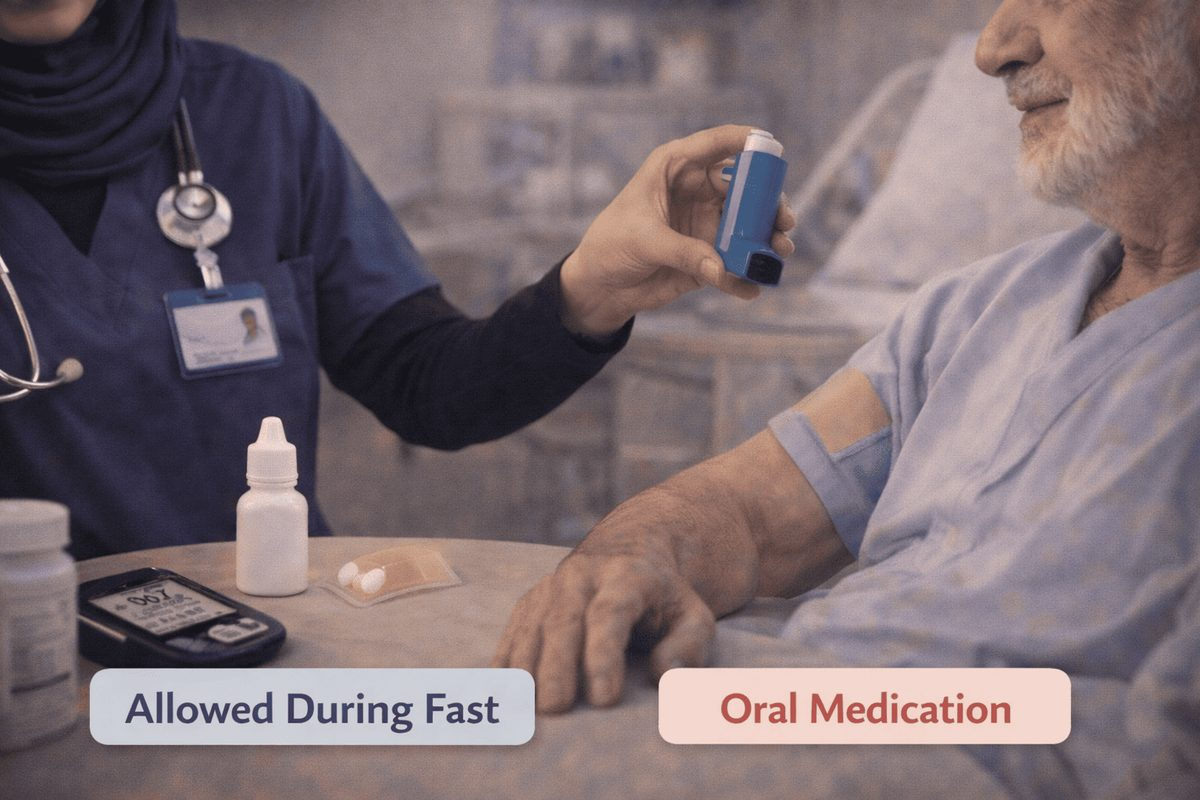
One of the most common reasons patients skip their medicine during Ramadan is the fear that taking it will "break" their fast. As a nurse, providing culturally sensitive care begins with educating patients on which routes of administration are generally considered "fast-safe" by religious and medical authorities. Most Islamic scholars agree that medications that do not enter the gastrointestinal tract (the stomach) for nutrition do not break the fast. This is a "game-changer" for patient compliance, as it allows many life-saving treatments to continue during daylight hours without interruption.
Generally, "fast-safe" routes include Inhalers for asthma or COPD, Eye and Ear drops, Topical creams or patches (like nicotine or pain patches), and Sublingual tablets (placed under the tongue, like Nitroglycerin for chest pain). Even Injections—such as insulin or heparin—are usually permitted as long as they are not for nutritional purposes. However, any medication taken orally (pills, syrups, or water used to swallow them) will break the fast. By clarifying these distinctions for your patients, you can prevent them from stopping their asthma inhalers or heart patches, which significantly reduces the risk of an emergency room visit mid-fast.
2. Chronotherapy: Adjusting Oral Medications for the Fasting Cycle
For medications that must be taken by mouth, nurses must use the principles of Chronotherapy—the timing of medical treatment in coordination with the body’s internal clock and the fasting schedule. The biggest risk during Ramadan is "Dose Compression," where a patient who usually takes pills three times a day tries to take them all at once at Iftar (sunset). This can lead to a toxic level of the drug in the blood, causing severe side effects. Conversely, if a patient misses a dose entirely, the level of the drug may drop too low, causing a "breakthrough" of symptoms like high blood pressure or seizures.
For patients on "Once-a-Day" medications, the switch is usually simple: move the dose to Iftar or Suhoor (pre-dawn). However, for "Twice-a-Day" medications, the doses should be split between these two meals. Nurses should work with doctors to see if "Modified-Release" or "Extended-Release" (XR/SR) versions of the drug are available. These versions stay in the blood for 24 hours, making them much safer for fasting patients. If a patient is on a high-risk drug with a "Narrow Therapeutic Index" (like Warfarin or Lithium), the nurse must schedule more frequent blood tests during the month to ensure the levels remain within the safe "window" despite the change in eating habits.
3. Managing Diabetes and Hypoglycemia Risks
Managing insulin and oral hypoglycemic agents is perhaps the most critical task for a nurse during Ramadan. When a patient with diabetes fasts, the risk of Hypoglycemia (low blood sugar) increases significantly, especially in the late afternoon. If a patient takes their usual dose of a "Sulfonylurea" or "Insulin" in the morning but does not eat all day, their blood sugar can drop to dangerous levels, leading to confusion, fainting, or even a coma. Nurses must be proactive in "Dose Titration"—adjusting the amount of medicine based on the fast.
The general clinical guideline is to reduce the "morning" dose (now taken at Suhoor) and keep the "evening" dose (taken at Iftar) relatively stable. Nurses should teach patients to monitor their blood glucose at least four times a day: mid-morning, mid-afternoon, before Iftar, and two hours after Iftar. It is a vital nursing duty to remind patients that "Finger-prick testing does NOT break the fast." Most importantly, nurses must provide a "Rescue Protocol." If a patient’s blood sugar drops below 3.9 mmol/L (70 mg/dL), they must break their fast immediately with a quick-acting sugar source. Safety is the ultimate form of worship in healthcare.
4. The Impact of Dehydration on Drug Toxicity

Dehydration is a constant threat during the long hours of a Ramadan fast, particularly for patients in warm climates or those working physically demanding jobs. For a nurse, dehydration is not just about thirst; it is about how the kidneys and liver process medicine. When the body is dehydrated, the blood becomes more concentrated, and the kidneys may slow down their "clearance" of drugs. This can cause medications to "build up" in the body, leading to accidental toxicity.
+1
Nurses should be especially careful with "Nephrotoxic" drugs—medicines that can hard the kidneys—such as NSAIDs (Ibuprofen/Naproxen) or certain blood pressure medications like ACE Inhibitors. If a patient is dehydrated and takes an Ibuprofen for a headache, it can cause "Acute Kidney Injury" (AKI). Nurses should advise patients to use Paracetamol (Acetaminophen) for pain instead, as it is safer for the kidneys during a fast. Additionally, patients on Lithium or Digoxin need to be warned that dehydration can quickly cause their levels to become toxic. The nursing advice should always be: "Hydrate aggressively with water and electrolytes between Iftar and Suhoor to protect your organs."
5. Nurse Self-Care: Managing Your Own Medication and Energy
Nurses are patients too! Many healthcare professionals manage their own chronic conditions—like hypothyroidism, hypertension, or allergies—while working 12-hour shifts. Managing your own medication schedule is essential for maintaining your "Clinical Alertness." If you take medication for a thyroid condition (like Levothyroxine), which must be taken on an empty stomach, the best time is usually at least 30 minutes before Suhoor or 4 hours after Iftar. If you take allergy medication that causes drowsiness, ensure you take it only at night so it doesn't affect your performance on the ward.
Beyond your own pills, managing your "Biological Energy" is a form of medication. Fatigue is a side effect of fasting that can be managed with "Nutritional Timing." Avoid high-caffeine drinks right before you start your fast at Suhoor; caffeine is a diuretic and will make you lose fluids faster, leading to a "withdrawal headache" by noon. Instead, use your Iftar to rehydrate with electrolytes. By keeping your own health in check, you ensure that you have the mental "bandwidth" to catch medication errors in your patients. A healthy nurse is the best defense against medical mistakes during the busy month of Ramadan.
Frequently Asked Questions
Q: Does using an asthma pump break my fast? A: Most medical and religious experts say No. Inhaled medications go to the lungs, not the stomach, and are used for life-saving breathing support. You should continue to use your inhaler as prescribed to avoid an emergency.
+1
Q: What should I do if I forget to take my medication at Suhoor? A: Do not "double up" at Iftar. If it is a life-sustaining medication (like for seizures or heart rhythm), contact your nurse or doctor immediately. For most other meds, take the dose at Iftar and resume your schedule, but never take two doses at once without medical advice.
Q: Can I use a nicotine patch while fasting? A: Yes. Nicotine patches are applied to the skin and do not involve eating or drinking. They are an excellent way to manage withdrawal symptoms during your shift so you can stay focused on your patients.
Q: I have a patient who refuses to take their heart medication during the day. What can I do? A: As a nurse, you should explain the risks of stopping the medication. Suggest alternative routes (like patches) or see if the doctor can change the pill to a "Long-Acting" version that can be taken at Iftar. Respect their choice, but ensure they are fully informed of the safety risks.
Q: Does a Vitamin B12 injection break the fast? A: Most scholars agree that intramuscular (IM) or subcutaneous (Sub-Q) injections for medical reasons do not break the fast. However, "Nutritional IV drips" or "Glucose infusions" are generally considered to break the fast because they provide nourishment.