

Summary
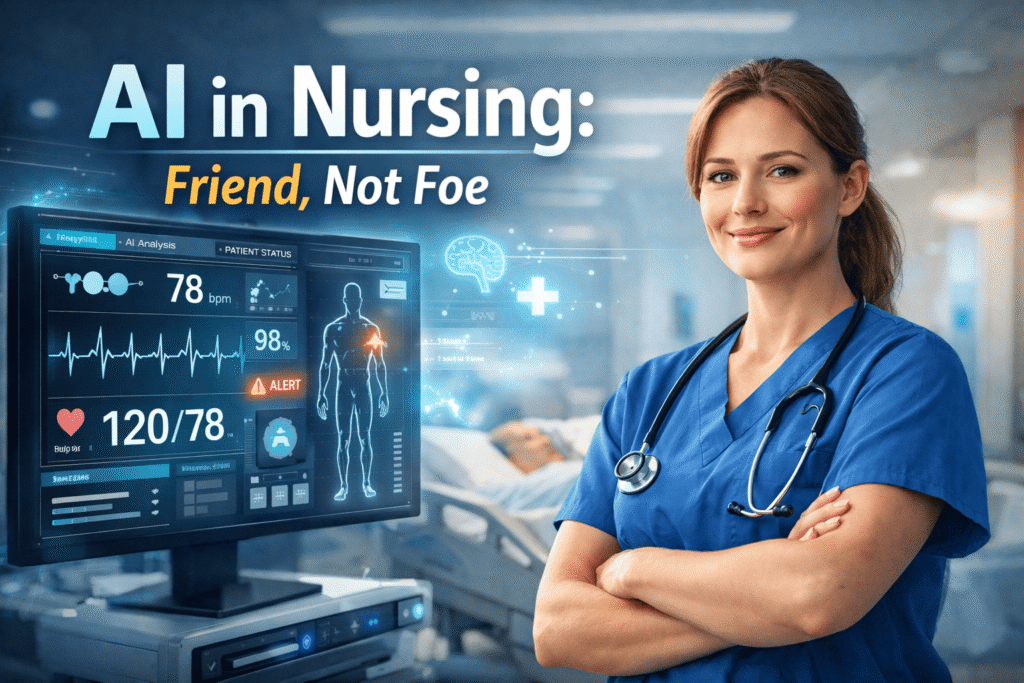
Globally, artificial intelligence (AI) is drastically altering healthcare practices. AI is no longer merely a concept for the future in nursing practice; it is now being utilized in clinics, hospitals, assisted living institutions, and community health settings. AI tools are quietly helping nurses every day with everything from patient monitoring systems to electronic health records.
It is becoming more and more crucial for nursing students to comprehend the advantages of artificial intelligence in nursing practice. AI is intended to support nurses, not to replace them, despite the concerns of many students. It lessens effort, enhances patient safety, and frees up nurses to concentrate more on providing direct patient care.
The main advantages of artificial intelligence in nursing practice are succinctly and clearly explained in this essay. It is written especially for nursing students and new graduates, with real-world explanations rather than technical language.
What Is Artificial Intelligence in Nursing Practice?
Computer programs that are capable of data analysis, pattern recognition, and decision assistance are referred to as artificial intelligence. AI typically operates in the background in nursing practice through digital tools and software that help with routine chores.
AI is frequently used, for instance, when a hospital system notifies a nurse that a patient’s vital signs are changing. AI is assisting in the background when electronic records indicate possible hazards or recommend drug schedules.
In nursing, AI does not make decisions on its own. Rather, it offers corroborating data that nurses utilize in conjunction with their expert judgment. Students who get this are better able to view AI as a useful tool rather than a danger.
How Artificial Intelligence Improves Patient Safety

Improved patient safety is one of the main advantages of artificial intelligence in nursing practice. Nurses oversee numerous patients, prescription drugs, and clinical duties concurrently. By offering early alerts and reminders, AI systems aid in lowering human mistake.
AI-driven monitoring systems are able to identify minute variations in vital signs, such blood pressure, heart rate, or oxygen levels, before they become serious. This enables nurses to take action sooner and avoid problems.
Another crucial topic is medication safety. Nurses can receive alerts from AI systems about possible drug combinations, allergies, or improper dosages. This additional safety measure is particularly helpful for nursing students learning how to administer medications.
Overall, by serving as a second pair of eyes and assisting nurses in identifying problems early, AI promotes safer treatment.
Reducing Nursing Workload and Saving Time
Nursing is an emotionally and physically taxing profession. A nurse’s shift is mostly devoted to administrative, charting, and documentation duties. By automating repetitive operations, artificial intelligence contributes to a reduction in this workload.
For instance, voice-to-text documentation enables nurses to take notes more rapidly. Routine data can be automatically filled in by smart charting systems, saving time on paperwork.
Nurses can spend more time with patients by reducing the amount of time they spend on administrative tasks. Better learning opportunities and more chances to practice clinical skills rather than being overburdened with paperwork are what this means for nursing students.
While AI does not relieve nurses of their responsibilities, it does improve time management and lessen burnout.
Supporting Clinical Decision-Making for Nurses
Support for clinical decision-making is one of artificial intelligence’s main advantages for nursing practice. Large volumes of patient data are analyzed by AI systems, which reveal patterns that might not be immediately apparent.
For instance, based on their medical history and present state, AI can assist in identifying individuals who are at risk of deterioration, pressure injuries, or falls. The final choice is still made by nurses, although AI offers helpful information to help with care planning.
This is particularly useful for nursing students when they are on placement. By supporting clinical reasoning and assisting students in comprehending the rationale behind prescribed interventions, AI techniques can enhance learning.
Instead than taking the place of nursing judgment, AI serves as a learning partner.
Enhancing Personalised and Patient-Centred Care

Healthcare providers can now give more individualized care thanks to artificial intelligence. AI can enable individualized care plans by analyzing patient data, including age, medical history, lifestyle, and reaction to medicines.
This implies that care is not “one-size-fits-all” in nursing practice. AI can recommend follow-up times, educational requirements, or customized monitoring programs.
This emphasizes to nursing students the value of comprehensive, patient-centered care. Instead of concentrating solely on symptoms, AI helps nurses perceive the patient’s whole picture.
Both patients and healthcare teams gain from personalized care since it enhances patient outcomes and satisfaction.
Improving Communication and Care Coordination
AI facilitates better communication amongst healthcare teams, which is crucial in nursing practice. AI-driven technologies guarantee that patient data is updated instantly and available to all pertinent personnel.
This lessens misunderstandings during transfers, handovers, and shift changes. AI-assisted handover tools, for instance, might draw attention to important details that shouldn’t be overlooked.
Clear communication mechanisms promote safer learning settings and lessen misunderstanding for nursing students. Students are better able to comprehend patient priorities and adhere to care plans precisely.
Better teamwork and more efficient processes are the results of improved communication.
AI in Nursing Education and Skill Development
Nursing education is also changing as a result of artificial intelligence. AI is currently used in simulation labs to produce realistic patient scenarios that react instantly to student activities.
AI-powered learning systems are able to pinpoint pupils’ weak points and offer tailored study advice. Students can more effectively improve by concentrating on their areas of weakness.
AI-enhanced education gives nursing students more self-assurance and better equips them for clinical practice in the real world.
Ethical Considerations and the Human Role in AI-Supported Nursing
AI creates ethical questions even if it has numerous advantages. When utilizing AI-supported technologies, nurses must guarantee patient privacy, data security, and informed consent.
Crucially, human empathy, compassion, and moral judgment cannot be replaced by AI. The nursing profession is still focused on people. AI does not replace the nurse-patient interaction; rather, it is a tool that helps nurses.
In order to practice nursing in the present era, students must learn to strike a balance between technology and compassion.
What Nursing Students Should Know About the Future of AI in Nursing
Future nurses will collaborate with increasingly sophisticated technologies as AI in healthcare continues to progress. AI-savvy nursing students will be more equipped for today’s profession.
Future nurses will need to learn how to utilize AI ethically, challenge its recommendations, and integrate it with clinical judgment.
Students should view AI as a tool that can make nursing safer, more effective, and more patient-focused rather than as something to be afraid of.
Conclusion: Why Artificial Intelligence Is a Benefit, Not a Threat, to Nursing
Improved patient safety, less workload, better decision-making, and more patient-centered care are just a few advantages artificial intelligence offers to nursing practice. AI offers additional assistance to nursing students during their education and clinical rotations.
Human care, empathy, and moral discernment will always be necessary in nursing. AI only makes it easier for nurses to provide excellent care in challenging healthcare settings.
Students feel more assured and equipped for the future of healthcare when they comprehend the advantages of artificial intelligence in nursing practice.
People Also Ask
How is AI used in nursing practice today?
AI supports monitoring, documentation, medication safety, and decision-making.
Will Artificial Intelligence replace nurses?
No, AI supports nurses but cannot replace human care and judgment.
Is AI safe to use in healthcare?
When used responsibly with privacy protections, AI improves safety.
Do nursing students need to learn about AI?
Yes, understanding AI prepares students for modern healthcare systems.
Does AI improve patient outcomes?
Yes, by supporting early detection, personalised care, and safer practices.
Useful Documents for every Nursing Student
CV Section Template for Nursing students
AHPRA – NMBA Registration Document Checklist (International Students-Graduates)
Clinical Placement Reflection Template (NMBA-aligned)
Cover Letter Template for Nursing Students
Disclaimer: “I researched this information on the internet; please use it as a guide and also reach out to a professional for assistance and advice.This information is not medical advice, so seek your medical professional’s assistance.”