

Summary
One of the most popular and most misinterpreted forms of evaluation for nursing degrees is reflective writing. When asked to “reflect,” many nursing students find it difficult, yet they feel comfortable producing essays based on research and data. Even when a student has put in a lot of effort and complied with their placement requirements, this uncertainty frequently results in bad grades.
Thinking that a reflective essay is merely a personal narrative is one of the most common errors made by nursing students. Markers aren’t actually judging your feelings or life experiences. Your critical thinking, professional insight, self-awareness, and capacity to connect experience to nursing standards and learning objectives are all being graded.
With a strong emphasis on what markers look for and the most frequent causes of low reflection scores, this article shows how to create nursing reflective essays that score highly. For the benefit of both undergraduate and graduate nursing students, everything is described in plain English.
What Is a Nursing Reflective Essay (Really)?
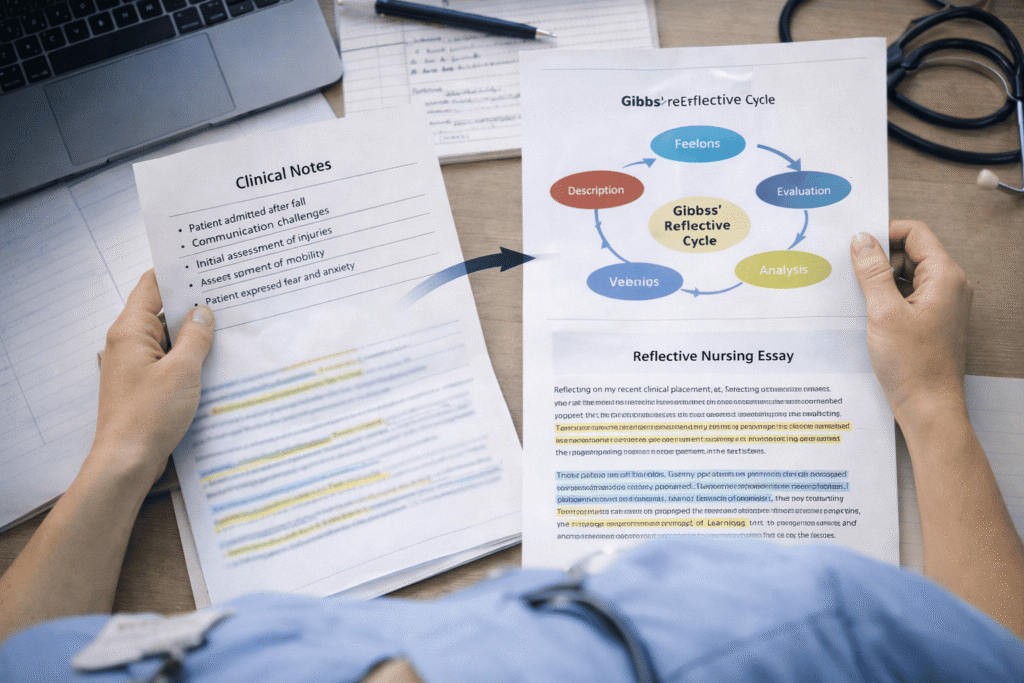
An academic essay that analyzes a real-world experience from a clinical placement, simulation, or educational activity is called a nursing reflective essay. Analyze, not describe, is the crucial term here.
Many students give excellent accounts of what transpired, but they neglect to discuss the significance of the event, the lessons they gained, and how it affected their nursing practice. Growth, not narrative, is the goal of reflection.
Reflective essays are used in nursing education to evaluate students’ abilities to:
• Gain knowledge from clinical encounters • Determine their practice’s advantages and disadvantages. • Utilize theory in practical nursing scenarios
• Exhibit ethical and professional awareness
• Enhance patient care in the future
Markers are searching for proof that you are growing into a safe, considerate, and introspective nurse rather than merely a placement participant.
What Markers Actually Look For in High-Scoring Reflections

Understanding what markers want is the fastest way to improve your reflective writing. Many low scores happen simply because students focus on the wrong things.
Clear Reflection Structure
Markers anticipate that reflective essays will adhere to a recognized reflection paradigm, such as Johns’ paradigm, Rolfe’s Framework, or Gibbs’ Reflective Cycle. Markers anticipate natural progression even in situations where a model is not specifically needed.
A reflection with a high score flows easily from:
• An explanation of the circumstances
• Individual ideas and emotions • Critical evaluation
• Acquired knowledge
• Use in nursing practice in the future
Your essay will receive a lower score if it alternates between concepts at random or remains mired in description.
Depth of Critical Thinking
Depth is one of the most crucial marking criteria. Markers are looking for evidence that you are thinking beyond the obvious.
“I felt nervous and learned that communication is important” is an example of a shallow reflection.
“I felt nervous because I lacked confidence in therapeutic communication,” is an example of deep reflection. This brought to light a weakness in my interpersonal abilities that may compromise patient safety and trust. I now see how structured communication techniques can enhance patient outcomes after thinking about communication ideas.
Analysis is rewarded by markers, not only feelings.
Linking Experience to Nursing Theory and Standards
High-scoring reflective essays connect experience with:
- Nursing theories
- Clinical guidelines
- Evidence-based practice
- Professional standards (such as NMBA standards in Australia)
Because they believe that contemplation should be “personal,” many students steer clear of theory. This is an error. In nursing, reflection is not journaling but rather scholarly reflection.
The ability to relate a real-world experience to what you have studied in books and lectures is what markers look for.
Honest Self-Evaluation (Not Self-Criticism)
Markers value honesty, but not negativity. Saying “I did everything wrong” does not score high. Instead, markers want balanced self-evaluation.
Strong reflections acknowledge:
- What went well
- What could have been improved
- Why those strengths and weaknesses exist
- What will change next time
Showing insight into your own practice demonstrates professional maturity.
Clear Learning Outcomes and Future Practice

A high-scoring reflection clearly explains how this experience will change your future nursing practice. This is one of the most important sections.
Markers want answers to questions like:
- What specific skill will you improve?
- How will you act differently next time?
- How will this benefit patient care and safety?
If your reflection ends without clear learning outcomes, it usually scores lower.
Common Reasons Nursing Reflective Essays Score Low
Many nursing students lose marks for the same reasons every semester. Understanding these mistakes can help you avoid them completely.
Too Much Description, Not Enough Reflection
This is the number one reason reflections score low.
Students often spend most of the essay explaining:
- What happened
- Who was involved
- What they did
Markers are not interested in lengthy narratives, even though some description is required. They are curious about the significance of the encounter.
Your grades will suffer if descriptions make up more than half of your essay.
Writing Like a Diary Instead of an Academic Paper
Reflective essays are still academic writing. This means:
- Formal tone
- Clear structure
- Correct referencing
- Logical arguments
Writing that sounds like a diary entry often lacks depth and academic strength. Phrases like “I was really upset” without analysis do not score well.
Not Using a Reflection Model Properly
While mentioning a reflection model in the introduction, some students disregard it in the body. Some people adhere to the model too strictly without doing any actual analysis.
Markers anticipate that the model will direct your thought rather than restrict it. It is insufficient to merely provide shallow answers to the model’s questions.
Avoiding Weaknesses or Mistakes
Because they fear their grades may suffer, many students are reluctant to own up to their faults. The reverse is actually true.
Insight is important to marketers. Your reflection may appear unrealistic or superficial if everything went according to plan. It doesn’t matter whether you were flawless; what counts is how you overcame obstacles.
Weak or Generic Learning Statements
Phrases such as “I learned that communication is important”
are overly ambiguous.
Markers are looking for particular learning, like “I learned the importance of using open-ended questions to encourage patient disclosure and reduce anxiety.”
Particular learning demonstrates genuine introspection.
How to Structure a High-Scoring Nursing Reflective Essay
A strong structure helps markers clearly see your thinking.
Introduction
The introduction should briefly explain:
- The context of the experience
- The reflection model used
- The purpose of the reflection
Do not give too much detail here. Save analysis for later.
Description (Brief and Focused)
Explain the situation clearly but briefly. Include only details that are relevant to your reflection and learning.
Feelings and Initial Thoughts
Explain what you felt and thought at the time. Then explain why you felt that way. This is where many students stop — but you should go further.
Critical Analysis
This is the most important section.
Analyse:
- What went well and why
- What didn’t go well and why
- How theory, guidelines, or standards apply
Use references to support your analysis.
Learning and Future Practice
Clearly explain:
- What you learned
- How your thinking changed
- What you will do differently in future practice
This section often determines whether a reflection scores average or high.
Language and Style That Markers Prefer
Markers prefer writing that is:
- Clear
- Structured
- Reflective, not emotional
- Evidence-informed
Avoid dramatic language. Keep your writing professional and thoughtful.
Referencing in Reflective Essays
Many students think reflective essays do not need references. This is incorrect.
You should reference:
- Reflection models
- Nursing theories
- Clinical guidelines
- Communication frameworks
Referencing shows academic depth and strengthens your reflection.
Editing and Proofreading: The Final Step Students Skip
Even strong reflections lose marks due to:
- Poor grammar
- Repetition
- Unclear sentences
Proofreading improves clarity and professionalism, which directly affects marks.
Conclusion: Reflection Is a Skill You Can Learn
Reflective writing is not about being naturally good at writing. It is about learning how to think critically about your practice. Nursing students who understand what markers want and avoid common mistakes consistently score higher.
Reflection is not just an assignment — it is a core nursing skill that improves patient care, professional growth, and lifelong learning.
People Also Ask
1. What do nursing markers look for in reflective essays?
Markers look for critical thinking, learning, and application to future practice.
2. Why do reflective essays score lower than research essays?
Students often describe instead of analysing.
3. Do reflective essays need references?
Yes, especially for models, theory, and professional standards.
4. Can I admit mistakes in a reflective essay?
Yes, thoughtful self-evaluation often improves marks.
5. What reflection model is best for nursing students?
Gibbs’ Reflective Cycle is commonly used and well-accepted.
Useful Documents for every Nursing Student
CV Section Template for Nursing students
AHPRA – NMBA Registration Document Checklist (International Students-Graduates)
Clinical Placement Reflection Template (NMBA-aligned)
Cover Letter Template for Nursing Students
Disclaimer: “I researched this information on the internet; please use it as a guide and also reach out to a professional for assistance and advice.This information is not medical advice, so seek your medical professional’s assistance.”