


Summary
One of the most important goals for foreign nursing students wishing to study in Australia is comprehending how CRICOS operates. When applying for a student visa, selecting a university, or determining whether a nursing course is authorized for overseas students, many students come across the term “CRICOS”. But many students still don’t fully grasp what CRICOS is, why it’s necessary, or how it impacts their nursing careers. This uncertainty frequently results in incorrect course choices, delayed visas, or even rejection. For this reason, it’s crucial to have a straightforward explanation.
In order to guarantee that the education that foreign students receive is authentic, excellent, and formally acknowledged by the Australian government, CRICOS is crucial. Without a CRICOS-registered course, international students cannot receive a student visa and cannot legally study in Australia. In order to help nursing students understand CRICOS, how it operates, and why it is important for future registration, placements, visas, and employment, this handbook explains everything in plain English.
What Is CRICOS and Why Is It Important for Nursing Students?
The Commonwealth Register of Institutions and Courses for Overseas Students is known by its acronym, CRICOS. All of the universities, colleges, and courses that are authorized to instruct overseas students are listed in this official government system. The Australian government has reviewed, approved, and verified that a course satisfies national education requirements if it is listed on CRICOS.
It is crucial for nursing students to take a course that is registered with CRICOS. Only credentials from authorized and certified programs are recognized by AHPRA and NMBA. A student cannot apply for an Australian student visa, participate in a clinical placement, or register as a nurse after completing the program if they select a non-CRICOS course. By guaranteeing that courses are authentic, secure, and compliant with professional standards, CRICOS safeguards international students.
Additionally, CRICOS makes sure that all universities that grant nursing degrees to foreign students adhere to stringent standards for instruction, facilities, student assistance, and evaluation. This makes it easier for students to get fair treatment and a top-notch education while they are in Australia. Additionally, because a CRICOS-registered qualification is respected globally, it protects their career goals.
How CRICOS Works for International Nursing Students in 2026
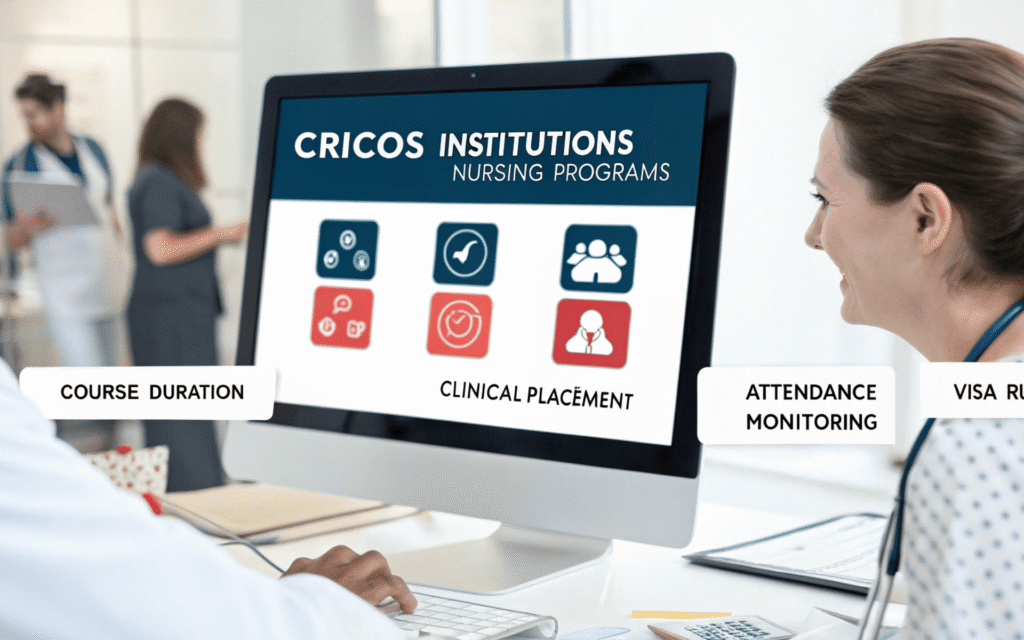
Institutions and individual programs are approved by the CRICOS system. This implies that not all of a university’s courses are automatically eligible, even if it has a CRICOS registration. For instance, a university may offer numerous nursing degrees, but international students can only enroll in those that have a CRICOS code. Before enrolling, students must verify the unique CRICOS code assigned to each approved course.
The Australian government is still using CRICOS in 2026 to ensure that international students receive high-quality education. To obtain a CRICOS code, a program must have the appropriate length, mandatory study hours, approved learning objectives, and clinical placement arrangements. Because clinical training, simulation labs, and supervision must be set up correctly, nursing programs have even more stringent requirements.
Monitoring academic achievement and attendance is another crucial role of CRICOS. Because colleges are required to notify students who do not meet visa requirements, attendance is particularly crucial for nursing students. In other words, CRICOS registration guarantees that educational institutions respect student rights and adhere to visa regulations in addition to approving the course.
Additionally, CRICOS mandates that educational institutions include academic counseling, English assistance, and health and safety information. For nursing students who deal with demanding workloads, lengthy clinical shifts, and difficult evaluations, all of these are crucial.
Why Nursing Students Must Study a CRICOS-Approved Course

It is not only advised, but legally mandatory for all international students to enroll in a CRICOS-registered nursing program. The primary visa for studying in Australia, the Student Visa Subclass 500, cannot be obtained by a student without it. Only Confirmations of Enrollment (CoE) from CRICOS-registered providers are accepted for this visa.
Students who take a CRICOS course are likewise protected when they later apply for AHPRA registration. Qualifications from certified nursing degrees that satisfy Australian requirements are recognized by AHPRA. Students who successfully finish CRICOS-approved nursing courses are qualified to become either Registered Nurses (RN) or Enrolled Nurses (EN), depending on the program they select. This is because these courses must adhere to national nursing curriculum criteria.
Additionally, CRICOS guarantees the validity and supervision of clinical placements that are part of the curriculum. A CRICOS-approved structure ensures that students fulfill the clinical hours required by AHPRA for registration, as placements are a crucial component of nursing education in Australia.
Lastly, obtaining a nursing degree that has been approved by CRICOS aids students in qualifying for post-study visas like the Temporary Graduate Visa (Subclass 485). Students must enroll in a CRICOS-registered program for a minimum amount of time in order to be granted this visa. Students cannot apply for this visa without CRICOS clearance, and they will lose the opportunity to work in Australia or obtain local experience.
How to Check Whether a Nursing Course Is CRICOS-Registered

Verifying CRICOS registration is crucial because many international students are concerned about selecting the incorrect course. It’s an easy process. CRICOS codes are listed on the course sites of every Australian nursing college or university. By entering the institution name, course name, or CRICOS code, students can also conduct a direct search of the government CRICOS database. This provides precise information about the length of the course, tuition costs, instructional strategies, and school location.
Students should verify if a nursing program has been certified by the Australian Nursing and Midwifery Accreditation Council (ANMAC). CRICOS and ANMAC serve separate purposes: CRICOS authorizes the course to accept international students, whereas ANMAC assures the education satisfies nursing professional standards. Together, these approvals guarantee that students can pursue their education lawfully and become eligible for nursing registration.
Because Australian visa regulations stipulate a minimum amount of study time, students must additionally verify information such as course duration. Visa eligibility may be impacted if the term specified on CRICOS is less than anticipated. Students may become confused if a college advertises a lengthy course but lists a shorter time on CRICOS. This uncertainty is eliminated and the student’s future is safeguarded by checking immediately on the CRICOS website.
CRICOS and Visa Requirements for Nursing Students in Australia
CRICOS is essential to the processing of student visas. Only Confirmation of Enrollment (CoE) from CRICOS-approved programs are accepted by the Department of Home Affairs. This guarantees that all overseas nursing students adhere to visa regulations, take authentic courses, and receive a top-notch education. This phase cannot be compromised for a nursing student. The student visa cannot be granted without a CoE that is registered with CRICOS.
Additionally, CRICOS guarantees that the course satisfies the minimal study criteria needed to obtain a visa. Numerous study sessions, lab work, clinical placements, and simulations are typical components of nursing programs. In order to keep students in compliance with visa regulations, CRICOS makes sure that institutions plan adequate contact time and keep an eye on attendance. The CRICOS institution may have to notify immigration if a student misses too many classes or has low attendance, which affects visa status.
Students can also apply for employment visas like the Temporary Graduate visa after finishing a program that has been authorized by CRICOS. Students must finish at least two academic years of CRICOS-registered coursework in order to be eligible for this visa. Studying a CRICOS degree is the only way to be eligible for this visa, which many nursing students rely on to obtain experience in Australian hospitals.
By guaranteeing that students acquire the necessary training for registration, CRICOS safeguards students. Clinical hours, supervised placements, and evaluations that meet AHPRA requirements must all be included in nursing programs. Students have an easier transition from student life to becoming a professional nurse in Australia because CRICOS integrates education with national health standards.
People Also Ask
1. What does CRICOS mean in Australia?
The official registry of authorized programs and educational establishments for foreign students is called CRICOS. It safeguards visa compliance and guarantees the quality of education.
2. Why is CRICOS important for nursing students?
Students cannot get a visa, finish clinical placements, or register as nurses after graduation without a CRICOS-registered nursing program.
3. How do I know if a nursing course is CRICOS-approved?
You can search for the CRICOS code on the website of the institution or college or consult the government CRICOS database.
4. Can I get a student visa without a CRICOS course?
No. Studying a non-CRICOS course makes you ineligible for an Australian student visa.
5. Does CRICOS affect AHPRA registration?
Yes. AHPRA recognizes nursing qualifications only from accredited and CRICOS-approved programs.
Useful Documents for every Nursing Student
CV Section Template for Nursing students
AHPRA – NMBA Registration Document Checklist (International Students-Graduates)
Clinical Placement Reflection Template (NMBA-aligned)
Cover Letter Template for Nursing Students
Disclaimer: “I researched this information on the internet; please use it as a guide and also reach out to a professional for assistance and advice.This information is not medical advice, so seek your medical professional’s assistance.”