

Summary
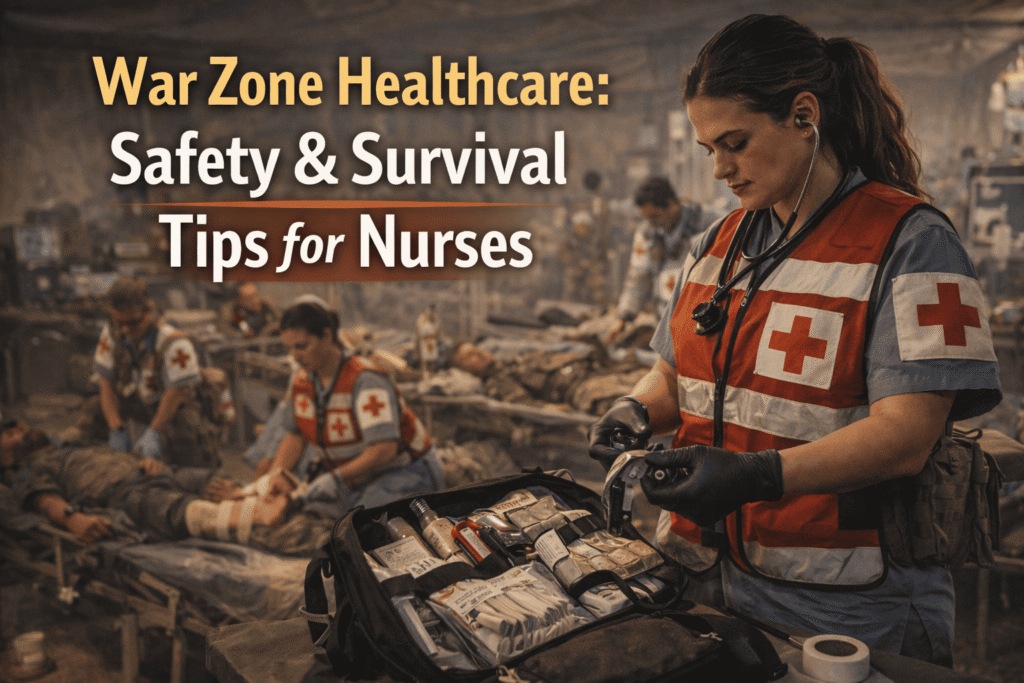
Few settings in the field of contemporary medicine are as physically, psychologically, and morally draining as a war zone. A total change in operational strategy is necessary for nurses, physicians, and nursing students to move from a tranquil, resource-rich hospital to a conflict-driven healthcare system. The objective of healthcare in these high-intensity areas shifts from “optimal wellness” to “maximum survival.” You are no longer merely a physician; instead, you are a frontline responder working under the continual threat of supply chain disruptions, power outages, and bombardment.
Extreme situational awareness and tactical clinical abilities are essential for survival in military nursing. Your ability to stay safe is the only way you can continue to save people, whether you are working in your home country during an armed war or volunteering with a humanitarian organization. This article provides medical personnel with a thorough instruction on how to handle the massive influx of trauma patients with limited resources, traverse the perils of a conflict zone, and uphold their professional integrity.
Situational Awareness and the “Hardened Facility” Protocol
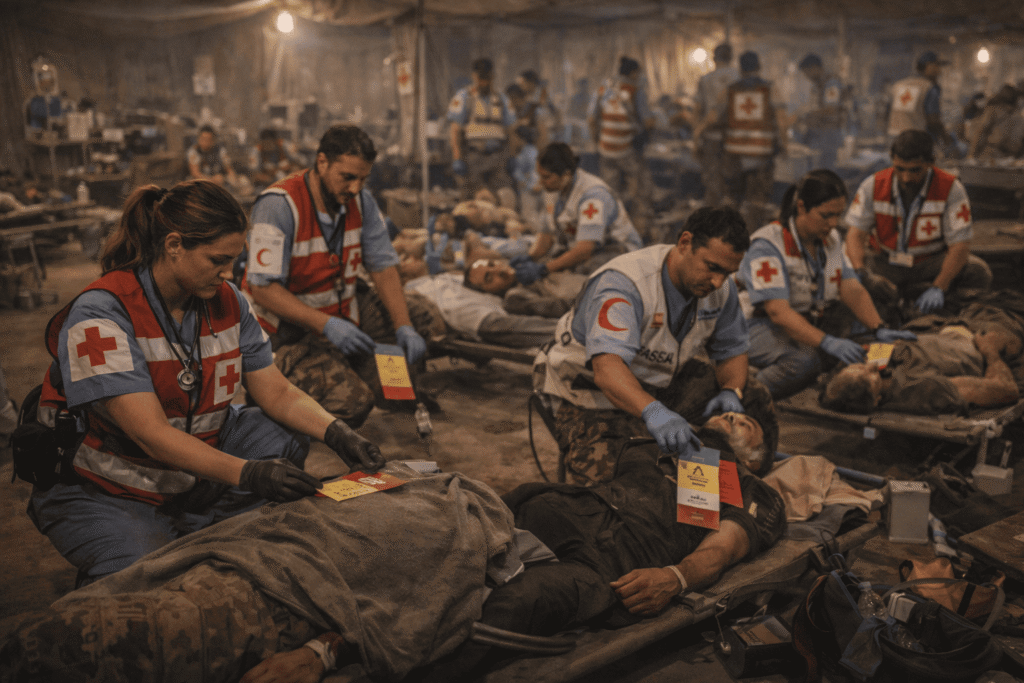
The cornerstone of healthcare in a war area is personal safety. The Geneva Conventions and other international humanitarian law offer hospitals and medical personnel “protected status.” However, this defense is frequently disregarded in contemporary asymmetric combat. As a result, nurses need to become proficient in “Situational Awareness.” This entails continuously keeping an eye out for changes in the front lines, the sound of approaching artillery, or the existence of unidentified armed formations. For each ward you work in, you must have a prearranged “emergency exit” plan and be aware of the “safe routes” to and from your facility.
Employees in the hospital are required to follow “Hardened Facility” procedures. In order to avoid injuries from broken glass and blast waves, patient beds must be moved away from windows. “Basement Medicine”—moving surgical suites and recovery wards to the building’s lowest, most fortified levels—becomes the norm in the case of active bombardment. Additionally, nurses should always wear obvious medical identification, either an armband with a recognized medical symbol or a high-visibility vest. Recall that if you become a casualty yourself, you are unable to administer life-saving care. Keeping your “Physical Perimeter” safe is your first therapeutic responsibility.
Mass Casualty Triage: The Ethics of Scarcity
A Mass Casualty Incident (MCI) occurs when a large number of injured patients arrive at once in a combat zone; this is nearly always more than the staff and supplies that are available. In these situations, Wartime Triage must take the role of conventional nursing practice. This involves classifying patients according to their urgency and chances of survival given the available resources. Because it incorporates the “Ethics of Scarcity,” it is arguably the most challenging skill for a nursing student to acquire.
The START (Simple Triage and Rapid Treatment) approach is commonly employed by nurses. Green (minor injuries), Yellow (delayed but serious), Red (immediate life-threat), and Black (expectant/deceased) are the colors used to tag patients. If there is just one oxygen tank and ten patients in a crisis, the “Red Tag” patient who has the best chance of surviving gets it. It is emotionally taxing to “black tag” a patient who is still alive but whose injuries are too serious to be treated in a situation with limited resources. Effective triage, however, keeps the medical staff from completely collapsing and guarantees that scarce resources, like as sterile bandages and blood supplies, are used where they may save the greatest number of lives.
Tactical Trauma Care: Master of Hemorrhage Control
Uncontrolled bleeding (hemorrhage) is the main cause of death in conflict areas. Whether from gunshot wounds, shrapnel, or building collapses, a nurse needs to be an expert in “Tactical Trauma Care.” This is more than just basic first aid. A Combat Application Tourniquet (CAT) must be able to be applied in the dark, under pressure, and frequently with little help. A tourniquet is a first-line intervention to stop a patient from bleeding out in a matter of minutes, not a “last resort” during a battle.
The MARCH procedure (Massive Hemorrhage, Airway, Respiration, Circulation, Head/Hypothermia) should be adhered to by nurses. In addition to tourniquets, “Wound Packing” with hemostatic gauze is an essential technique for injuries in the neck or groin that a tourniquet cannot reach. Furthermore, blast injuries frequently result in “Blast Lung” or non-visible internal organ damage. Nurses need to be on the lookout for symptoms of “Internal Hemorrhage” or “Tension Pneumothorax” (a collapsed lung that raises blood pressure). You can give trauma patients a “Safety Net” before they can get to a surgical theater by becoming proficient in these manual, high-speed therapeutic abilities.
Resourcefulness and Improvised Medical Support
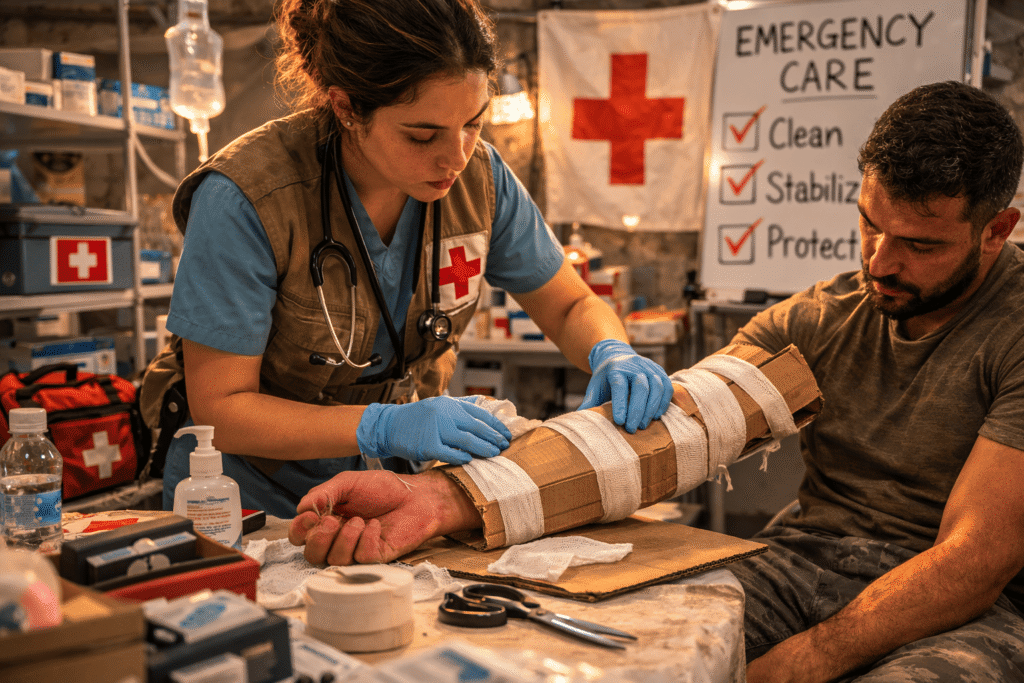
During a conflict, supply chains are the first to disintegrate. You might run out of splints, sterile drapes, or even specific drugs like antibiotics. A “War Zone Nurse” needs to be extremely resourceful and engage in what is commonly referred to as “Improvised Medicine.” This is the capacity to carry out crucial therapeutic tasks using common materials without sacrificing fundamental safety and sanitary standards.
For instance, “Improvised Splints” made of cardboard or wooden boards can be used to stabilize fractures and stop more tissue damage. “Occlusive Dressings” for sucking chest wounds can be made using plastic wrapping found in medical supplies. Nurses must prioritize “Dry Hygiene” and the prudent use of hand sanitizers in regions without running water. The nursing staff must do “Manual Ventilation” (using an Ambu-bag) around-the-clock in the event of an electricity outage. Being creative guarantees that the hospital will continue to be a “Healing Zone” even when it is isolated from the outside world.
Psychological Resilience and Peer Support
Medical personnel are equally affected by the “invisible wounds” of war as patients are. There is a significant danger of Secondary Traumatic Stress and Moral Injury while dealing with large casualties, working under pressure, and making morally challenging judgments. In a conflict zone, burnout is more than just fatigue; it’s a condition of emotional exhaustion that can result in medical mistakes. Nurses need to put “Psychological Resilience” first in order to survive.
This involves the “Buddy System,” in which two nurses watch out for each other’s mental health and make sure that everyone eats, drinks water, and takes quick “Micro-Naps” when circumstances permit. It is crucial to practice “Psychological First Aid” for both yourself and your coworkers, concentrating on urgent requirements and regulating emotions. You have to admit that although the surroundings are “abnormal,” your responses to them are “normal.” The medical team maintains unity and continues to work as a single, life-saving force by helping one another with their mental health.
People Also Ask (FAQ)
Q: Are healthcare workers targeted in wars?
They are protected by international law. Unfortunately, “collateral damage” or deliberate attacks target healthcare facilities in many contemporary conflicts. For this reason, “hardening” your space and avoiding windows is an essential survival strategy.
Q: Can I refuse to treat an enemy combatant?
No. Medical personnel are required by the Geneva Conventions and the Nursing Code of Ethics to treat all injured individuals only on the basis of clinical necessity. No matter which side they are on, an injured person is first and foremost a patient.
Q: What should I keep in my “Personal Survival Kit” on the ward?
A “Go-Bag” with two tourniquets, trauma shears, a headlamp with additional batteries, a permanent marker, a personal water filter, and a high-calorie protein bar should be carried by every nurse in a combat zone.
Q: How do I handle “Moral Injury” after the conflict ends?
Making difficult decisions (such as triage) results in moral harm. Speaking with peer support groups or professional counselors who are knowledgeable in wartime nursing is crucial. You need to remind yourself that you used your resources to do the “Greatest Good” possible.
Q: Can nursing students volunteer in conflict zones?
Numerous humanitarian organizations hire students for support positions (such as documentation, wound treatment, and triage help). Students should only join respectable groups that offer safety training and “Protected Status” identification because it is a high-risk setting.
Useful Documents for every Nursing Student
CV Section Template for Nursing students
AHPRA – NMBA Registration Document Checklist (International Students-Graduates)
Clinical Placement Reflection Template (NMBA-aligned)
Cover Letter Template for Nursing Students
Disclaimer: “I researched this information on the internet; please use it as a guide and also reach out to a professional for assistance and advice.This information is not medical advice, so seek your medical professional’s assistance.”