

Summary
Specialized nursing services are in high demand as a result of the National Disability Insurance Scheme (NDIS), which has completely changed the way disability support is provided in Australia. Being an NDIS Nursing Provider gives nurses a fantastic chance to work on their own, start a business, and give participants individualized, one-on-one care in their homes or communities. On the other hand, the NDIS is a highly regulated setting. To guarantee participant safety and high-quality care, certain legal, clinical, and administrative requirements must be fulfilled; you cannot just start billing the government.
Knowing the NDIS Quality and Safeguards Commission criteria is crucial, regardless of whether you are a Registered Nurse (RN) launching a larger nursing agency or hoping to become a “sole trader.” The complicated world of NDIS provider criteria is broken down into easy-to-manage procedures in this article. We will assist you in making the move from a hospital employee to a prosperous NDIS nursing professional, covering everything from AHPRA registration and insurance to the demanding audit procedure.
Professional Registration and Scope of Practice
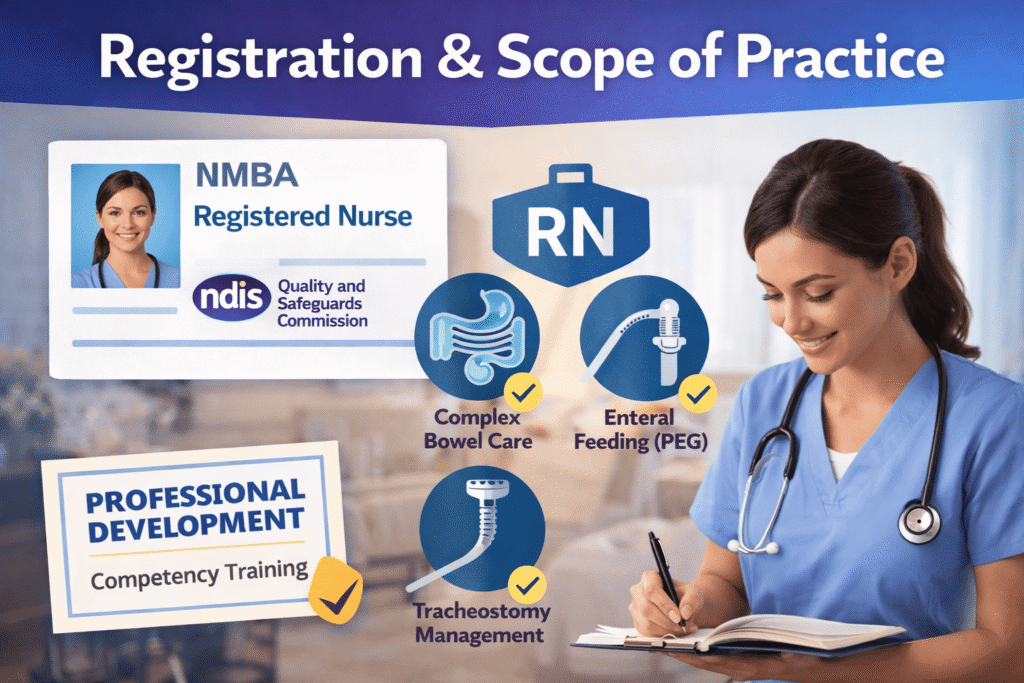
A current and valid registration with the nurse and Midwifery Board of Australia (NMBA) through AHPRA is the first and most important prerequisite for every NDIS nurse provider. Only certified professionals are permitted to provide “Specialist Nursing Health Supports” under the NDIS. This implies that you must be a Registered Nurse (RN) or an Enrolled Nurse (EN) working under an RN’s supervision if you are promoting yourself as a nurse. Any “conditions” or “undertakings” that might prohibit you from giving independent care in a community setting must be removed from your AHPRA registration.
Additionally, you have to work within your scope of practice. As an NDIS provider, you are frequently the main clinical decision-maker in a hospital, where you are supported by a group of physicians and senior nurses. You must make sure you possess the particular abilities needed to meet the needs of your participants, such as Enteral Feeding (PEG), Tracheostomy Management, or Complex Bowel Care. It is both morally and legally required that you seek “professional development” or “competency training” before beginning a service for which you have not received training in a number of years. One of the most important requirements that NDIS auditors will look for during your registration is documentation of your abilities and continued training.
Choosing Between Registered and Unregistered Status
Choosing to operate as an unregistered provider or register as a provider with the NDIS Commission is a crucial choice for any new NDIS nursing provider. You must be a Registered Provider in order to do “High Intensity Daily Personal Activities,” which include the majority of difficult nursing duties like ventilator management or catheter care. Working with participants whose funds are “NDIS Managed” (controlled directly by the government) is made possible through registration. Additionally, you can use “Restrictive Practices” if a behavior support plan calls for them.
It’s easier and requires less paperwork to operate as an unregistered provider, but you can only work with participants who “Self-Manage” their funds or hire a “Plan Manager.” The NDIS Code of Conduct still applies to you even if you are an unregistered provider. This code mandates that you behave honorably, protect participants’ privacy, and deliver services in a competent and safe manner. Because it opens up the entire market of NDIS participants and demonstrates to the community that you have fulfilled Australia’s highest “Gold Standard” of disability care, the majority of professional nursing agencies opt to complete the entire registration process.
The NDIS Audit and Quality Management System
The biggest obstacle for individuals who want to become Registered Providers is the NDIS Audit. You must pass a “Verification” or “Provisional” audit (and subsequently a “Certification” audit) in order to be registered. The majority of nursing providers are required to undergo the Certification Audit since nursing is regarded as a “high-risk” service. This entails having your Quality Management System (QMS) examined by an impartial auditor. Your QMS is a set of documentation, guidelines, and practices that outline your company’s safe operations.
Written policies on participant privacy, risk management, incident management, and complaint handling are essential. For instance, your policy must specify how you report a prescription error to the NDIS Commission within 24 hours. In order to verify that you have completed NDIS Worker Screening Checks (police checks) for both yourself and any employees you hire, auditors will also review your “Human Resources” files. These processes are intended to shield you from legal liability and guarantee that each participant receives consistent, safe, and expert nursing care, even though the paperwork may seem daunting.
Mandatory Insurance and Financial Protections

Even with the finest care, things may go wrong in the high-stakes field of nursing. As a result, both AHPRA and the NDIS Commission mandate that providers have strong insurance. Public liability (PL) and professional indemnity (PI) insurance are typically required for NDIS nursing providers. You are protected by professional indemnity in the event that you make a clinical error, such as failing to identify an infection or applying a complicated wound dressing incorrectly. If a participant or member of the public gets hurt while under your care as a result of a non-clinical mishap, such tripping over your equipment bag in their corridor, you are protected by public liability.
Proof of at least $10 million to $20 million in coverage for both forms of insurance is required by the majority of NDIS contracts and Plan Managers. If you operate for yourself as a “sole trader,” you need to make sure that “NDIS supports” and “Community Nursing” are specifically covered by your policy. You won’t be covered for independent work by standard hospital insurance from a previous company. Additionally, you need to have the proper commercial vehicle insurance if you travel between homes or use a car to transport members. Having the proper insurance is more than just a “tick-box” exercise; it serves as a financial barrier to safeguard both your personal assets and your nursing license in the event that you are sued.
Compliance with the NDIS Practice Standards
You are required to continue adhering to the NDIS Practice Standards after registering. These criteria serve as the benchmarks for superior medical care. The “High Intensity Daily Personal Activities” module is frequently the most pertinent section for nurses. This module specifies how complicated tasks need to be completed and recorded. For example, if you are administering “Subcutaneous Injections,” you must have a “Medication Chart” that complies with the National Residential Medication Chart requirements and a clear “Handover” procedure.
Additionally, you have to take part in the “Participant Choice and Control” criterion. This entails including the patient (as well as their family) in all care decisions. You must jointly draft a “Service Agreement” and a “Care Plan” rather than just deciding what is best for them. The goal of the NDIS is to enable individuals with disabilities to lead fulfilling lives. It is your responsibility as a nurse to give that life the medical support it needs. Regular “Internal Audits” are necessary to stay compliant, where you examine your own files to ensure that you are upholding these exacting requirements each and every day.
People Also Ask (FAQ)
Q: Can an Enrolled Nurse (EN) be a sole trader NDIS provider?
Yes, but with certain restrictions. A Registered Nurse (RN) must constantly provide “direction and delegation” for an enrolled nurse. According to NMBA regulations, an EN must have a formal agreement with an RN to supervise and oversee sophisticated clinical duties if they wish to be an NDIS provider.
Q: How much does it cost to become a Registered NDIS Nursing Provider?
The expenses may be high. A quality management system will cost you between $1,000 and $3,000, insurance premiums will cost you between $800 and $2,000 annually, and the independent audit charge will cost you between $2,000 and $5,000. Many small providers begin as “unregistered” in order to cut expenses while they establish their initial clientele.
Q: Do I need a separate ABN for my NDIS nursing business?
Indeed. You need an Australian Business Number (ABN) in order to conduct business or work as an independent contractor in Australia. You can register as a “Sole Trader,” which is the most straightforward and affordable structure for a lone nurse operating alone.
Q: What is a “Service Agreement” in NDIS nursing?
You and the participant enter into a formal contract through a service agreement. It describes what nursing services you will offer, how much you will charge (based on the NDIS Price Guide), how cancellations will be handled, and how a participant can file a complaint. All NDIS providers are required to have it.
Q: How often do I need to be audited by the NDIS?
After becoming a Registered Provider, you will typically undergo a complete audit every three years, with a lesser “Mid-Term Audit” taking place roughly eighteen months into your registration cycle. This guarantees that when your company expands, you will continue to adhere to the Practice Standards.
Useful Documents for every Nursing Student
CV Section Template for Nursing students
AHPRA – NMBA Registration Document Checklist (International Students-Graduates)
Clinical Placement Reflection Template (NMBA-aligned)
Cover Letter Template for Nursing Students
Disclaimer: “I researched this information on the internet; please use it as a guide and also reach out to a professional for assistance and advice.This information is not medical advice, so seek your medical professional’s assistance.”