
Working in the healthcare sector is a noble yet grueling journey. For nurses and nursing students, the daily routine involves managing high-stress situations, witnessing patient suffering, and standing for long hours on the ward. When you add the spiritual and physical requirements of Ramadan—such as fasting from dawn to sunset and engaging in nightly prayers—the mental load can become significant. Maintaining your mental health isn't just a personal luxury; it is a professional necessity. A nurse who is mentally exhausted is at a higher risk of burnout and clinical errors.
This guide explores how healthcare workers can protect their psychological well-being during the holy month. We will look at the connection between physical fasting and mental clarity, strategies for managing "compassion fatigue," and practical ways to practice self-care amidst a chaotic hospital schedule. By prioritizing your mind, you can serve your patients and your faith with a heart that is full rather than drained.
1. The Connection Between Fasting and Cognitive Resilience
Many people worry that fasting will make them "brain fogged" or irritable on the job. While the initial few days of Ramadan can be a challenge as the body adjusts to a different metabolic rhythm, there is a fascinating psychological side to fasting known as cognitive resilience. For many nurses, the act of fasting provides a sense of discipline and mental "cleansing." However, the key to maintaining this mental sharpness lies in how you manage your glucose levels and hydration during the non-fasting hours. When your brain is deprived of steady fuel, the "amygdala"—the part of the brain that handles emotions—can become more reactive, leading to feelings of "hangry" or short-temperedness with colleagues and patients.
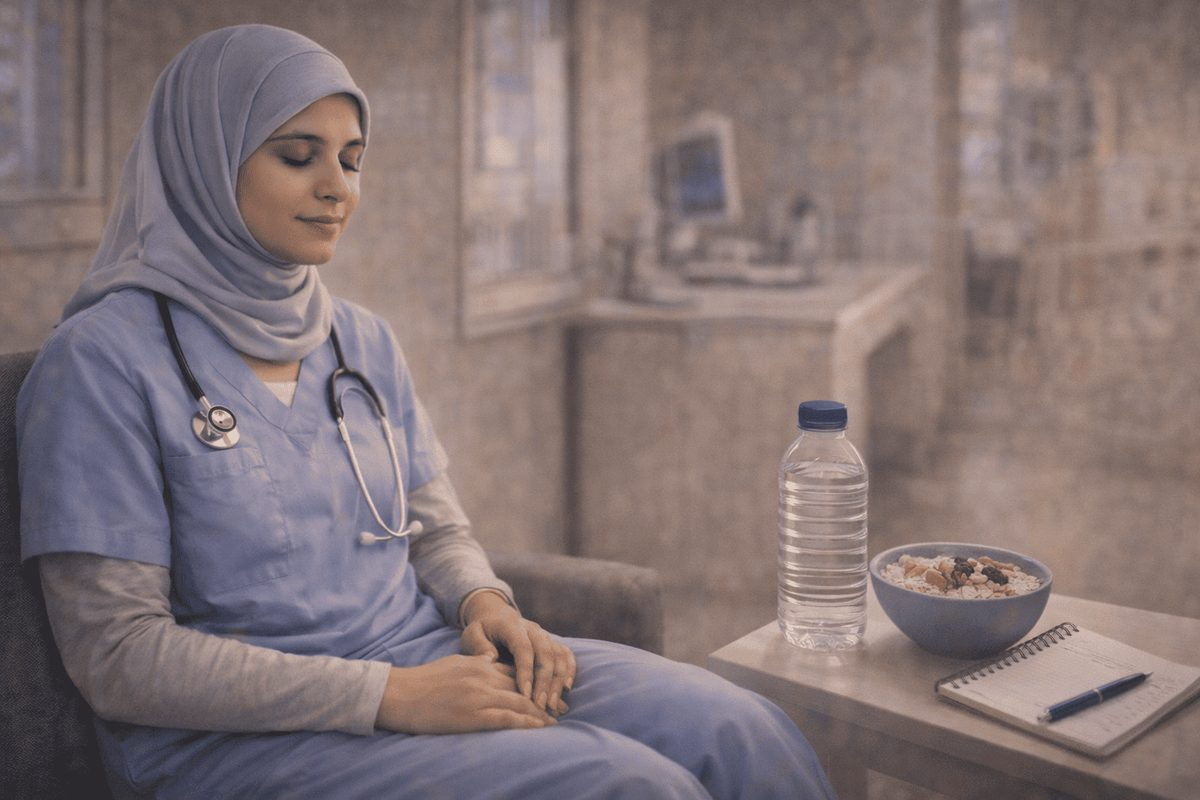
To protect your mental clarity, focus on "brain foods" at Suhoor. Omega-3 fatty acids found in walnuts and seeds, along with slow-release carbohydrates like oats, act as a stabilizing force for your mood. By preventing sharp spikes and crashes in blood sugar, you avoid the emotional "rollercoaster" that often leads to workplace stress. Additionally, acknowledging that you might be more tired than usual allows you to practice mindfulness. Taking just sixty seconds between patient visits to practice deep breathing can reset your nervous system, moving you from a state of "fight or flight" back into a state of calm, professional focus.
2. Managing "Compassion Fatigue" on the Ward
Nurses are the primary emotional support system for patients. This role can lead to "compassion fatigue"—a state where you feel emotionally blunted or overwhelmed by the suffering of others. During Ramadan, your emotional reserves may feel thinner because you are physically depleted. You might find it harder to offer the same level of empathy to a difficult patient or a grieving family. It is important to understand that this isn't a sign that you are a "bad nurse"; it is a physiological response to the extra demands being placed on your body and soul.
To combat this, midwives and nurses should practice "emotional boundaries." This means being present for your patients while also recognizing that you cannot carry their burdens as your own. During the month of Ramadan, try to use your spiritual practice as a shield. Many nurses find that offering a silent prayer for their patients during the day provides a sense of purpose and connection without draining their own emotional energy. Remember, self-care is a form of "stewardship." By taking care of your own heart, you ensure that you have the strength to continue being a source of mercy for those under your care.
3. The Power of "Micro-Self-Care" for Busy Students

Nursing students often feel they have no time for self-care. Between attending lectures, completing clinical hours, and studying for exams, the idea of a "spa day" or a long walk seems impossible. This is where micro-self-care comes in. These are small, 5-minute actions that help regulate your stress levels throughout the day. For a fasting student, this might look like stepping into a quiet breakroom and using a cooling facial mist, or listening to a calming recitation or podcast during your commute to the hospital.
Another vital aspect of self-care is learning to say "no." During Ramadan, there are many social invitations for large Iftar gatherings. While community is a huge part of the month, a nursing student on a 12-hour rotation needs to prioritize sleep and quiet time. It is perfectly okay to decline social events if it means you can get an extra two hours of rest. Protecting your peace of mind is essential for your academic success and your clinical performance. Real self-care isn't always about "doing" more; often, it is about "doing" less so your mind can recover from the high-pressure environment of the hospital.
4. Navigating Workplace Stress and Communication

The hospital environment is rarely quiet, and tension can run high during shift changes or emergencies. For a fasting nurse, the sound of a monitor alarm or a demanding supervisor can feel twice as loud. Effective communication is your best tool for reducing workplace stress. Don't be afraid to let your team know you are fasting. Most colleagues are supportive and may even offer to handle more physically taxing tasks during the late afternoon when they know your energy might be dipping.
If you feel a conflict arising with a co-worker, practice the "Ramadan Pause." This is the habit of waiting three seconds before responding to a stressful comment. Since fasting is as much about "fasting from anger" as it is from food, this practice serves both your spiritual goals and your professional reputation. If the stress becomes overwhelming, speak to your mentor or supervisor about "shift-splitting" or taking your breaks at times that align with your lowest energy points. A supportive work environment is built on transparency, and being honest about your needs helps prevent the buildup of resentment and anxiety.
5. Spiritual Fulfillment as a Buffer Against Burnout
One of the unique aspects of being a Muslim nurse is the ability to view clinical work as a form of Ibadah (worship). When you realize that every pillow you fluff, every medication you give, and every hand you hold is an act of charity, the "work" feels less like a burden and more like a blessing. This shift in perspective is a powerful buffer against burnout. Research in positive psychology shows that finding meaning in your work significantly reduces the risk of depression and chronic stress.
During the long hours of the fast, remind yourself of the rewards associated with serving the sick. This spiritual "reframing" can give you a second wind when you are feeling physically exhausted. Instead of focusing on the hunger or the thirst, focus on the privilege of being the person someone relies on in their most vulnerable moments. By connecting your professional duties to your spiritual values, you create a sense of internal harmony. This doesn't mean the work isn't hard, but it means the hardness has a purpose. This sense of purpose is the ultimate form of self-care, providing a deep well of mental strength that lasts long after Ramadan has ended.
🌙 The Mindful Nursing Journal: Ramadan Edition
🌅 Part 1: The Morning Intention (Pre-Shift / Suhoor)
Before the chaos begins, set the "tone" for your nervous system.
Today’s Purpose: Aside from clinical tasks, what is one quality I want to show my patients today? (e.g., patience, gentleness, active listening).
My quality for today is: ___________________________
The "Act of Worship" Reminder: Remind yourself: "Every step I take for a patient is a step of charity."
Physical Check: How does my body feel right now? (Scan from head to toe). Where am I holding tension? (Release your jaw, drop your shoulders).
🏥 Part 2: The Mid-Shift "Reset" (The 60-Second Pause)
Do this during a handoff, after a difficult patient interaction, or while washing your hands.
Breath Prayer: Inhale for 4 seconds, hold for 4, exhale for 4.
Silent Phrase: (Inhale) "I am calm…" (Exhale) "I am capable."
Grounding (5-4-3-2-1): * Name 5 things you see (The monitor, the IV bag, the floor tile…)
Name 4 things you can touch (Your scrub fabric, the pen, the cold sink…)
Name 3 things you hear (The hum of the AC, footsteps, a distant beep…)
Name 2 things you smell (Sanitizer, coffee in the distance…)
Name 1 thing you are grateful for right now.
🌇 Part 3: The Iftar/Post-Shift Reflection
Decompressing and letting go of the hospital’s weight.
The "Handoff" of Burdens: As you leave the hospital, mentally "leave" the patient’s worries at the door. You have done your best; the rest is out of your hands.
Today’s Small Win: What is one thing that went well today? Even if it was just successfully inserting a difficult IV or a patient saying "thank you."
My win: ___________________________
Compassion Check: Was I kind to myself today? If I was tired or made a minor mistake, do I forgive myself?
Evening Gratitude: Name one blessing you noticed today that had nothing to do with work.
💡 Weekly Mental Health Check-In
Every Friday (or your day off), answer these two questions honestly:
Am I "Emptying the Cup"? Am I talking to someone (friend, spouse, or mentor) about the emotional things I saw this week, or am I bottling them up?
The Burnout Gauge: On a scale of 1–10, how heavy does my heart feel?
If above 7: It is time to prioritize 8 hours of sleep and perhaps skip a social gathering to rest.
A Note for the Fasting Nurse:
"Your hands are the hands that provide comfort when people are at their weakest. Even if you feel 'empty' of energy, your heart is performing a great service. Be gentle with yourself—you are doing enough."
Frequently Asked Questions
Q: I feel guilty because I’m too tired to pray Taraweeh after a long shift. What should I do? A: It is important to remember that as a nurse, your work is a form of service. If you are physically exhausted to the point where you cannot perform extra prayers safely, prioritize your obligatory prayers and your sleep. Islam is a religion of balance. You can engage in "Dhikr" (remembrance) while you work or during your commute, which carries great reward without requiring extra physical standing.
Q: How can I handle the "brain fog" during afternoon clinicals? A: Brain fog is often caused by a dip in hydration or blood sugar. Since you cannot eat, try a "sensory reset." Splash cold water on your face, or if your workplace allows, use a scent like peppermint or citrus to alert your senses. Also, ensure you are eating "slow-burn" carbs like oats or sweet potatoes at Suhoor to keep your brain fueled for longer.
Q: What if I feel like crying or I’m extra emotional during my shift? A: This is very common. Fasting can make your emotions feel more "on the surface." If you feel overwhelmed, find a private space—like a supply closet or a bathroom—and give yourself two minutes to breathe. Acknowledge the feeling without judgment. It is okay to be human. If the feeling persists, talk to a trusted friend or a professional counselor.
Q: How do I deal with non-Muslim colleagues who don't understand why I’m fasting? A: Most people are curious rather than judgmental. Use it as an opportunity for a simple, friendly explanation. You can say, "I’m fasting for Ramadan to practice self-discipline and gratitude. It’s a bit challenging, but it’s very meaningful to me!" Most people will respect your dedication once they understand the "why" behind it.
Q: Is it okay to take a mental health day during Ramadan? A: Absolutely. If you feel that your mental health is deteriorating and it is affecting your ability to care for patients safely, you should follow your hospital’s protocol for taking a sick day. Taking one day to rest and "reset" can prevent a much longer period of burnout later on.