


Summary
One of the most important tasks for nursing students who wish to study, work, or register as a nurse in Australia is selecting the appropriate English test. IELTS, OET, and PTE Academic are the three main English tests that are acceptable for nursing in 2026. Every test has a unique format, degree of difficulty, and score requirements. The Nursing and Midwifery Board of Australia (NMBA) is a test that many overseas nursing students are unsure about which is the easiest, which is appropriate for their talents, and which offers them the best chance of registering. During their quest to become a nurse in Australia, students can save time, money, and stress by being aware of the differences between these exams.
The required scores, exam difficulty, processing time, test style, and the ideal exam for nursing students in 2026 are all explained in detail in this book.
Why English Tests Are Required for Nursing in Australia

Nursing standards are highly valued in Australia. Every nurse must communicate effectively with patients, physicians, and healthcare teams in order to ensure patient safety. For this reason, international nursing students and graduates are required by the NMBA and the Australian Health Practitioner Regulation Agency (AHPRA) to demonstrate their command of the English language.
The results of an English test have an impact on a number of crucial processes, including the approval of student visas, university entrance, clinical placement eligibility, graduate visa paths, and ultimate AHPRA registration as a registered nurse or enrolled nurse. Many students experience delays or are unable to begin their nursing careers in Australia if they do not receive the proper English test score. For this reason, it’s crucial to select the right exam right away.
IELTS for Nursing in Australia (2026 Requirements & Details)

For many years, one of the most popular English tests for nurses has been the IELTS. All Australian universities, employers, nursing boards, and visa authorities accept it. IELTS offers two exam formats, but only IELTS Academic is approved for nursing registration.
IELTS primarily assesses students’ comprehension of academic English in authentic healthcare environments. The score requirement for nurses is still stringent in 2026. Candidates must receive a minimum score of 7.0 in each of the following bands in order to register with AHPRA as nurses: speaking, reading, writing, and listening. Although AHPRA occasionally permits a combination of two sittings provided the results meet certain requirements, students must obtain this score in a single sitting.
The writing portion of the IELTS is perceived by many students as being difficult. Strong grammar, paragraph organization, and academic vocabulary are necessary for the writing assignments. Nonetheless, the format of the IELTS is predictable, which aids in students’ preparation. Students who can speak comfortably in person may benefit from the speaking portion, which is conducted face-to-face with an examiner.
Despite the fact that IELTS was not created with healthcare professionals in mind, many students select it for the straightforward reason that it is widely accessible, reasonably priced, and universally recognized.
IELTS (Academic)
Required Score: 7.0 each band
Best For: Students confident with academic writing and face-to-face speaking.
Difficulty: Writing is challenging for most students.
Result time: 3–6 days.
OET for Nursing in Australia (2026 Requirements & Why It’s Popular)

The Occupational English Test (OET) was created specifically for nurses and other healthcare workers. OET uses writing assignments, vocabulary, and scenarios relating to healthcare, in contrast to IELTS and PTE. As a result, the test is frequently simpler to comprehend and more pertinent to nursing students. OET assigns students to write nurse letters, patient discharge summaries, or medical referral notes rather than writing about broad subjects like the environment or technology. These duties correspond to the everyday communication that Australian nurses are expected to perform.
AHPRA mandates that nurses receive at least a Grade B in each of the four components speaking, listening, reading, and writing by 2026. Because test settings feel familiar to students, OET is thought to be more nurse-friendly and less stressful. For instance, the speaking exam includes patient role-plays, providing pupils with a natural way to communicate.
However, the primary drawback of OET is its expense. Generally speaking, it costs more than PTE and IELTS. Due to the lengthy recordings from real-world healthcare scenarios, some students also find the listening portion challenging. However, because it closely relates to nursing responsibilities, OET continues to be the most popular exam among Australian nurses.
OET (Nursing)
Required score: B in all sections
Best for: Students who want healthcare-based tasks and real nursing scenarios.
Difficulty: Listening and writing can be tough but content is familiar.
Result time: 10–16 days.
PTE Academic for Nursing in Australia (2026 Requirements & Benefits)

In recent years, PTE Academic has become increasingly popular among nursing students. There are no human examiners, no in-person interviews, and no handwritten essays because it is completely computer-based. PTE results are frequently higher for students who excel in typing and computer-based learning. Students who are uncomfortable speaking in front of examiners can feel less anxious because the speaking portion is recorded using a microphone.
The minimal PTE score for nursing registration in 2026 will be 65 in each of the following categories: speaking, listening, reading, and writing. Students who require urgent English proof for visas or AHPRA filing might benefit from the test’s quick results, which typically appear in two to three days.
PTE’s automated scoring system presents a problem. Pronunciation, intonation, speed, and clarity become crucial when responses are verified by a computer program. Students may receive lower grades if they talk too quickly, too slowly, or with a noticeable accent. Additionally, the test contains question types like “Repeat Sentence” and “Re-order Paragraphs,” which are challenging for novices and do not appear in IELTS or OET.
Despite these difficulties, PTE continues to be a popular option for many overseas students because of its fast results and consistent question formats.
PTE Academic
Required score: 65 each component
Best for: Students comfortable with computer-based tests.
Difficulty: Computer scoring can be strict.
Result time: 2 to 3 days.
IELTS vs OET vs PTE: Which Is the Best Choice for Nursing Students in 2026?
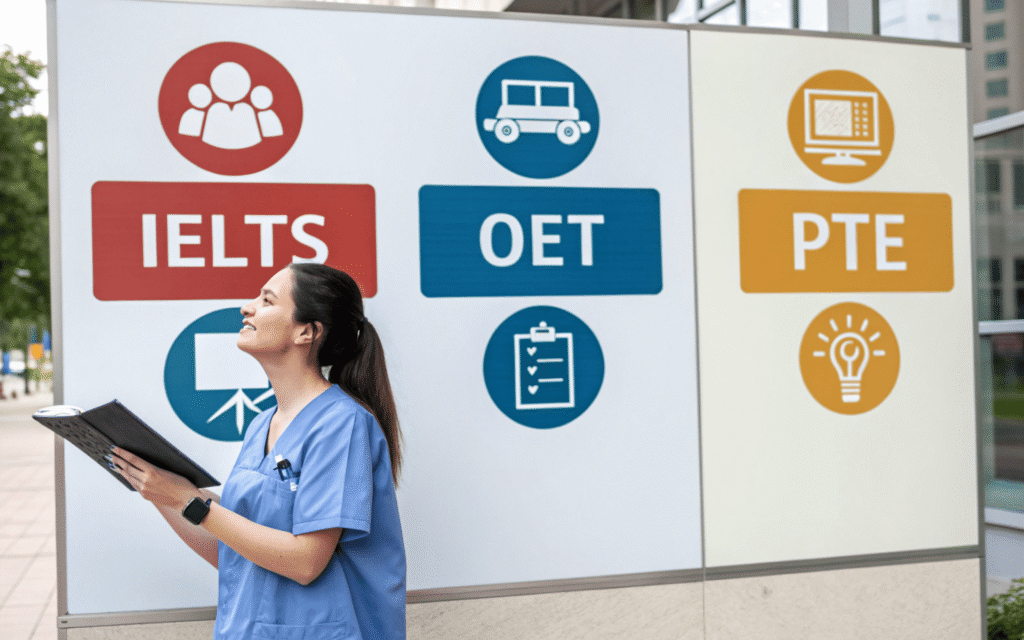
The student’s talents, weaknesses, background, and study style all play a role in selecting the appropriate English exam. Students who are at ease with academic writing and face-to-face communication should take the IELTS. For individuals seeking genuine nurse communication activities and healthcare-related information, OET is ideal. For students who prefer computer-based tests, quick results, and no human interaction, PTE is perfect.
OET frequently becomes the simplest choice for many nursing students since it aligns with their practical expertise. Confusion during reading and listening assignments is decreased by using well-known medical terminology. However, some students might find the expense prohibitive, particularly if they are paying for repeated exam tries.
Because the computer evaluates their speaking abilities, students who are excellent writers but have trouble speaking frequently select PTE. IELTS, on the other hand, is appropriate for pupils who favor conventional testing forms and precise scoring standards. Although there are benefits to each test, comfort is the most crucial consideration. Students should select an exam that they can confidently study for and pass with the necessary scores.
People Also Ask
1. Which English test is easiest for nurses in Australia?
Most students find OET easier because it uses nursing vocabulary and realistic workplace scenarios.
2. Can I combine test results for nursing registration?
AHPRA sometimes allows combining two test sittings for IELTS and OET, but strict rules apply. PTE results cannot be combined.
3. Which English test is fastest for results?
PTE Academic gives results within two to three days, making it the fastest option.
4. Does AHPRA accept all three tests in 2025?
Yes, IELTS Academic, OET, and PTE Academic are all accepted for nursing registration.
5. What happens if I fail one component of the test?
You must retake the exam or apply for a resit option (available only for OET). AHPRA requires minimum scores in every section.
Useful Documents for every Nursing Student
CV Section Template for Nursing students
AHPRA – NMBA Registration Document Checklist (International Students-Graduates)
Clinical Placement Reflection Template (NMBA-aligned)
Cover Letter Template for Nursing Students
Disclaimer: “I researched this information on the internet; please use it as a guide and also reach out to a professional for assistance and advice.This information is not medical advice, so seek your medical professional’s assistance.”