


Summary
One of the most common and most feared questions in graduate nurse applications is:
“Why do you want to work at this hospital?”
Even though almost all nursing students are aware that this issue will come up, many still find it difficult to provide a strong response. Lack of interest is not the issue. The issue is that the majority of responses sound cliched, practiced, or lifted verbatim from hospital websites.
Every intake, recruiters for graduate nurses review hundreds or thousands of applications. Applications soon melt together when people see the same terms repeatedly, such as “excellent reputation,” “supportive learning environment,” and “values align with mine.”
Nursing students will learn from this article how to respond to the question “Why this hospital?” in a straightforward, sincere, and unique manner. You will examine instances of strong and weak answers, grasp a basic research strategy, and comprehend precisely what recruiters are looking for.
This manual was created especially for Australian graduate nursing applications and uses simple English that students can easily understand and apply.
Why “Why This Hospital?” Matters So Much in Graduate Nurse Applications
Graduate nurse programs are not just about skills. Hospitals are investing time, money, and supervision into new nurses. They want graduates who:
- Understand the organisation
- Are genuinely interested in that hospital
- Are likely to stay and grow
When a student gives a generic answer, recruiters may think:
- The student applied everywhere without thinking
- The student does not understand the hospital
- The student may leave quickly
This question helps employers decide who is truly interested versus who is just applying broadly.
A strong answer can make an average resume stand out. A weak answer can undo an otherwise good application.
Why Most Nursing Students Sound Generic (Without Realising It)
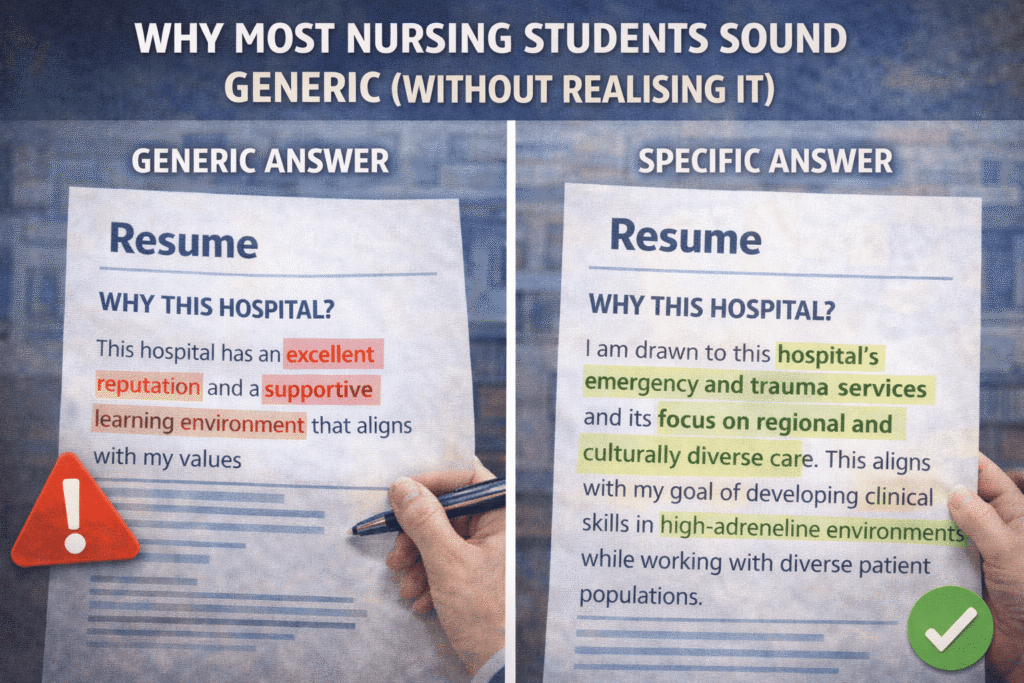
Many students unintentionally fall into frequent traps even though they think they are answering the question correctly.
Copying words from hospital websites is one of the main causes. Nearly all healthcare websites use terms like “patient-centered care,” “excellence,” and “quality outcomes.” Students’ responses seem hollow when they repeat these terms without providing personal context.
Answering the question too broadly is another problem. Declaring your desire to work at a hospital because it is “large” or “well known” does not explain why you would be a good match there.
Lastly, a lot of students simply discuss what they will benefit from rather than what they can offer. Recruiters for recent graduates are looking for reciprocal benefits.
The first step to creating a compelling response is to recognize these errors.
The Simple Research Framework That Makes Your Answer Stand Out
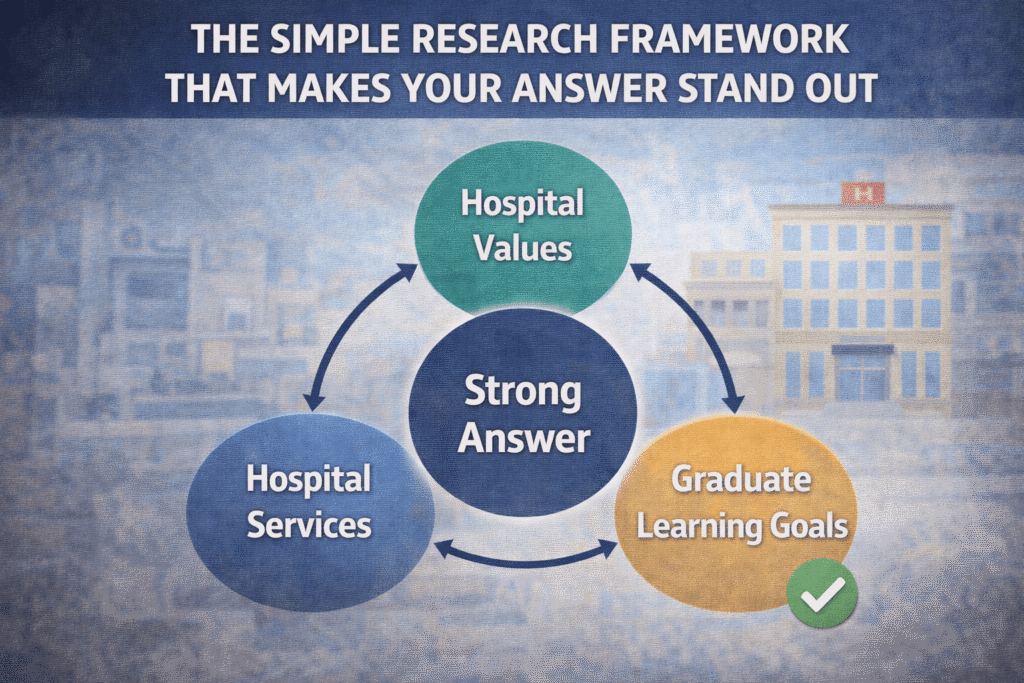
To avoid sounding generic, you need a clear research framework. This does not mean spending hours reading everything about the hospital. It means researching the right things.
A strong answer is built on three research pillars:
- The hospital’s focus and services
- The hospital’s values and culture
- Your personal learning goals as a graduate nurse
When these three elements connect, your answer feels genuine and specific.
Research Pillar 1: Understand the Hospital’s Services and Patient Population
Instead of saying the hospital is “excellent,” look at what it actually does.
Ask yourself:
- Is it a tertiary hospital or community hospital?
- Does it specialise in trauma, mental health, oncology, or aged care?
- Does it serve a diverse or regional population?
For example, a hospital with a strong emergency and trauma service offers very different learning opportunities than a smaller community hospital.
When students mention specific services, recruiters immediately see effort and interest.
Research Pillar 2: Learn the Hospital’s Values—But Don’t Copy Them
Most hospitals publish values such as respect, compassion, integrity, and teamwork. Simply repeating these words is not enough.
Instead, think about:
- Which value genuinely connects to your placement experiences?
- How have you seen that value in action during placements or work?
For example, if a hospital emphasises teamwork, explain how teamwork supported safe care during your placement. This turns abstract values into lived experience.
Research Pillar 3: Connect the Hospital to Your Graduate Learning Goals
Graduate programs are about development. Hospitals want graduates who understand what they want to learn and why that hospital is the right place to learn it.
Think about:
- Clinical exposure you want
- Support structures you value
- Areas you want to grow in
This shows self-awareness and motivation, both highly valued in graduate nurses.
Strong vs Weak Answers: What Recruiters Actually Notice
Understanding the difference between strong and weak answers can completely change how you write.
Example of a Weak Answer (Generic)
“I want to work at this hospital because it has a strong reputation for excellence and provides high-quality patient-centred care. I believe this environment will support my development as a graduate nurse.”
Why this fails:
- Could apply to almost any hospital
- No specific service or feature mentioned
- Focuses only on what the student gains
- No personal connection
Recruiters see versions of this answer repeatedly.
Example of a Strong Answer (Specific and Genuine)
“This hospital’s broad patient mix and strong emphasis on acute medical and surgical services are what drew me in. I discovered during my clinical internships that I learn best in hectic settings where cooperation and effective communication are crucial. Because I appreciate structured feedback and supervised skill improvement, I am especially drawn to this hospital’s emphasis on supported graduate rotations. This setting, in my opinion, supports my objective of providing safe, patient-centered care while establishing solid clinical underpinnings.”
Why this works:
- Mentions specific services
- Links experience to hospital environment
- Shows learning goals
- Sounds thoughtful and genuine
How to Structure Your Answer Step by Step
A strong answer does not need to be long or complex. It needs to be structured.
A simple structure that works well is:
- Start with a specific hospital feature
- Link it to your experience or interest
- Explain how it supports your graduate development
This structure keeps answers focused and avoids rambling.
Common Mistakes That Instantly Weaken Your Answer
When responding to this question, even proficient pupils make preventable errors.
Overpraising the hospital without proof is one error. Recruiters favor thoughtful, well-rounded responses over overly enthusiastic ones.
Being overly ambiguous is another problem. Sayings like “I like the culture” are meaningless unless they are accompanied by an explanation.
Additionally, several students express a desire for the hospital due to its proximity to their homes. Location is important, but it should never be the primary justification.
Lastly, it can be dangerous to duplicate responses from friends or online examples. Repeated phrases in applications are frequently noticed by recruiters.
How Long Should Your Answer Be?
Graduate nurse applications often limit word counts. Most answers work well between 150–250 words.
Quality matters more than length. A short, specific answer is better than a long, generic one.
Always check the application instructions and stick to them.
Adapting the Answer for Interviews vs Written Applications
Although the delivery varies, the same main point can be made in both written applications and interviews.
Clarity and organization are crucial in written applications.
Authenticity and confidence are more important during interviews. Instead of sounding memorized, you should seem natural.
You can make sure your response sounds authentic and not staged by practicing it aloud.
Why This Question Is Really About Fit
At its core, “Why this hospital?” is a question about fit.
Recruiters want to know:
- Do you understand our environment?
- Will you engage with our program?
- Are you likely to grow here?
When you answer thoughtfully, you show maturity, insight, and professionalism—qualities hospitals want in graduate nurses.
Final Thoughts: Specific Beats Perfect Every Time
You do not need to say the “perfect” thing. You need to say something specific and honest.
A well-researched, clearly structured answer tells recruiters that you:
- Took the application seriously
- Understand the hospital
- Are motivated to learn
That alone can set you apart from many other applicants.
People Also Ask
1. Why do hospitals ask “Why this hospital?”
To assess interest, fit, and commitment.
2. Can I use the same answer for every hospital?
No, answers should be tailored to each hospital.
3. How much research is enough for this question?
Enough to mention specific services, values, and learning opportunities.
4. What makes an answer sound generic?
Vague praise without personal connection or evidence.
5. Is it okay to mention learning goals as a graduate nurse?
Yes, hospitals value self-awareness and development focus.
Useful Documents for every Nursing Student
CV Section Template for Nursing students
AHPRA – NMBA Registration Document Checklist (International Students-Graduates)
Clinical Placement Reflection Template (NMBA-aligned)
Cover Letter Template for Nursing Students
Disclaimer: “I researched this information on the internet; please use it as a guide and also reach out to a professional for assistance and advice.This information is not medical advice, so seek your medical professional’s assistance.”