

Summary
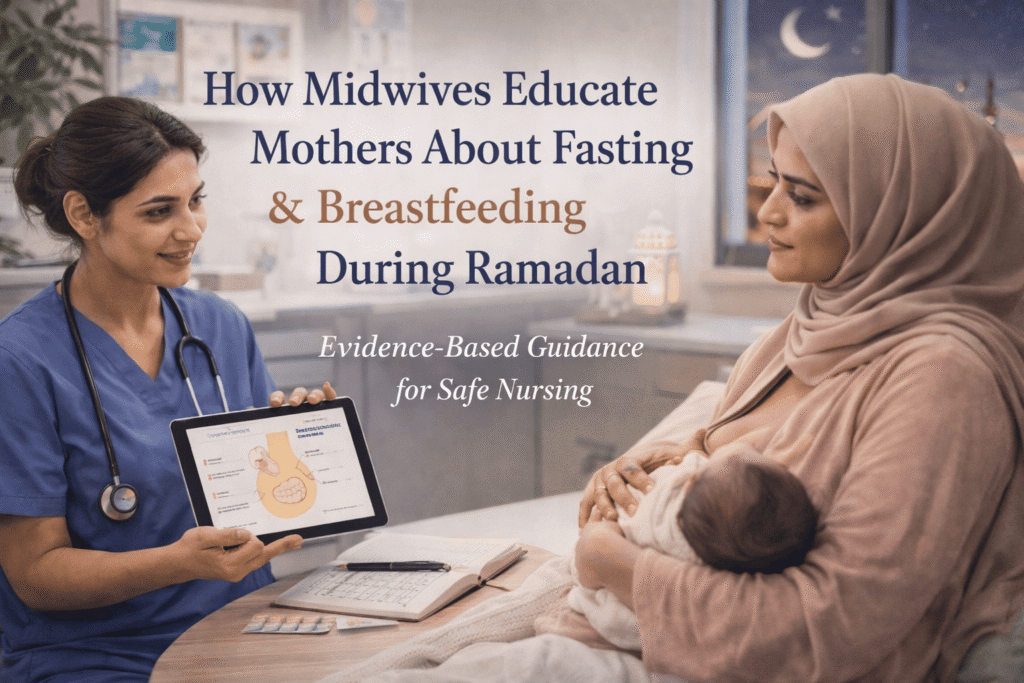
When Ramadan arrives, a lot of Muslim women want to follow the spiritual custom of fasting. However, this desire is frequently met with a barrage of inquiries when a woman is nursing: Will my milk become dry? Is my infant going to be hungry? Is my personal health at risk? In this situation, midwives play a crucial role as clinical advisors and educators. Their job is to deliver evidence-based knowledge that strikes a balance between the mother’s religious beliefs and the infant’s and mother’s biological demands.
A midwife’s instruction is more than just a “yes” or “no.” It is a safety road map. Midwives assist moms in identifying the distinct symptoms of dehydration as well as the physiology of breastfeeding, which explains how the body produces milk even when food intake is restricted. Midwives guarantee that the experience of Ramadan is one of spiritual fulfillment rather than physical anxiety by arming mothers with knowledge.
Explaining the Physiology of Lactation and Fasting

Explaining how the female body makes milk is the first step in a midwife’s instructional arsenal. Many mothers worry that their breasts would just stop making milk if they go 12 to 15 hours without eating. Mothers are taught by midwives that the body is extraordinarily robust. The mother’s fat reserves and blood are used to make breast milk. Even after a fast, the short-term nutritional quality of breast milk the lipids, proteins, and vitamins remains extremely steady. In order to maintain the milk’s ability to support life, the body will give the baby priority and draw nutrients from the mother’s own reserves.
Additionally, midwives teach that even when the quality of the milk is still excellent, the mother’s level of hydration may affect the quantity (volume) of milk produced. If a mother is severely dehydrated, her blood volume may drop, which could lead to a slower “let-down” reaction or less milk produced overall. Midwives use this scientific explanation to help mothers understand that what they eat in the hours between Iftar and Suhoor is crucial to the “success” of fasting while nursing. Understanding that their bodies are reservoirs, mothers can focus on “filling the tank” at night to sustain the “output” throughout the day.
Identifying “Red Flags” for Maternal and Infant Health

Teaching moms how to be their own “clinical monitors” is an essential component of a midwife’s training. The mother must be aware of the precise moment when a fast needs to be broken because a midwife cannot be with her all the time. Midwives give mothers a list of symptoms to look out for in themselves. Extreme thirst, black urine, a pounding headache, dizziness that doesn’t go away with rest, or feeling particularly lightheaded are some of these symptoms. These indicate a potentially dangerous alteration in the mother’s blood pressure or electrolyte balance.
More significantly, midwives instruct mothers on how to keep an eye on their infants. A baby cannot tell you if they are dehydrated, therefore the mother must search for outward signs. Midwives provide instruction on the “Wet Diaper Test.” In a 24-hour period, a healthy, well-hydrated baby should have at least 6 to 8 heavy, wet diapers. The baby’s behavior is another indicator that the midwife teaches: is the infant unusually lethargic and “floppy” or alert and active? Does the baby’s tongue appear dry or is their mouth moist? By providing moms with these particular clinical indicators, the midwife shifts the discussion from “guesswork” to “observation,” guaranteeing that the baby’s safety is never jeopardized.
Strategic Nutrition and Hydration Education
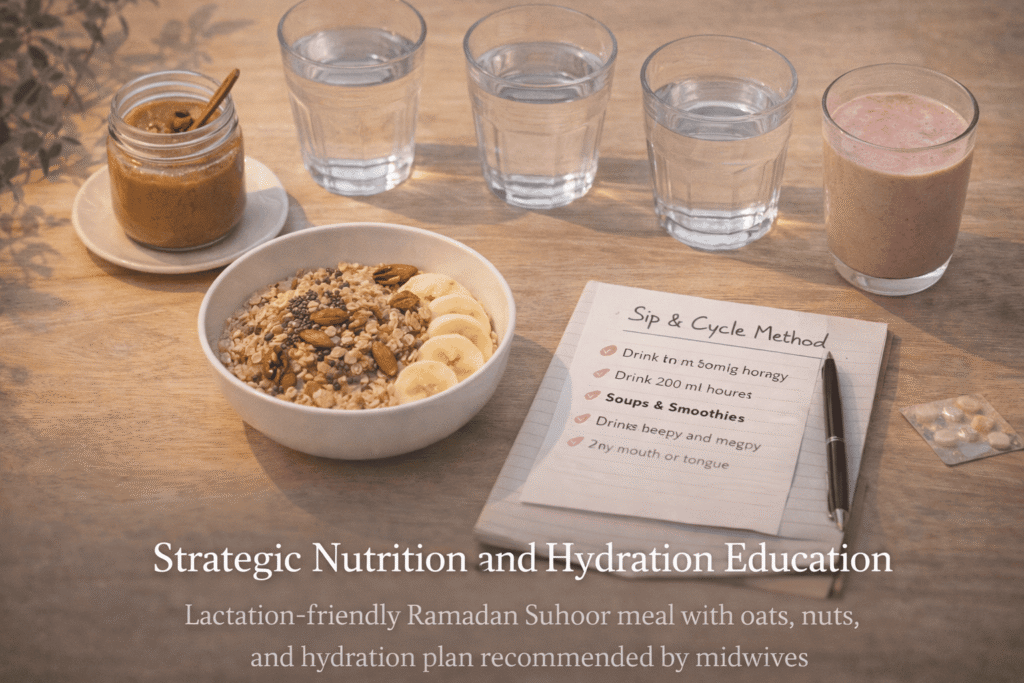
During Ramadan, midwives serve as specialist nutritionists, assisting women in creating “lactation-friendly” meal plans. High-density nutrition is the main topic of instruction. At Suhoor, midwives advise against consuming “empty calories” like white bread or sugary candies. Rather, they suggest “lactogenic” foods, which are known to promote the production of milk. This includes leafy greens, flaxseeds, almonds, and oats, which are high in fiber and iron. The midwife at Suhoor could recommend a big dish of oats with almond butter and chia seeds, which offers high protein and slow-burning energy.
Education on hydration is equally thorough. The “Sip and Cycle” approach is frequently taught by midwives. Mothers are instructed to drink 200 milliliters of water every hour they are awake during the night instead of downing a liter of water during the morning prayer, which the body will simply flush out. Soups, stews, and smoothies are examples of “liquid foods” that midwives recommend since they are hydrating and high in calories. They stress the need to stay away from coffee because it can serve as a diuretic and even find its way into breast milk, making the infant fussy or unable to fall asleep. The goal of this dietary guidance is to maintain the mother’s energy levels throughout the extended fasting period.
Navigating the Religious Exemptions with Compassion
Giving “permission” is one of the most important things a midwife can do. If they are unable to fast, many moms experience intense guilt because they believe they are not fulfilling their religious obligations. moms are reminded by midwives—who frequently collaborate with religious academics or use culturally sensitive materials—that Islam clearly exempts nursing moms if they are concerned about the health of the infant or themselves. If the medical evidence indicates that fasting is dangerous, the midwife’s job is to support the mother’s decision to not fast.
Mothers are taught by midwives that “taking the exemption is an act of worship.” The mother is upholding a fundamental Islamic ideal by safeguarding the child’s life and well-being. Clinical counsel is crucial, but so is this emotional and spiritual instruction. It lowers the mother’s stress levels, and excessive levels of stress are believed to be a “milk killer” since they prevent the release of the hormone oxytocin. Whether or not she fasts, a mother’s breastfeeding journey is far more likely to be successful when she feels encouraged and content with her choice.
Transitioning to “Intermittent Fasting” Models
Midwives may recommend a “gradual” or “intermittent” strategy for moms who are committed to fast but are concerned about their milk supply. The mother may fast every other day or only on weekends when she has more help at home and can get more sleep as part of this teaching technique. This gives the mother’s body a “recovery day” to completely refill its fluid and glycogen reserves.
Additionally, midwives teach about “Time-Shifting.” If a baby is older and consuming some solid foods, the midwife may advise the mother to fast during the day but make sure the child receives their highest-calorie “solid” meals during the day, reserving the most intense nursing sessions for the night when the mother is well-hydrated. Without unduly taxing the mother’s fasting body, this strategic approach to the nursing schedule helps preserve the relationship and the supply. This degree of individualized instruction guarantees that the mother will perceive it as a flexible approach that puts safety first rather than a “all or nothing” scenario.
People Also Ask (FAQ)
Q: Does fasting make breast milk “thin” or less nutritious?
According to midwives, the fundamental makeup of breast milk never changes. Your body will use what it needs from your stockpiles to maintain the nutritional value of the milk. Even though the quality is still high, the quantity of milk may drop if you are really dehydrated.
Q: Can I take lactation supplements while fasting?
Yes, but timing is crucial. Any herbal supplements (such as fenugreek or blessed thistle) should be taken with lots of water during Iftar or Suhoor, according to midwives. Without water, taking them during the day can upset the stomach and reduce their effectiveness.
Q: My baby is 3 months old and exclusively breastfed. Should I fast?
Since a baby depends entirely on your milk during the first six months of life, most midwives advise being extremely cautious. During the initial months, your supply is still “regulating.” Using the religious exemption during this crucial stage of growth and making up the fasts later is frequently safer.
Q: What is the best way to break my fast if I am nursing?
Start with a big glass of water or coconut water and some dates. Coconut water supplies the electrolytes (potassium and magnesium) that assist your body swiftly replenish your milk production, while dates give you an instant energy boost.
Q: Will fasting cause me to lose my milk supply permanently?
Generally, no. If you observe a decrease in supply, it is mostly always transient and caused by dehydration. Your supply should return to normal in 24 to 48 hours after you resume regular eating and drinking.
Useful Documents for every Nursing Student
CV Section Template for Nursing students
AHPRA – NMBA Registration Document Checklist (International Students-Graduates)
Clinical Placement Reflection Template (NMBA-aligned)
Cover Letter Template for Nursing Students
Disclaimer: “I researched this information on the internet; please use it as a guide and also reach out to a professional for assistance and advice.This information is not medical advice, so seek your medical professional’s assistance.”