

Table of Contents
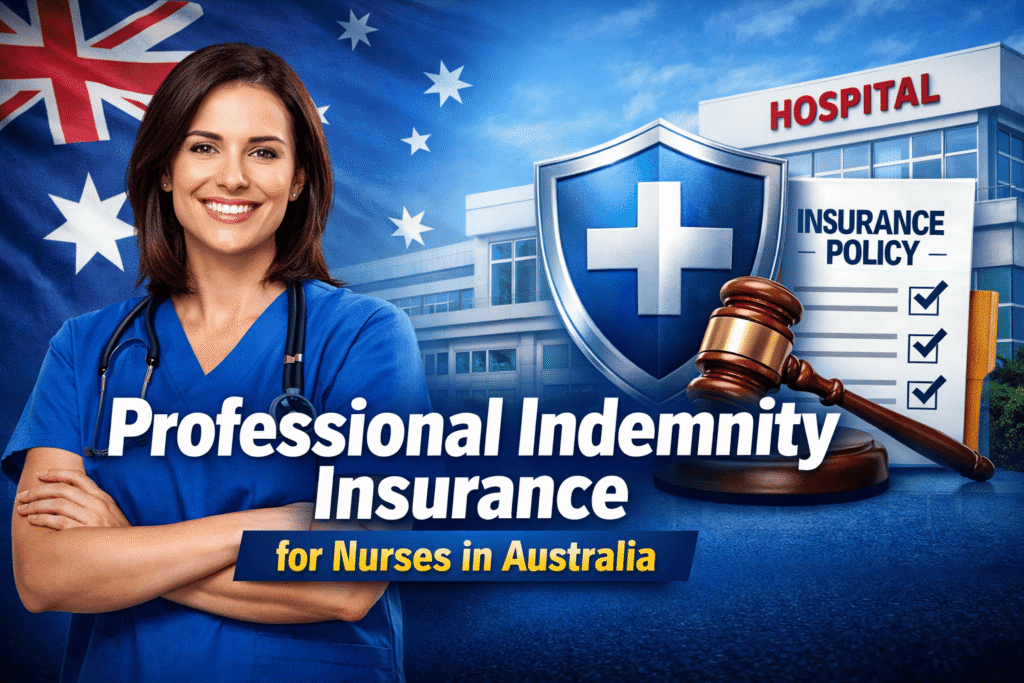
The healthcare landscape in Australia is shifting, with more nurses than ever choosing to step away from traditional hospital roles to become self-employed practitioners, independent contractors, or NDIS providers. While the freedom of setting your own hours and choosing your patients is exciting, it brings a new set of professional risks that are no longer managed by a hospital’s HR department. For any nurse operating independently, the question of Professional Indemnity Insurance (PII) and Public Liability Insurance is not just about financial safety—it is a strict legal requirement for maintaining your registration in Australia.
In this comprehensive guide, we will explore the specific insurance needs for self-employed nurses, the mandatory standards set by the Nursing and Midwifery Board of Australia (NMBA), and why “going it alone” without a robust insurance policy could end your career before it truly begins. Whether you are providing home-based aged care, aesthetic nursing, or specialized consultancy, understanding your liability is the first step to building a successful and sustainable independent business.
The Mandatory Legal Requirement for NMBA Registration
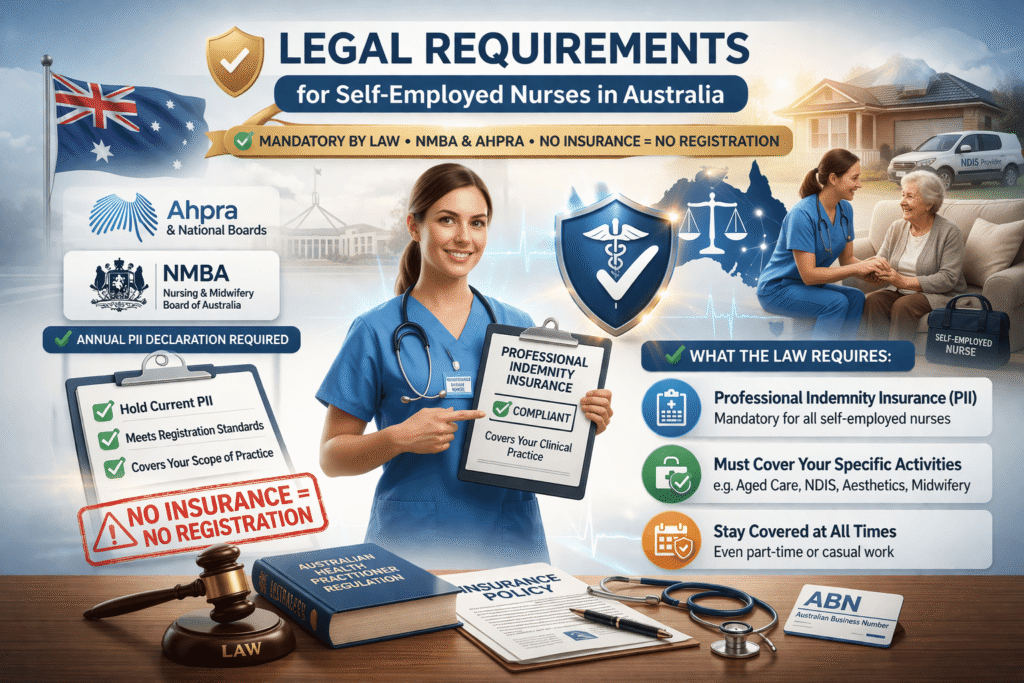
In Australia, the law is very clear: you cannot practice nursing without appropriate Professional Indemnity Insurance (PII). This rule applies to every single nurse on the register, but it is especially critical for those who are self-employed. When you work for a major health service like NSW Health or a private hospital group, you are usually covered by their “vicarious liability” policies. However, the moment you issue an invoice under your own ABN (Australian Business Number), that safety net disappears. You become personally responsible for every clinical decision you make.
The Australian Health Practitioner Regulation Agency (AHPRA) requires you to declare every year that you have met the PII registration standard. For a self-employed nurse, “meeting the standard” means your insurance must cover the specific nature of your work. If you are an independent midwife, a cosmetic nurse injector, or a mental health consultant, your policy must explicitly state those activities. Practicing without insurance, or with insurance that doesn’t cover your specific “scope of practice,” is considered professional misconduct. This can lead to heavy fines, the suspension of your license, and a permanent mark on your professional record that can be seen by any future employer or patient.
Professional Indemnity vs. Public Liability: Knowing the Difference
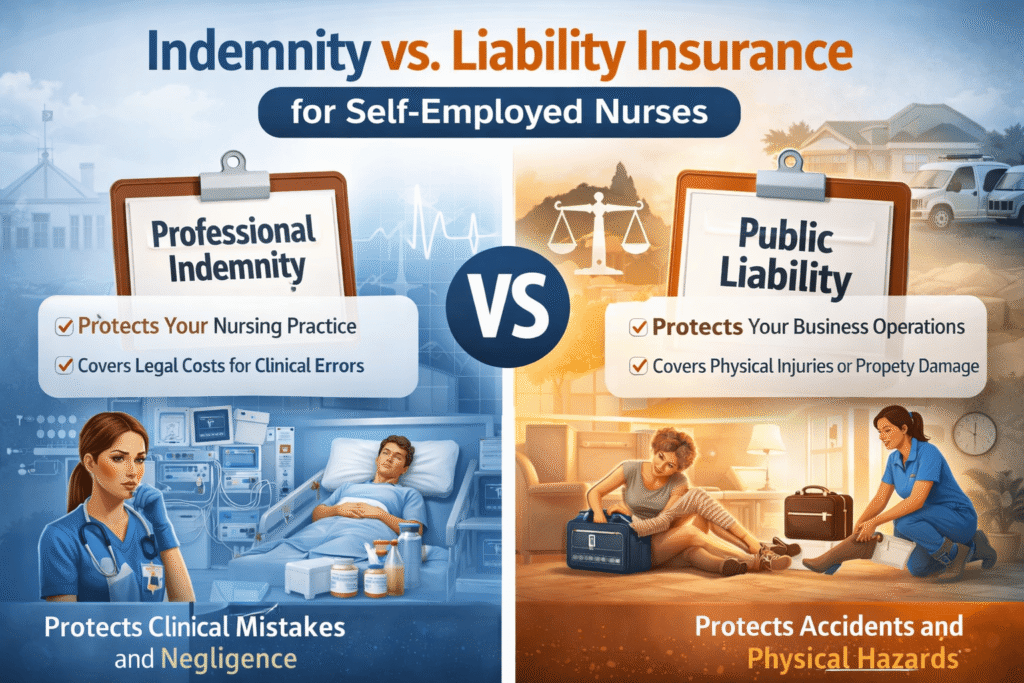
One of the most common mistakes self-employed nurses make is confusing Professional Indemnity Insurance with Public Liability Insurance. While they sound similar, they protect you from very different types of risks, and as a business owner, you likely need both. Professional Indemnity (PII) is about your clinical expertise. It protects you if a patient claims you made a mistake in their treatment, gave the wrong medication, or provided advice that led to an injury. It covers your legal defense and any compensation you are ordered to pay for professional negligence.
On the other hand, Public Liability Insurance is about your physical environment. If you run a clinic from your home or visit patients in their houses, and someone trips over your medical bag and breaks their arm, that is a public liability claim. It isn’t about your “nursing” skill; it’s about the safety of your business operations. Many NDIS contracts and private insurance providers will not even sign a contract with you unless you can show proof of at least $10 million to $20 million in Public Liability cover. For the self-employed nurse, having PII protects your “brain” and your “license,” while Public Liability protects your “wallet” and your “assets.”
The Hidden Risks of NDIS and Private Contracting
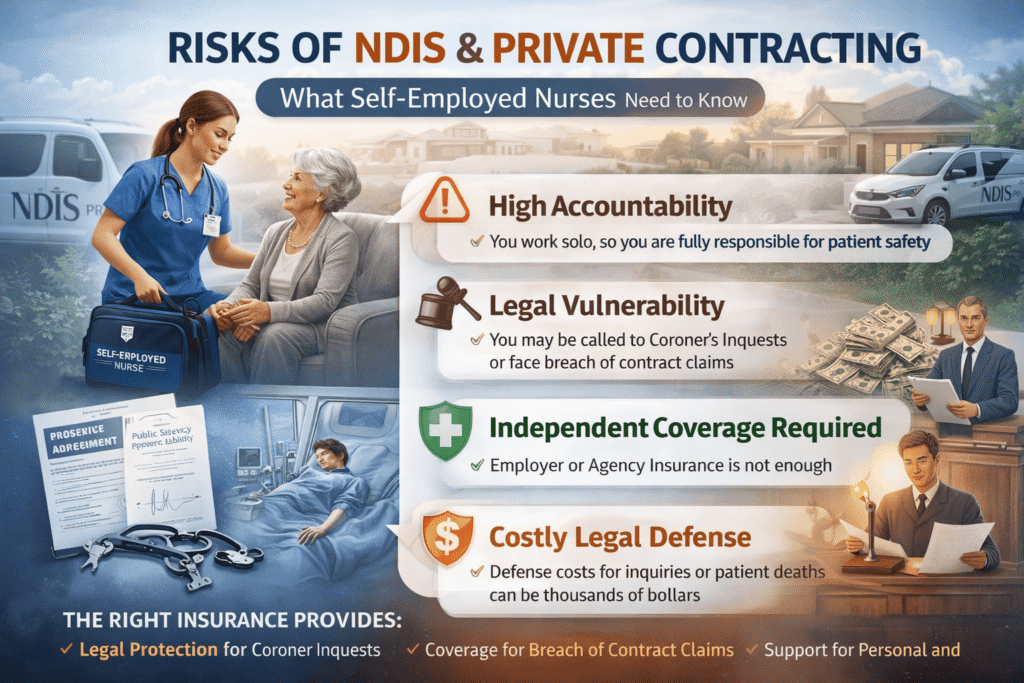
Many nurses transition into self-employment by becoming NDIS (National Disability Insurance Scheme) providers. The NDIS is a fantastic way to provide one-on-one care, but it comes with a high level of responsibility. When you are working in a patient’s home, you are often working without a doctor or a senior nurse nearby to double-check your work. If an incident occurs—such as a patient falling during a transfer or an adverse reaction to a medication—the family or the NDIS Quality and Safeguards Commission will look directly at you for accountability.
As an independent contractor, you are also at risk of breach of contract claims. If you are unable to provide the services promised in your service agreement due to an illness or a legal dispute, you could be sued for financial loss. Furthermore, self-employed nurses are often called to Coroner’s Inquests if a patient passes away under their care. Even if you did nothing wrong, the legal cost of having a lawyer represent you at an inquest can be thousands of dollars. A private insurance policy designed for self-employed nurses will cover these legal costs, ensuring that you don’t have to sell your home or use your savings just to prove your innocence in court.
Why Employer Insurance is Not Enough for Contractors
Some nurses work part-time in a hospital and part-time for themselves, assuming that their hospital’s insurance will cover them across both roles. This is a dangerous misconception. Employer-provided insurance is strictly limited to the work you perform for that employer. It does not follow you when you leave the hospital gates to see a private client. If you are a “moonlighting” nurse providing wound care or health coaching on the side, you are essentially “uninsured” for those private hours unless you have your own separate policy.
Even if you are working as an agency nurse (an independent contractor for a nursing agency), you should check the fine print. Many agencies have “deductibles” or “excesses” that can be as high as $5,000 or $10,000. If a claim is made against you, the agency might expect you to pay that first few thousand dollars out of your own pocket. Having your own independent Professional Indemnity policy through an organization like the ANMF (Australian Nursing and Midwifery Federation) or a specialized medical insurer ensures that you have “first-dollar” protection and an independent legal team that is loyal to you, not the agency or the hospital.
Choosing the Right Policy: Run-Off Cover and Retroactive Dates
When shopping for insurance as a self-employed nurse, there are two technical terms you must understand: Retroactive Dates and Run-Off Cover. Australian PII policies are usually “claims-made” policies. This means the insurance that is active at the time the claim is made is the one that pays out, not the insurance you had when the incident actually happened. If you switch insurers, you must ensure your new policy has a “Retroactive Date” that covers your previous years of work, or you could be left with a “gap” where no one will cover you for old mistakes.
Run-Off Cover is equally vital for when you decide to stop being self-employed or retire. In Australia, a patient can sometimes sue a healthcare provider many years after the event (especially in cases involving children or long-term injuries). Run-off cover ensures that if a claim arrives three years after you closed your business, your insurance will still step in to defend you. Many modern policies include run-off cover for free once you retire, but it is something every self-employed nurse must verify. Protecting your past is just as important as protecting your present when you are the one in charge of your own business.
People Also Ask (FAQ)
Q: Is professional indemnity insurance tax-deductible for self-employed nurses?
Yes. Because insurance is a mandatory requirement for your work and a necessary business expense, you can generally claim the full cost of your Professional Indemnity and Public Liability premiums as a tax deduction on your annual tax return.
Q: How much does liability insurance cost for a self-employed nurse in Australia?
The cost varies depending on your scope of practice. A consultant nurse might pay a few hundred dollars a year, while a cosmetic nurse or an independent midwife might pay several thousand due to the higher risk of claims. It is best to get quotes from specialized medical insurers.
Q: Do I need insurance if I am only doing “non-clinical” consulting?
Yes. Even if you aren’t touching patients, providing professional advice is considered “nursing practice” by the NMBA. If your advice leads to a negative outcome or financial loss for a client, you can still be sued for professional negligence.
Q: Does my insurance cover me if I provide care to family or friends?
Generally, no. Most insurance policies exclude “pro-bono” or “informal” care provided to family members. It is always safer to maintain professional boundaries and ensure all care is provided within a formal, documented business relationship.
Q: Can I use my home insurance for my nursing business?
Almost certainly not. Standard home and contents insurance usually excludes business activities. If a patient is injured at your home office, your home insurance provider will likely reject the claim, which is why a specific Public Liability policy is essential.
Useful Documents for every Nursing Student
CV Section Template for Nursing students
AHPRA – NMBA Registration Document Checklist (International Students-Graduates)
Clinical Placement Reflection Template (NMBA-aligned)
Cover Letter Template for Nursing Students
Disclaimer: “I researched this information on the internet; please use it as a guide and also reach out to a professional for assistance and advice.This information is not medical advice, so seek your medical professional’s assistance.”