

Summary
Global healthcare systems are increasingly incorporating artificial intelligence (AI). AI tools are now used in hospitals, clinics, assisted living homes, and community health services for task management, patient monitoring, documentation, and decision assistance. Although AI has many advantages, nurses who are expected to utilize these tools safely and competently face significant hurdles.
AI causes confusion, anxiety, and even fear in many nursing students and early-career nurses. Some fear that nurses may be replaced by technology. Others feel overburdened by the need to rely on machines while yet being solely accountable for patient outcomes, new systems, and continuous alarms.
The actual difficulties nurses encounter while utilizing AI in their day-to-day clinical practice are described in this article. Real-world nursing examples, concise explanations, and a student-focused viewpoint are all included in this straightforward English text. The intention is to help nurses comprehend AI in a realistic, safe, and self-assured way not to frighten them.
Understanding Artificial Intelligence in Nursing Practice
In nursing, computer programs that analyze patient data, identify trends, and offer recommendations or warnings to enhance treatment are referred to as artificial intelligence. These technologies could be used to flag prescription dangers, plan documentation, predict patient decline, or continuously monitor vital signs.
AI does not, however, take the place of nursing judgment. Even with the use of AI tools, nurses remain legally and professionally accountable for patient care. This puts nurses in a difficult position where they must both trust and doubt technology.
This balance might be particularly challenging for kids. AI techniques are frequently introduced in nursing programs without a thorough explanation of their limitations, hazards, or ethical issues.
Lack of Proper Training and Education
Lack of training is one of the main issues nurses have with AI. AI systems are swiftly introduced by many healthcare organizations, and nurses are expected to adjust without sufficient training.
Why This Is a Problem
Short lessons or quick demonstrations are frequently used to teach nurses how to use AI tools. This leaves insufficient time to comprehend:
• The way the AI decides
• The information it utilizes
• What are its restrictions
• When it might be incorrect
Because of this, nurses may experience anxiety and uncertainty when utilizing AI systems, particularly in high-stress settings like intensive care units or emergency rooms.
Impact on Nursing Students
Without adequate justification, students on placement would be asked to use AI-supported systems. This may result in uncertainty about responsibility and a dread of making mistakes.
Over Reliance on AI and Loss of Clinical Judgment
Although AI tools are intended to assist nurses, there is a genuine risk of becoming overly dependent on them. Over time, clinical judgment may deteriorate if nurses have an uncritical faith in AI.
Why Over-Reliance Is Dangerous
Algorithms and data, not human comprehension, are the foundation of AI systems. They are unable to:
• Completely comprehend the feelings of patients
• Recognise subtle behavioural changes
• Take into account individual or cultural influences.
• Use moral reasoning.
Nurses may cease challenging decisions that need to be closely evaluated if they depend too much on AI alerts and recommendations.
Example in Practice
While a skilled nurse may spot minor indications of concern, an AI system might not identify a patient as high-risk. Care can be delayed and harm can result if human judgment is ignored in favor of AI.
Increased Mental Load and Alert Fatigue
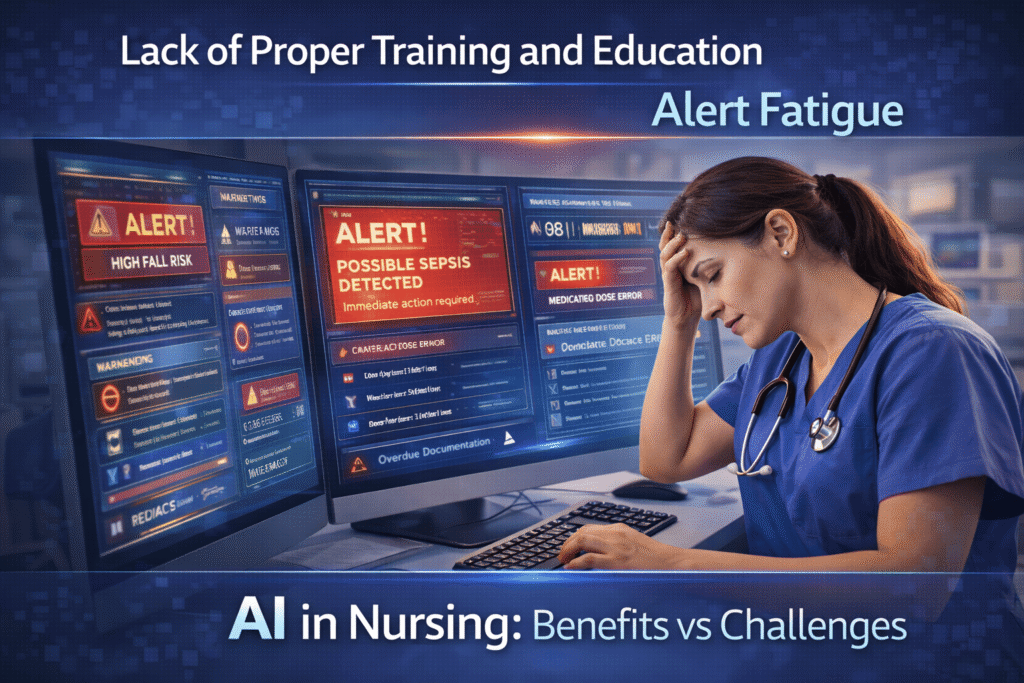
AI systems frequently produce notifications, reminders, and alerts. Although these are designed to increase safety, nurses may become overburdened by them.
What Is Alert Fatigue?
When nurses get so many warnings that they start to ignore them or put off responding, it’s known as alert fatigue. This is typical in environments where:
• Regular notifications are generated by monitoring systems.
• A lot of alerts are not urgent.
• The systems’ customization is inadequate.
How This Affects Nurses
Stress and mental tiredness are increased by constant notifications. There is a greater chance that nurses will overlook crises if they are unable to determine which warnings are actually essential.
Patient Safety Risks Related to AI Errors
Artificial intelligence is not flawless. They rely on precise data entry and software that works. Nurses are frequently the last to respond when mistakes are made.
Common AI-Related Risks
AI errors may happen due to:
- Incorrect patient data
- Software glitches
- Bias in algorithms
- Outdated clinical guidelines
If nurses trust incorrect AI output, patient safety can be compromised.
Accountability Pressure on Nurses
Nurses may still be held accountable for mistakes even if AI is a contributing factor. This makes using AI a source of anxiety, tension, and uncertainty.
Ethical Challenges and Moral Distress
Ethics is a core part of nursing practice. AI introduces new ethical dilemmas that nurses may not feel prepared to handle.
Privacy and Confidentiality Concerns
AI systems collect large amounts of patient data. Nurses worry about:
- Who can access this data
- How it is stored
- Whether patients truly understand consent
Moral Distress
When AI recommendations go against patient preferences or professional ideals, nurses may feel morally distressed. It can be unethical to be made to obey system procedures.
Bias and Inequality in AI Systems
AI systems are only as good as the data they are trained on. If the data contains bias, the AI will reflect that bias.
How Bias Affects Nursing Care
AI may:
- Misinterpret symptoms in minority populations
- Undervalue social determinants of health
- Provide less accurate predictions for certain groups
This puts nurses in difficult positions when AI recommendations do not align with patient needs.
Increased Workload Instead of Workload Reduction
Although AI is meant to reduce workload, poorly implemented systems can actually increase it.
Why This Happens
Nurses may need to:
- Double-check AI outputs
- Correct documentation errors
- Manage system failures
- Explain technology to patients
Instead of saving time, AI can add extra tasks and frustration.
Emotional Distance in Patient Care
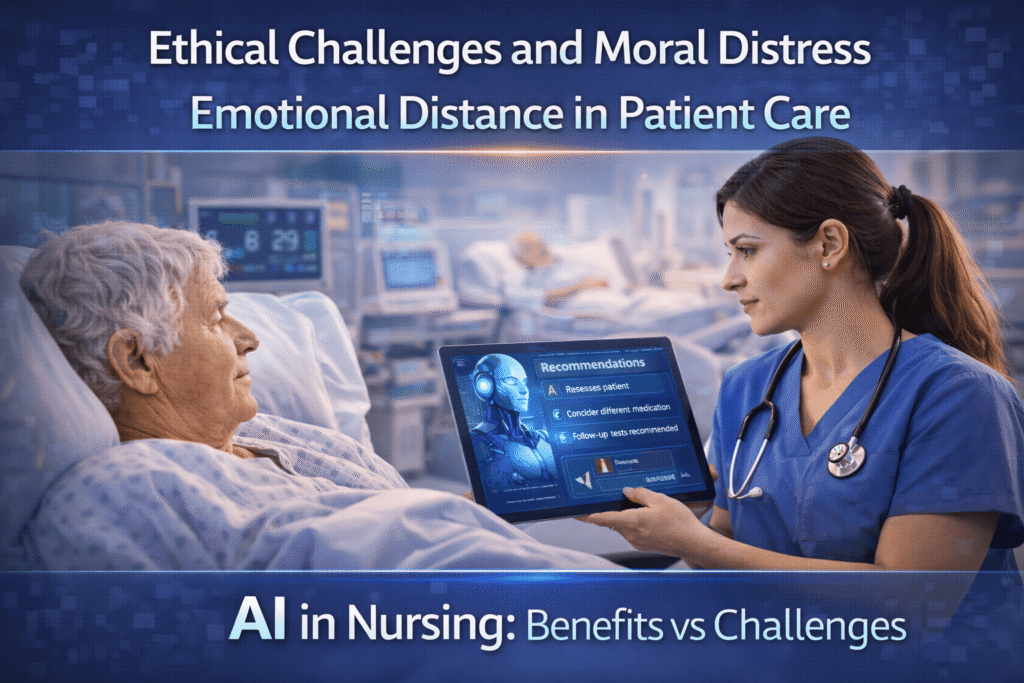
Nursing is built on human connection. Overuse of technology can unintentionally reduce face-to-face interaction.
Impact on Nurse-Patient Relationships
When nurses focus more on screens than patients, patients may feel:
- Ignored
- Confused
- Less emotionally supported
This can reduce patient satisfaction and trust.
Legal and Professional Responsibility Confusion
AI creates uncertainty around legal responsibility. Nurses may ask:
- Who is responsible if AI is wrong?
- Can I question the system?
- Will I be blamed for following AI advice?
This lack of clarity increases stress and fear of litigation.
Resistance to Change and Workplace Tension
Not all nurses feel comfortable with AI. Differences in confidence and skill levels can create tension in teams.
Common Workplace Issues
- Older nurses may feel excluded
- Younger nurses may feel pressured
- Lack of support leads to frustration
Healthy teamwork requires proper communication and training.
The Emotional Fear of Job Replacement
Even though AI is meant to support nurses, fear of replacement still exists.
Why This Fear Persists
Media headlines often exaggerate AI capabilities. Without clear communication, nurses may feel:
- Insecure about their future
- Undervalued
- Replaceable
This fear can lower morale and job satisfaction.
Preparing Nurses for the Future of AI
AI will continue to evolve. Nurses need education, support, and ethical guidance to use it safely.
What Nurses Need
- Ongoing AI education
- Clear policies and accountability
- Strong leadership support
- Emphasis on human-centered care
AI should strengthen nursing—not weaken it.
People Also Ask
What is the biggest challenge nurses face with AI?
Lack of proper training and fear of responsibility are the biggest challenges.
Can AI make nursing unsafe?
Yes, if used incorrectly or without clinical judgment.
Do nurses trust AI systems?
Many nurses are cautious and prefer to double-check AI recommendations.
Does AI increase nurse burnout?
Poorly designed systems can increase stress and fatigue.
Will AI replace nurses in the future?
No. Nursing requires human care, ethics, and judgment that AI cannot replace.
Conclusion
While AI has the potential to enhance healthcare, it also presents significant obstacles for nurses. AI must be implemented cautiously and sensibly, addressing issues such as ethical dilemmas, training gaps, patient safety hazards, and psychological strain.
The core of healthcare is still nurses. AI shouldn’t replace nursing expertise; rather, it should enhance it. Nurses may employ AI with confidence while preserving patient safety and nursing care ideals if they have the right training, ethical protections, and strong professional leadership.
Useful Documents for every Nursing Student
CV Section Template for Nursing students
AHPRA – NMBA Registration Document Checklist (International Students-Graduates)
Clinical Placement Reflection Template (NMBA-aligned)
Cover Letter Template for Nursing Students
Disclaimer: “I researched this information on the internet; please use it as a guide and also reach out to a professional for assistance and advice.This information is not medical advice, so seek your medical professional’s assistance.”
