

Table of Contents
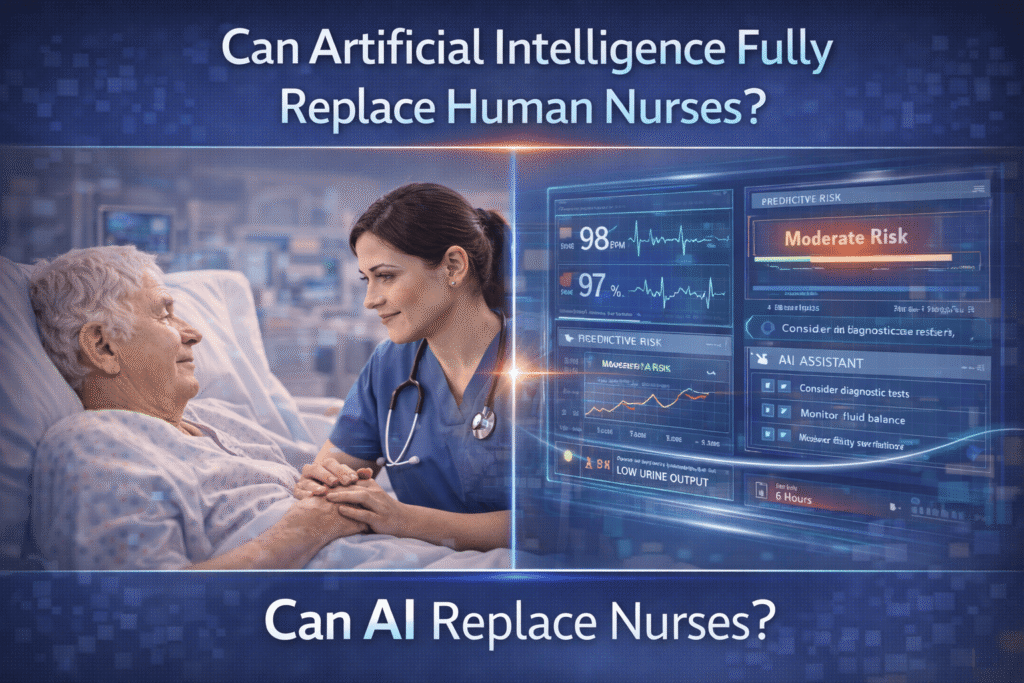
Artificial Intelligence (AI) is becoming more common in hospitals, clinics, aged-care facilities, and community health services. Many healthcare systems now use AI to monitor patients, analyse data, support diagnoses, and manage workloads. Because of this rapid growth, one big question worries nursing students and working nurses alike:
Can artificial intelligence fully replace human nurses?
Some headlines suggest that robots and AI systems will soon take over healthcare jobs. This creates fear, confusion, and anxiety especially for nursing students who are investing years of study, money, and emotional energy into their careers.
This article gives a clear, honest, and realistic answer to this question. It explains what AI can do, what it cannot do, and why human nurses remain essential to healthcare. It is written in simple English, with detailed explanations, and is designed to help students understand the future of nursing without fear or misinformation.
Understanding Artificial Intelligence in Healthcare
Artificial Intelligence refers to computer systems that can analyse large amounts of data, recognise patterns, and make predictions. In healthcare, AI uses information such as patient vital signs, lab results, medical history, and clinical notes to support decision-making.
AI is already used in many nursing-related areas. For example, AI systems can:
- Monitor heart rate, oxygen levels, and blood pressure
- Detect early signs of patient deterioration
- Support medication safety checks
- Assist with documentation and scheduling
- Help manage hospital resources
However, it is important to understand that AI does not think like a human. It does not understand emotions, values, or moral responsibility. It works based on data and rules created by humans.
This difference is central to the question of whether AI can fully replace nurses.
What Artificial Intelligence Can Do in Nursing Practice
AI is very good at tasks that involve data, repetition, and pattern recognition. In nursing practice, this can be helpful—but it has limits.
Patient Monitoring and Early Warning Systems
AI can continuously monitor patient data and alert nurses when something changes. This can improve patient safety by identifying problems earlier than traditional monitoring.
However, AI does not understand why something is happening. It cannot assess patient anxiety, fear, or pain in the way a nurse can.
Documentation and Administrative Support
AI can help with charting, voice-to-text documentation, and organising patient records. This reduces paperwork and allows nurses to spend more time with patients.
Still, nurses must review, correct, and take responsibility for all documentation.
Decision Support, Not Decision Making
AI may suggest possible diagnoses or care options based on data, but it does not make final decisions. Nurses and doctors remain responsible for applying clinical judgment.
AI supports care—it does not deliver care on its own.
Human Nursing Skills AI Cannot Replace
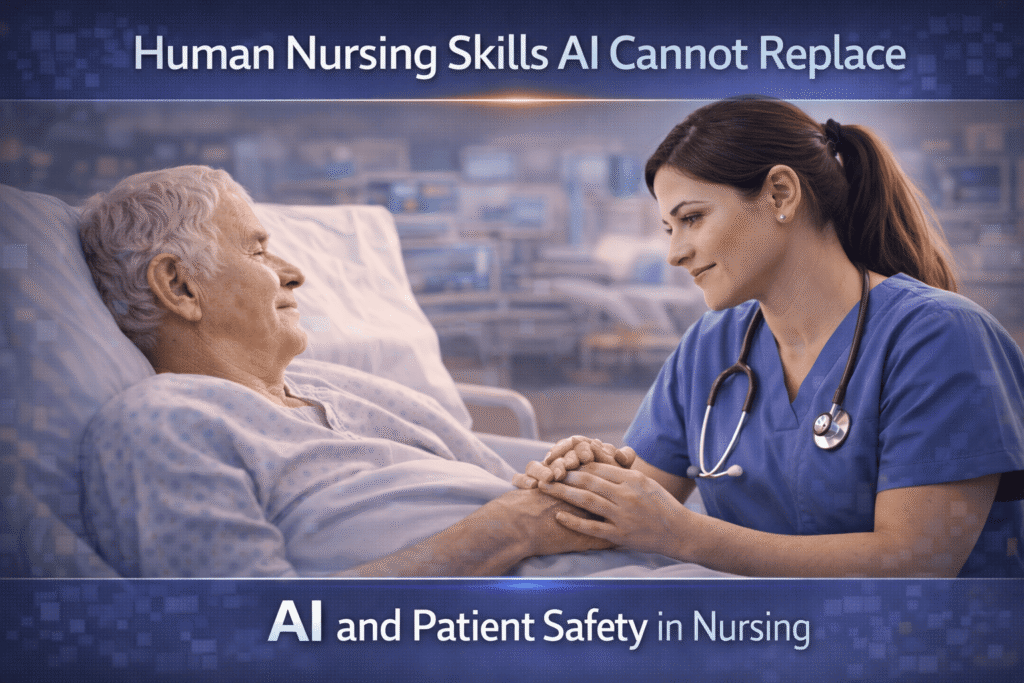
This is where the idea of replacing nurses with AI breaks down completely. Nursing is not only about tasks. It is about human connection, judgment, and responsibility.
Empathy and Emotional Care
Patients often feel scared, vulnerable, or confused. Nurses provide reassurance, comfort, and emotional support. AI cannot understand feelings or respond with compassion.
A machine cannot sit with a dying patient, support a grieving family, or calm an anxious child in a meaningful human way.
Communication and Trust
Nurses build trust through conversation, body language, tone, and presence. Patients often share important information only because they feel safe with a nurse.
AI cannot form trust or understand unspoken concerns.
Ethical Judgment
Nurses constantly make ethical decisions—about consent, dignity, privacy, and patient rights. These decisions require values and moral reasoning, which AI does not possess.
Clinical Judgment and Critical Thinking
Nursing involves complex decision-making that goes beyond rules and algorithms.
Adapting to Unique Situations
Every patient is different. Nurses adjust care based on culture, beliefs, family dynamics, and personal preferences. AI systems work on averages and patterns, not individual life stories.
Handling Uncertainty
Healthcare is unpredictable. Nurses often act with incomplete information, using experience and intuition. AI struggles in situations where data is unclear or conflicting.
Recognising Subtle Changes
Experienced nurses notice small changes in behaviour, mood, or appearance that may signal serious problems. These subtle cues are difficult for AI to interpret.
Legal and Professional Responsibility Cannot Be Automated
One of the strongest reasons AI cannot replace nurses is accountability.
Who Is Responsible for Patient Care?
If an AI system makes an error, the nurse is still legally responsible for patient safety. Healthcare laws and professional standards place accountability on human professionals—not machines.
Professional Registration and Regulation
Nurses are registered, regulated, and held to professional standards. AI systems cannot be licensed, disciplined, or held ethically accountable.
Patient Advocacy
When systems fail or decisions seem unsafe, nurses advocate for patients. AI cannot challenge authority or escalate concerns ethically.
Patient Safety Risks If Nurses Were Replaced
Replacing nurses with AI would introduce serious risks.
Technology Failure
AI systems can fail due to software errors, power outages, or incorrect data. Without nurses, these failures could be catastrophic.
Bias and Inequality
AI systems may contain bias based on the data used to train them. This can lead to unequal care for certain populations.
Human nurses recognise and challenge unfair treatment.
Loss of Holistic Care
Patients are not just medical conditions. They have emotional, social, and spiritual needs. AI cannot provide holistic care.
The Emotional and Human Side of Nursing
Nursing is deeply human work.
Patients remember how nurses treat them, not what technology was used. Compassion, kindness, and presence are central to healing.
Removing nurses would turn healthcare into a technical process rather than a caring relationship.
How AI Will Change Nursing Not Replace It
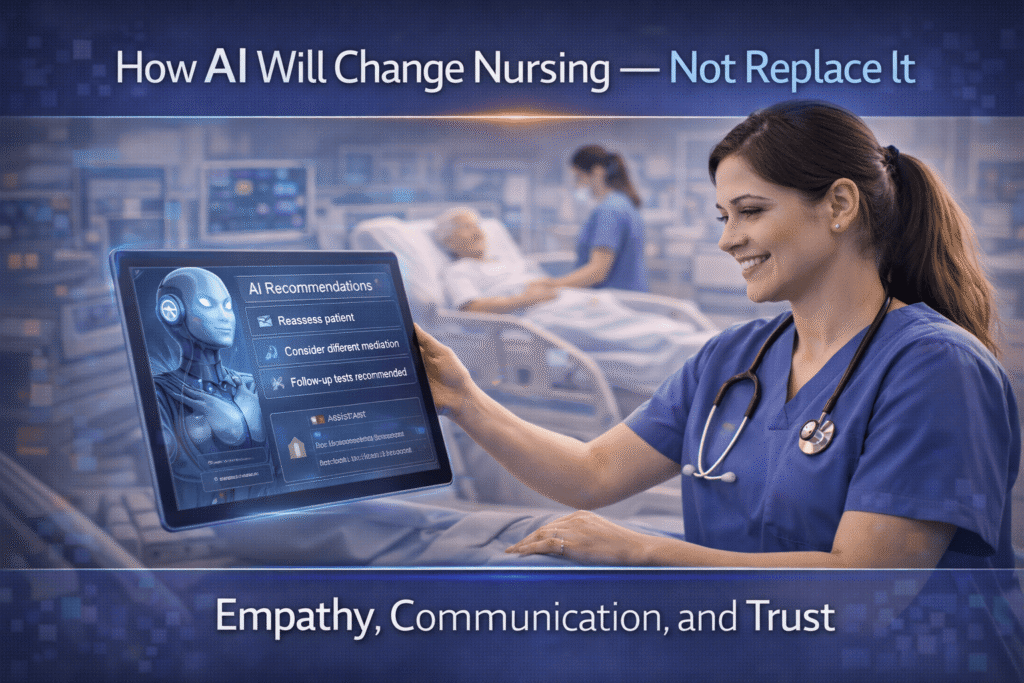
Instead of replacing nurses, AI will change how nurses work.
New Nursing Roles
Future nurses may specialise in:
- Clinical informatics
- Digital health coordination
- AI system oversight
- Data-informed care planning
More Focus on Patient Interaction
By reducing administrative work, AI can allow nurses to spend more time with patients.
Stronger Emphasis on Critical Thinking
Nurses will need to interpret AI information, not just follow it.
What Nursing Students Should Do to Prepare
Students should not fear AI—but they should understand it.
Develop Digital Literacy
Learn how healthcare technology works and its limitations.
Strengthen Human Skills
Communication, empathy, ethics, and teamwork will always be valuable.
Practice Critical Thinking
Question information, analyse situations, and make independent judgments.
People Also Ask
Can AI completely replace nurses?
No. AI cannot provide human care, ethical judgment, or accountability.
Will nursing jobs disappear because of AI?
No. Nursing roles will change, but demand for nurses will remain high.
Is AI safe in nursing care?
AI is safe when used as a support tool with human oversight.
Do nurses need to learn AI skills?
Yes. Basic understanding of AI will be important for future nurses.
What makes nurses irreplaceable?
Empathy, communication, ethics, and clinical judgment.
Conclusion
Artificial Intelligence is transforming healthcare, but it cannot fully replace human nurses. Nursing is not just a set of tasks it is a profession built on compassion, judgment, ethics, and responsibility.
AI can support nurses by improving safety, efficiency, and decision-making. However, human nurses remain essential for patient care, advocacy, and trust.
For nursing students, the future is not about competing with AI it is about working alongside it. The most successful nurses will be those who combine technological understanding with strong human values.
The future of healthcare belongs to nurses who are both skilled and compassionate, supported not replaced by artificial intelligence.
Useful Documents for every Nursing Student
CV Section Template for Nursing students
AHPRA – NMBA Registration Document Checklist (International Students-Graduates)
Clinical Placement Reflection Template (NMBA-aligned)
Cover Letter Template for Nursing Students
Disclaimer: “I researched this information on the internet; please use it as a guide and also reach out to a professional for assistance and advice.This information is not medical advice, so seek your medical professional’s assistance.”