

Table of Contents
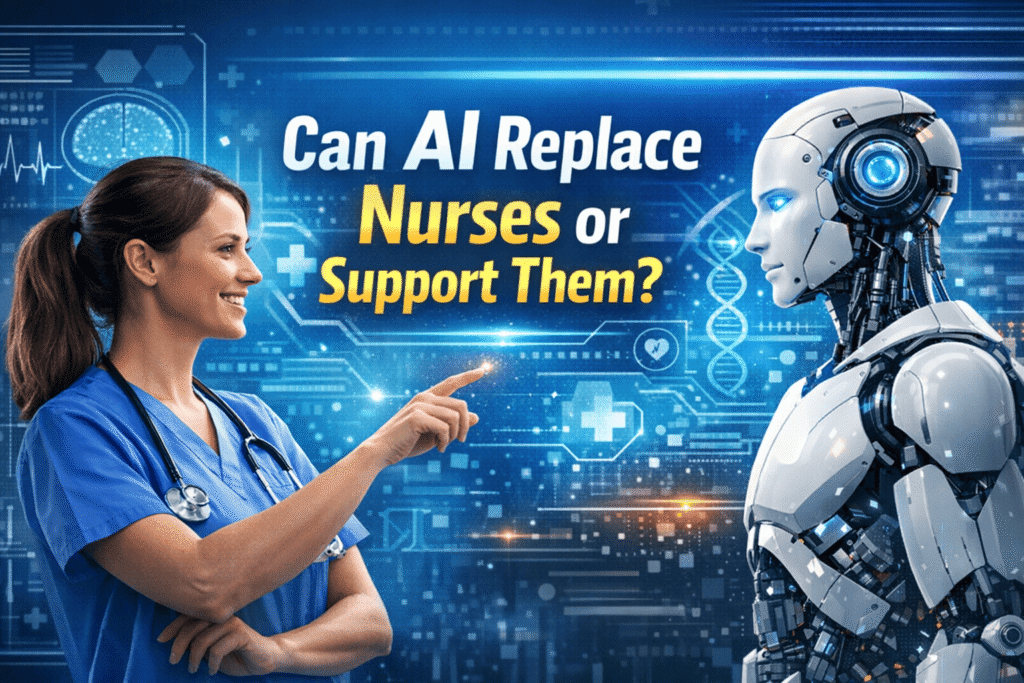
Healthcare is changing more quickly than ever before due to artificial intelligence (AI). AI is becoming a component of routine medical practice, from smart equipment that analyze patient data to virtual assistants that aid with hospital activities. Among nursing professionals and students, this quick expansion has brought up a significant and poignant question:
Can AI replace nurses, or is it meant to support them?
While some nurses view AI as a useful tool that can lessen burden and enhance patient care, many are concerned about their job security. The function of AI in nursing, its capabilities, and future readiness strategies for nurses will all be covered in this article. Students and beginners will find this tutorial easy to read because it is written in straightforward English.
Understanding Artificial Intelligence in Nursing
Computer programs that are capable of carrying out tasks that typically call for human intelligence are referred to as artificial intelligence. Learning from data, identifying trends, formulating forecasts, and assisting in decision-making are some of these activities.
AI is applied in nursing in a variety of ways, including:
• Keeping an eye on the vital signs of patients
• Estimating the hazards to patients
• Keeping track of electronic medical records
• Facilitating clinical judgments
• Cutting down on paperwork
Large volumes of healthcare data are used by AI systems to assist physicians and nurses in making safer and quicker decisions. But AI is not human in its thoughts or emotions. It operates solely on information and commands.
What Tasks Can AI Perform in Nursing?
AI excels in data-driven, repetitive, and technical activities. Nurses frequently spend a lot of time in these regions.
1. Patient Monitoring and Early Alerts
AI systems are able to continuously check temperature, oxygen saturation, blood pressure, and heart rate. The system can notify nurses right away if something goes awry. This enhances patient safety and helps avoid emergencies.
2. Reducing Paperwork
Nurses spend many hours documenting patient care. AI can:
- Automatically update patient records
- Convert voice notes into text
- Organize medical data
This allows nurses to spend more time with patients instead of computers.
3. Supporting Clinical Decisions
AI is able to evaluate a patient’s medical history and recommend potential dangers or courses of action. For instance, it can assist in identifying people who are susceptible to falls or infections.
4. Managing Hospital Workflows
AI can help schedule staff, manage bed availability, and improve hospital efficiency.
Why AI Cannot Replace Nurses
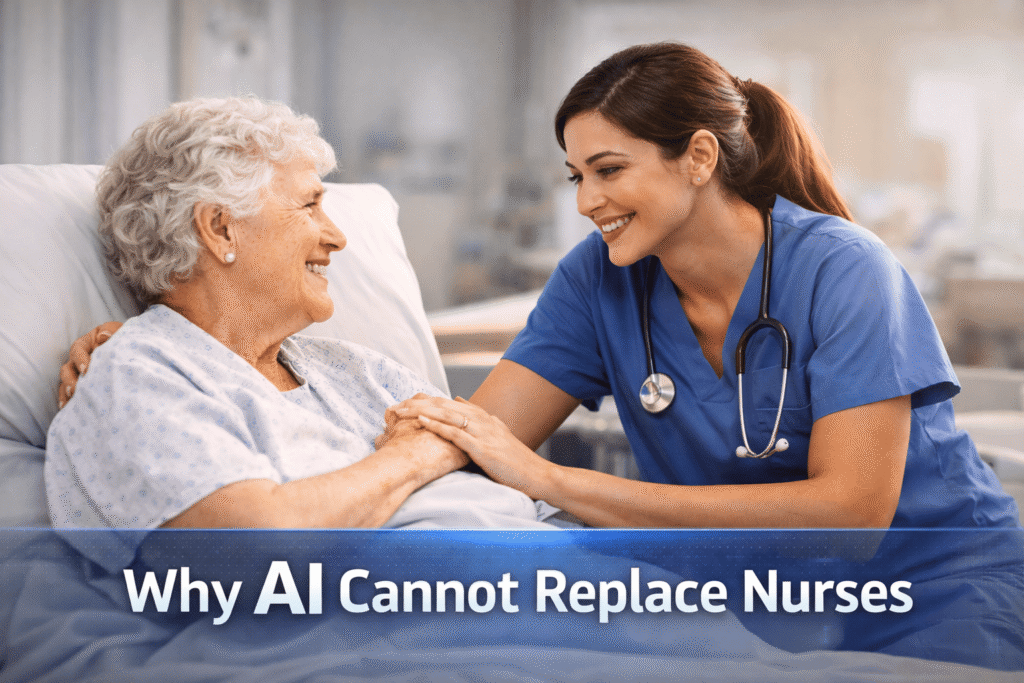
AI is limited in many ways, despite its benefits. Nursing involves more than just chores; it involves empathy, judgment, and human connection.
1. Nurses Provide Emotional Care
Patients require emotional support, consolation, and certainty. Nurses establish trust by listening to patients and understanding their concerns. AI is incapable of having feelings or showing true compassion.
2. Human Judgment Is Critical
Healthcare situations are often complex. Nurses make decisions based on:
- Experience
- Intuition
- Ethical understanding
- Cultural awareness
AI can support decisions, but it cannot replace human judgment in critical situations.
3. Ethical and Moral Responsibility
Ethical care and patient advocacy fall under the purview of nurses. AI lacks human-level comprehension of moral principles and patient rights.
4. Physical Care Requires Human Touch
Skilled human hands are required for tasks including wound care, patient mobility, injections, and personal cleanliness. AI and robots cannot completely replace this degree of attention.
How AI Supports Nurses Instead of Replacing Them
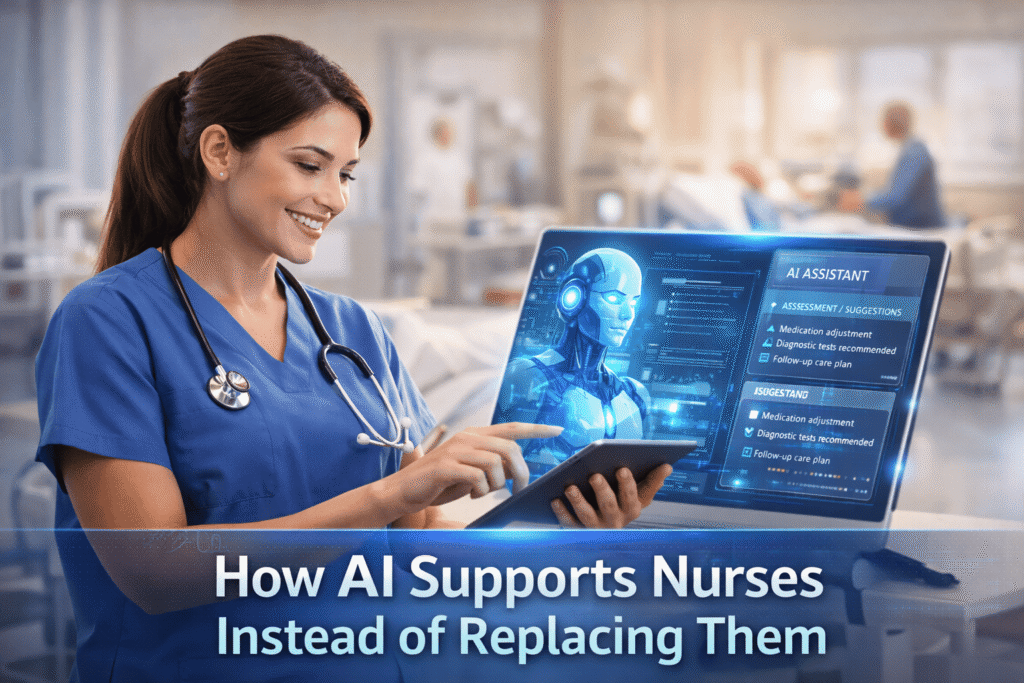
The real future of nursing is collaboration between nurses and AI, not competition.
1. AI as a Nursing Assistant
AI acts like a smart assistant that:
- Handles routine tasks
- Provides quick information
- Reduces mental workload
This helps nurses focus on patient-centered care.
2. Improving Patient Safety
By detecting early warning signs, AI helps nurses prevent complications. This makes nursing care safer and more effective.
3. Reducing Burnout
Nursing is a demanding profession. AI helps by:
- Reducing paperwork
- Supporting decision-making
- Managing workloads
This can lower stress and burnout among nurses.
4. Enhancing Learning and Training
AI is also used in nursing education through:
- Virtual simulations
- Personalized learning tools
- Clinical training support
Impact of AI on Nursing Jobs
Many people fear that AI will reduce nursing jobs. However, studies and healthcare experts suggest a different future.
1. Nursing Jobs Will Evolve, Not Disappear
AI will change how nurses work, not eliminate them. New roles are emerging, such as:
- Nursing informatics specialist
- AI system trainer
- Clinical data analyst
2. Demand for Nurses Will Increase
With aging populations and chronic diseases on the rise, the need for nurses is growing worldwide. AI helps manage this demand but cannot replace human caregivers.
3. New Skills Will Be Required
Future nurses will need skills such as:
- Digital literacy
- Understanding AI tools
- Data interpretation
- Technology-based care
Challenges of Using AI in Nursing
While AI is helpful, it also brings challenges that nurses must be aware of.
1. Data Privacy and Security
AI systems use sensitive patient data. Protecting privacy and preventing data breaches is a major concern.
2. Dependence on Technology
Over-reliance on AI can be risky if systems fail or give incorrect information. Nurses must always verify AI recommendations.
3. Training and Education Gaps
Not all nurses are trained to use AI tools. Proper education and training are essential.
4. Ethical Concerns
Questions about responsibility, bias in AI systems, and decision-making authority must be addressed.
How Nurses Can Prepare for an AI-Driven Future
Instead of fearing AI, nurses should prepare to work with it.
1. Learn Basic AI Concepts
Nurses do not need to become programmers, but understanding how AI works is important.
2. Develop Digital Skills
Skills in electronic health records, data analysis, and healthcare technology will be valuable.
3. Focus on Human Skills
Empathy, communication, critical thinking, and leadership will always be in demand.
4. Embrace Lifelong Learning
Healthcare is always changing. Continuous education will help nurses stay relevant.
The Future of Nursing: Humans and AI Together
The future of healthcare is not AI vs. nurses, but AI + nurses. Technology will continue to grow, but the heart of nursing will remain human.
AI will:
- Support clinical decisions
- Improve efficiency
- Enhance patient safety
Nurses will:
- Provide compassionate care
- Make ethical decisions
- Build patient relationships
Together, they will create a stronger, safer healthcare system.
People Also Ask
Can AI completely replace nurses?
No, AI cannot completely replace nurses. Nursing requires human judgment, emotional care, and physical interaction, which AI cannot provide.
Will AI reduce nursing jobs?
AI is unlikely to reduce nursing jobs. Instead, it will change nursing roles and create new opportunities within healthcare.
How does AI help nurses in daily work?
AI helps nurses by monitoring patients, reducing paperwork, supporting decisions, and improving workflow efficiency.
Should nursing students worry about AI?
No, nursing students should see AI as a tool that supports their work. Learning how to use AI will be an advantage in future careers.
What skills will nurses need in the future?
Future nurses will need digital skills, critical thinking, adaptability, and strong communication skills alongside clinical knowledge.
Conclusion
Nurses are not being replaced by artificial intelligence, but it is revolutionizing healthcare. Rather, AI is emerging as a potent ally that helps nurses deliver safer, more effective, and better care.
Human empathy, compassion, and ethical responsibility are qualities that AI cannot replicate. Nurses who use AI will become stronger, more proficient, and more valued than ever as technology develops.
Nursing has a bright future, and AI will be a part of it—not in place of nurses, but alongside them.
Useful Documents for every Nursing Student
CV Section Template for Nursing students
AHPRA – NMBA Registration Document Checklist (International Students-Graduates)
Clinical Placement Reflection Template (NMBA-aligned)
Cover Letter Template for Nursing Students
Disclaimer: “I researched this information on the internet; please use it as a guide and also reach out to a professional for assistance and advice.This information is not medical advice, so seek your medical professional’s assistance.”