

Summary
Globally, artificial intelligence (AI) is playing a significant role in contemporary healthcare systems. AI is not simply a futuristic concept in nursing care; it is currently being applied in home-based care, community health services, hospitals, and assisted living facilities. AI is gradually altering the way nurses operate, from clinical decision aids to documentation support and patient monitoring systems.
Early-career nurses and nursing students may find AI perplexing or even frightening. Many students question whether AI will make nursing less human and more technological, replace nurses, or limit hands-on care. Others, however, view AI as a useful instrument that can assist improved clinical judgment, lessen strain, and enhance patient safety.
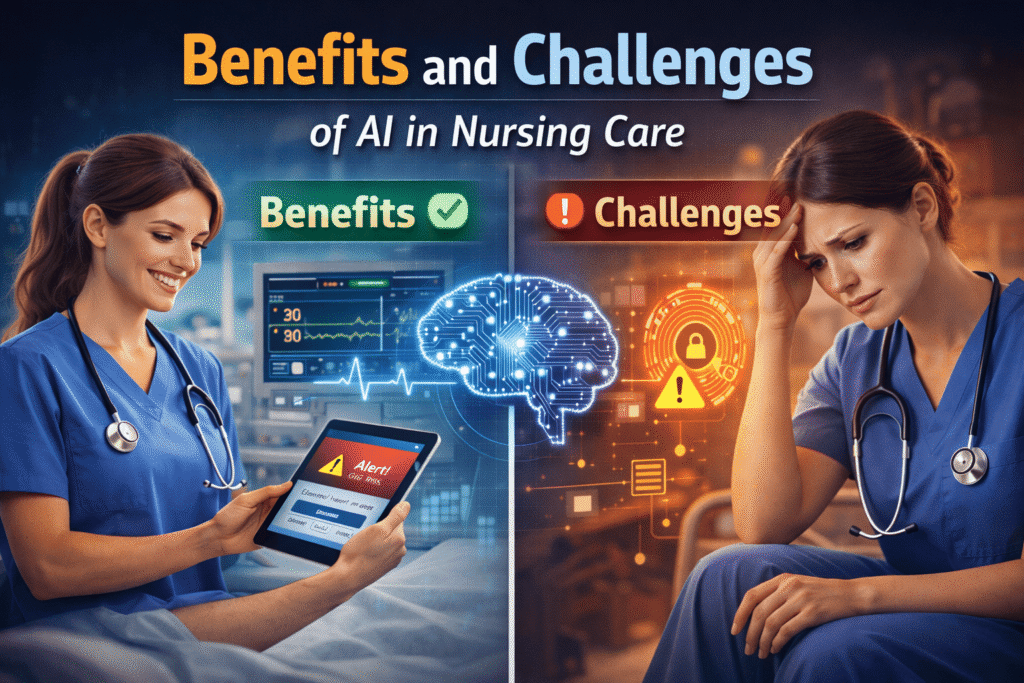
This article provides a fair and balanced explanation of the advantages and difficulties of AI in nursing care. It focuses on what artificial intelligence (AI) does in nursing, how it helps nurses rather than replaces them, and what students should know as they get ready for contemporary nursing practice. Students may easily comprehend and apply the language because it is maintained straightforward, understandable, and useful.
Understanding AI in Nursing Care
Computer programs that are able to analyze data, identify trends, and assist in clinical decision-making are referred to as artificial intelligence in nursing care. The purpose of these systems is to support nurses, not to take the place of or replace their professional judgment.
AI is frequently utilized in nursing care to:
• Constantly check the patient’s vital signs
• Recognize the first indications of decline
• Lessen the amount of paperwork
• Encourage clinical judgment
• Improve workflow and communication.
AI algorithms gain knowledge from vast volumes of medical data. Compared to previous methods, they can warn nurses about possible issues earlier by analyzing trends. However, nurses must evaluate, validate, and take action; AI cannot offer nursing care on its own.
Because it enables nurses to utilize AI safely and confidently, understanding this position is crucial.
Key Benefits of AI in Nursing Care

AI offers many advantages when it is used correctly and ethically. These benefits directly support nursing practice and patient safety.
Improved Patient Safety and Early Detection
Early identification of patient decline is one of the main advantages of AI in nursing care. Artificial intelligence (AI) devices are able to continuously monitor vital indicators and spot minute alterations that could go unnoticed during routine checks.
AI, for instance, can identify:
• Progressive variations in oxygen levels or heart rate
• The first indications of respiratory distress or sepsis
• A higher chance of pressure injuries or falls
This enables nurses to take action sooner, potentially saving lives and averting major consequences. In hectic wards where nurses tend to numerous patients at once, early detection is particularly crucial.
Reduced Nursing Workload
Nurses often experience heavy workloads, long shifts, and high documentation demands. AI helps reduce this pressure by automating certain tasks.
AI can:
- Automatically record vital signs
- Assist with clinical documentation
- Reduce repetitive manual data entry
By saving time on routine tasks, nurses can focus more on direct patient care, communication, and education. This improves both job satisfaction and quality of care.
Better Clinical Decision Support
AI provides nurses with data-driven insights that support clinical judgment. Instead of relying only on single readings, AI analyses trends over time.
This helps nurses:
- Prioritise high-risk patients
- Communicate more effectively with doctors
- Make informed decisions during emergencies
AI does not replace nursing judgment, but it strengthens it by providing reliable, timely information.
Enhanced Continuity of Care
AI systems help improve continuity of care by ensuring accurate and consistent information sharing across healthcare teams. Nurses benefit from clearer handovers, fewer documentation gaps, and better tracking of patient progress.
This is especially useful in:
- Shift changes
- Multidisciplinary care settings
- Long-term and aged-care facilities
How AI Supports Different Areas of Nursing Care
AI is used across many nursing environments, each with unique benefits.
Acute Care and Hospital Nursing
In hospitals, AI supports nurses through smart monitoring systems, early warning tools, and predictive analytics. These systems help nurses manage complex patient conditions safely.
Aged-Care and Long-Term Care
In aged-care settings, AI helps monitor mobility, detect falls, and track chronic conditions. This supports safer care for older adults and reduces physical strain on nurses.
Community and Home-Based Nursing
AI allows nurses to monitor patients remotely through wearable devices and digital platforms. This reduces unnecessary hospital visits and supports patient independence.
Mental Health Nursing
AI tools can help track mood changes, medication adherence, and behavioural patterns. Nurses use this data to support early intervention and ongoing care planning.
Challenges of AI in Nursing Care
While AI offers many benefits, it also presents important challenges that nurses must understand.
Risk of Over-Reliance on Technology
One major challenge is the risk that nurses may rely too heavily on AI systems. Technology can fail, give false alerts, or miss important contextual information.
Nurses must always:
- Assess the patient directly
- Use clinical judgment
- Confirm AI alerts before acting
AI should support—not replace—critical thinking.
Ethical and Privacy Concerns
AI systems collect large amounts of sensitive patient data. This raises concerns about privacy, confidentiality, and data security.
Nurses are responsible for:
- Protecting patient information
- Using systems according to policy
- Reporting data breaches or concerns
Ethical nursing practice remains essential, even when technology is involved.
Bias and Data Accuracy Issues
AI systems learn from existing data. If this data is incomplete or biased, AI predictions may be inaccurate.
This can affect:
- Minority populations
- Patients with complex conditions
- Non-standard presentations
Nurses must be aware of these limitations and advocate for patient safety.
Increased Learning and Training Demands
AI introduces new systems that nurses must learn to use. Without proper training, nurses may feel overwhelmed or frustrated.
For students and new graduates, this can add stress if support is not available.
Legal and Professional Responsibilities of Nurses Using AI
Even when AI is involved, nurses remain professionally accountable for patient care. AI does not hold legal responsibility—nurses do.
Nurses must:
- Follow organisational policies
- Document accurately
- Escalate concerns appropriately
- Maintain professional standards
Understanding this responsibility is critical for safe practice.
How Nursing Students Should Prepare for AI in Practice
Nursing students should view AI as a skill to learn, not something to fear. Preparing early makes the transition to professional practice smoother.
Students can prepare by:
- Learning how monitoring systems work during placements
- Asking questions about AI tools
- Practising critical thinking alongside technology
- Understanding ethical use of AI
AI literacy will become an essential nursing competency.
Balancing Technology and Human Care in Nursing

One concern about AI is that it may reduce human connection in nursing. However, when used properly, AI actually allows nurses more time for compassionate care.
By reducing workload and improving efficiency, AI supports:
- Better patient communication
- More emotional support
- Stronger nurse-patient relationships
Human care remains at the heart of nursing.
The Future of AI in Nursing Care
AI will continue to evolve, but it will not replace nurses. Instead, it will change how nurses work and what skills are required.
Future nursing care will require:
- Strong clinical judgment
- Ethical awareness
- Technology literacy
- Human empathy
Nurses who understand both benefits and challenges will lead safe and effective care.
Conclusion: A Balanced View of AI in Nursing Care
AI brings powerful benefits to nursing care, including improved safety, reduced workload, and better decision support. At the same time, it presents challenges related to ethics, training, and over-reliance on technology.
The key is balance. AI should support nurses, not replace them. Nursing care will always depend on human judgment, compassion, and professional responsibility.
For nursing students, understanding AI now means being better prepared for the future of healthcare.
People Also Ask
What is AI in nursing care?
AI in nursing care refers to technology that supports monitoring, decision-making, and patient safety.
Can AI replace nurses?
No. AI supports nurses but cannot replace human judgment and care.
Is AI safe to use in nursing?
Yes, when used with proper training and professional oversight.
Do nursing students need to learn about AI?
Yes. AI literacy is becoming an important nursing skill.
What is the biggest challenge of AI in nursing?
Over-reliance on technology without critical thinking.
Useful Documents for every Nursing Student
CV Section Template for Nursing students
AHPRA – NMBA Registration Document Checklist (International Students-Graduates)
Clinical Placement Reflection Template (NMBA-aligned)
Cover Letter Template for Nursing Students
Disclaimer: “I researched this information on the internet; please use it as a guide and also reach out to a professional for assistance and advice.This information is not medical advice, so seek your medical professional’s assistance.”