
The National Disability Insurance Scheme (NDIS) has revolutionized how disability support is delivered in Australia, creating a massive demand for specialized nursing services. For nurses, becoming an NDIS Nursing Provider offers an incredible opportunity to work independently, build a business, and provide personalized, one-on-one care to participants in their homes or communities. However, the NDIS is a highly regulated environment. You cannot simply start invoicing the government; there are strict legal, clinical, and administrative requirements that must be met to ensure participant safety and high-quality care.
Whether you are a Registered Nurse (RN) looking to become a “sole trader” or you are starting a larger nursing agency, understanding the NDIS Quality and Safeguards Commission standards is essential. This article breaks down the complex world of NDIS provider requirements into simple, manageable steps. We will cover everything from AHPRA registration and insurance to the rigorous audit process, helping you navigate the transition from a hospital employee to a successful NDIS nursing professional.
1. Professional Registration and Scope of Practice
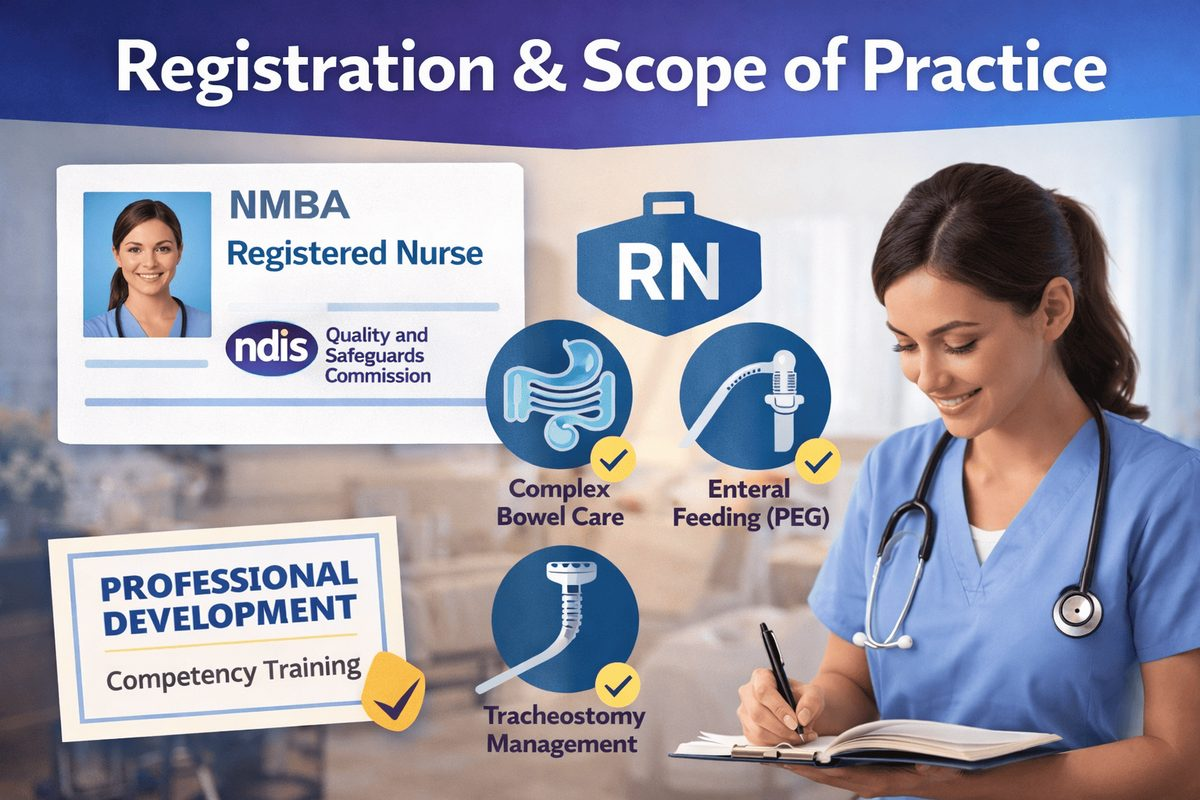
The first and most fundamental requirement for any NDIS nursing provider is a current and valid registration with the Nursing and Midwifery Board of Australia (NMBA) through AHPRA. Under the NDIS, “Specialist Nursing Health Supports” can only be delivered by qualified professionals. This means that if you are marketing yourself as a nurse, you must be a Registered Nurse (RN) or an Enrolled Nurse (EN) acting under the supervision of an RN. Your AHPRA registration must be clear of any “conditions” or “undertakings” that would prevent you from providing independent care in a community setting.
Furthermore, you must operate within your Scope of Practice. In a hospital, you have a team of doctors and senior nurses to back you up; as an NDIS provider, you are often the primary clinical decision-maker. You must ensure you have the specific skills required for your participants’ needs, such as Complex Bowel Care, Tracheostomy Management, or Enteral Feeding (PEG). If you are asked to provide a service that you haven’t been trained in for several years, you are ethically and legally required to seek “professional development” or “competency training” before starting. Documentation of your skills and ongoing training is a key requirement that NDIS auditors will look for during your registration.
2. Choosing Between Registered and Unregistered Status
A critical decision for any new NDIS nursing provider is whether to become a Registered Provider with the NDIS Commission or operate as an Unregistered Provider. If you want to provide “High Intensity Daily Personal Activities”—which includes most complex nursing tasks like catheter care or ventilator management—you must be a Registered Provider. Registration allows you to work with participants whose funds are “NDIS Managed” (managed directly by the government). It also allows you to implement “Restrictive Practices” if required by a behavior support plan.
Operating as an unregistered provider is simpler and involves less paperwork, but you can only work with participants who “Self-Manage” their funds or use a “Plan Manager.” Even as an unregistered provider, you are still legally bound by the NDIS Code of Conduct. This code requires you to act with integrity, respect the privacy of participants, and provide services in a safe and competent manner. Most professional nursing agencies choose to go through the full registration process because it opens up the entire market of NDIS participants and proves to the community that you have met the highest “Gold Standard” of disability care in Australia.
3. The NDIS Audit and Quality Management System
For those choosing to become Registered Providers, the NDIS Audit is the most significant hurdle. To be registered, you must undergo either a “Verification” or a “Provisional” audit (and later a “Certification” audit). Because nursing is considered a “high-risk” service, most nursing providers must complete the Certification Audit. This involves an independent auditor reviewing your Quality Management System (QMS). Your QMS is a collection of documents, policies, and procedures that explain exactly how you run your business safely.
You must have written policies on Incident Management, Complaints Handling, Risk Management, and Participant Privacy. For example, if a medication error occurs, your policy must show exactly how you report it to the NDIS Commission within 24 hours. Auditors will also look at your “Human Resources” files to ensure you have performed NDIS Worker Screening Checks (police checks) for yourself and any staff you hire. While the paperwork can feel overwhelming, these systems are designed to protect you from legal liability and ensure that every participant receives consistent, safe, and professional nursing care.
4. Mandatory Insurance and Financial Protections

Nursing is a high-stakes profession, and things can go wrong even with the best care. Therefore, the NDIS Commission and AHPRA both require providers to have robust insurance. As an NDIS nursing provider, you generally need two main types of insurance: Professional Indemnity (PI) and Public Liability (PL). Professional Indemnity protects you if you make a clinical mistake, such as an error in a complex wound dressing or a failure to spot an infection. Public Liability protects you if a participant or a member of the public is injured in your care due to a non-clinical accident, such as tripping over your equipment bag in their hallway.
Most NDIS contracts and Plan Managers will require proof of at least $10 million to $20 million in coverage for both types of insurance. If you are a “sole trader” (working for yourself), you must ensure your policy specifically covers “NDIS supports” and “Community Nursing.” Standard hospital insurance provided by a former employer will not cover you for independent work. Additionally, if you use a car to transport participants or travel between houses, you must have appropriate business vehicle insurance. Having the right insurance is not just a “tick-box” exercise; it is the financial shield that protects your personal assets and your nursing license if a legal claim is made against you.
5. Compliance with the NDIS Practice Standards
Once you are registered, you must maintain ongoing compliance with the NDIS Practice Standards. These standards are the benchmarks for high-quality care. For nurses, the most relevant section is often the “High Intensity Daily Personal Activities” module. This module outlines exactly how complex tasks must be performed and documented. For instance, if you are providing “Subcutaneous Injections,” the standards require you to have a clear “Handover” process and a “Medication Chart” that follows the National Residential Medication Chart standards.
You must also participate in the “Participant Choice and Control” standard. This means involving the participant (and their family) in every decision about their care. You cannot simply decide what is best for them; you must create a “Service Agreement” and a “Care Plan” together. The NDIS is about empowering people with disabilities to live the life they want. As a nurse, your role is to provide the medical support that makes that life possible. Staying compliant involves regular “Internal Audits” where you check your own files to make sure you are meeting these high standards every single day.
Frequently Asked Questions
Q: Can an Enrolled Nurse (EN) be a sole trader NDIS provider? A: Yes, but with conditions. An Enrolled Nurse must always work under the “direction and delegation” of a Registered Nurse (RN). If an EN wants to be an NDIS provider, they must have a formal agreement with an RN to provide supervision and oversight for complex clinical tasks, as per the NMBA standards.
Q: How much does it cost to become a Registered NDIS Nursing Provider? A: The costs can be significant. You will need to pay for a Quality Management System (approx. $1,000–$3,000), insurance premiums (approx. $800–$2,000 per year), and the independent audit fee (approx. $2,000–$5,000). Many small providers start as “unregistered” to save costs while they build their initial client base.
Q: Do I need a separate ABN for my NDIS nursing business? A: Yes. To operate as an independent contractor or a business in Australia, you must have an Australian Business Number (ABN). You can register as a “Sole Trader,” which is the simplest and cheapest structure for a single nurse working for themselves.
Q: What is a “Service Agreement” in NDIS nursing? A: A Service Agreement is a legal contract between you and the participant. It outlines what nursing services you will provide, how much you will charge (based on the NDIS Price Guide), how you will handle cancellations, and how the participant can make a complaint. It is a mandatory requirement for all NDIS providers.
Q: How often do I need to be audited by the NDIS? A: Generally, once you are a Registered Provider, you will have a full audit every three years, with a smaller “Mid-Term Audit” usually occurring about 18 months into your registration cycle. This ensures you are continuing to follow the Practice Standards as your business grows.