
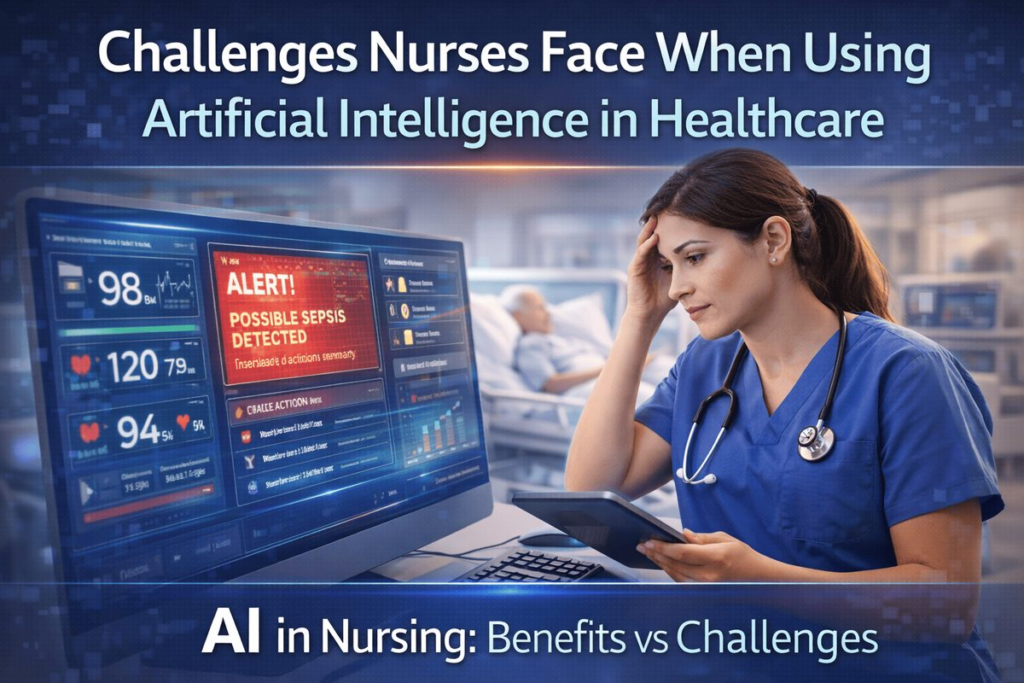
Artificial Intelligence (AI) is becoming a regular part of healthcare systems around the world. Hospitals, clinics, aged care facilities, and community health services now use AI tools for patient monitoring, documentation, decision support, and workload management. While AI offers many benefits, it also brings serious challenges for nurses who are expected to use these tools safely and professionally.
Many nursing students and early-career nurses feel confused, anxious, or even threatened by AI. Some worry that technology will replace nurses. Others feel overwhelmed by new systems, constant alerts, and the pressure to rely on machines while still being fully responsible for patient outcomes.
This article explains the real challenges nurses face when using artificial intelligence in daily clinical work. It is written in simple English, with clear explanations, real nursing examples, and a student-focused perspective. The goal is not to scare nurses, but to help them understand AI realistically, safely, and confidently.
Understanding Artificial Intelligence in Nursing Practice
Artificial Intelligence in nursing refers to computer systems that analyse patient data, recognise patterns, and provide suggestions or alerts to support care. These systems may help predict patient deterioration, flag medication risks, organise documentation, or monitor vital signs continuously.
However, AI does not replace nursing judgment. Nurses are still legally and professionally responsible for patient care, even when AI tools are used. This creates a complex situation where nurses must trust technology but also question it at the same time.
For students, this balance can be especially difficult. Many nursing programs introduce AI tools without fully explaining their limits, risks, or ethical concerns.
Lack of Proper Training and Education
One of the biggest challenges nurses face with AI is insufficient training. Many healthcare organisations introduce AI systems quickly, expecting nurses to adapt without adequate preparation.
Why This Is a Problem
Nurses often learn to use AI tools through short tutorials or brief demonstrations. This does not allow enough time to understand:
How the AI makes decisions
What data it uses
What its limitations are
When it can be wrong
As a result, nurses may feel uncertain and anxious when using AI systems, especially in high-pressure environments like emergency departments or intensive care units.
Impact on Nursing Students
Students on placement may be expected to use AI-supported systems without proper explanation. This can lead to fear of making mistakes and confusion about accountability.
Over-Reliance on AI and Loss of Clinical Judgment
AI tools are designed to support nurses, but there is a real risk of over-reliance. When nurses trust AI blindly, clinical judgment can weaken over time.
Why Over-Reliance Is Dangerous
AI systems are based on data and algorithms, not human understanding. They cannot:
Fully understand patient emotions
Recognise subtle behavioural changes
Consider cultural or personal factors
Apply ethical reasoning
If nurses rely too heavily on AI alerts and recommendations, they may stop questioning decisions that should be critically assessed.
Example in Practice
An AI system may not flag a patient as high-risk, but an experienced nurse might notice subtle signs of distress. Ignoring human judgment in favour of AI can delay care and cause harm.
Increased Mental Load and Alert Fatigue
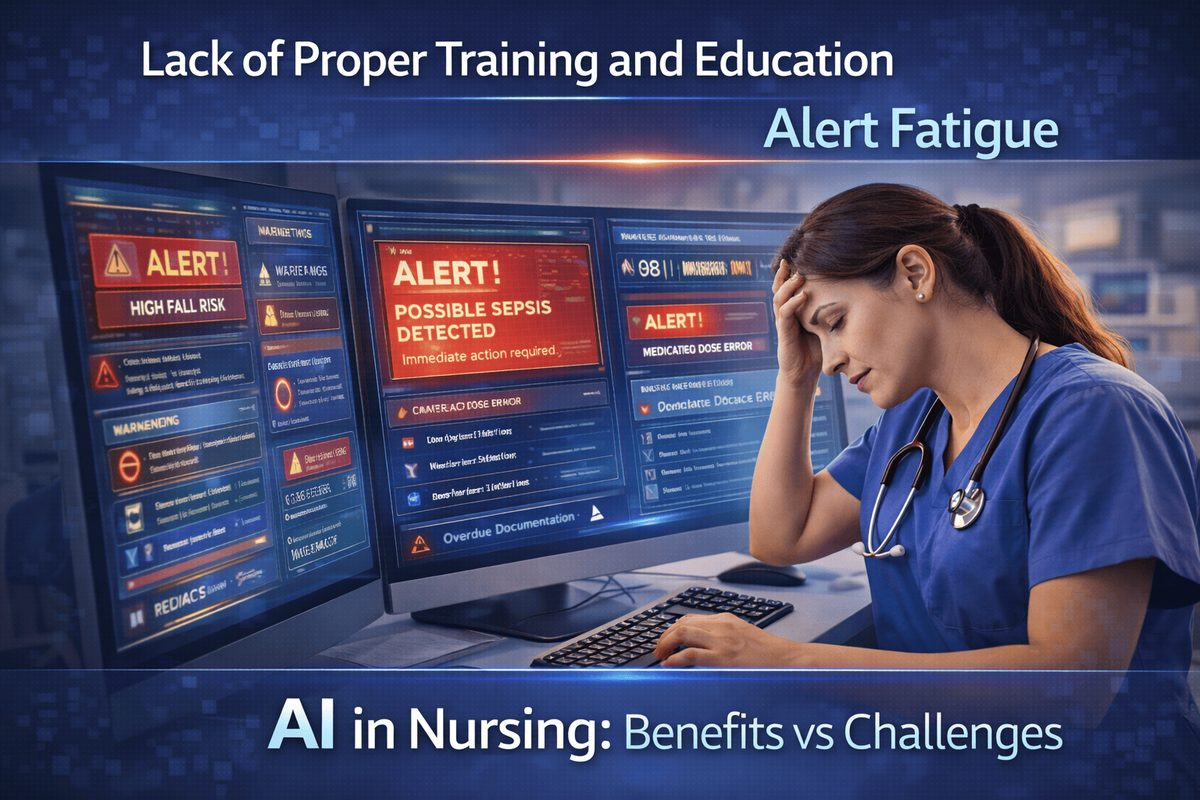
AI systems often generate alerts, reminders, and notifications. While these are meant to improve safety, they can also overwhelm nurses.
What Is Alert Fatigue?
Alert fatigue happens when nurses receive so many warnings that they begin to ignore or delay responses. This is common in settings where:
Monitoring systems generate frequent alerts
Many alerts are non-urgent
Systems are poorly customised
How This Affects Nurses
Constant alerts increase stress and mental exhaustion. Nurses may struggle to identify which alerts are truly critical, increasing the risk of missed emergencies.
Patient Safety Risks Related to AI Errors
AI systems are not perfect. They depend on accurate data input and properly functioning software. When errors occur, nurses are often the last line of defence.
Common AI-Related Risks
AI errors may happen due to:
Incorrect patient data
Software glitches
Bias in algorithms
Outdated clinical guidelines
If nurses trust incorrect AI output, patient safety can be compromised.
Accountability Pressure on Nurses
Even when AI contributes to an error, nurses may still be held responsible. This creates fear, stress, and uncertainty around AI use.
Ethical Challenges and Moral Distress
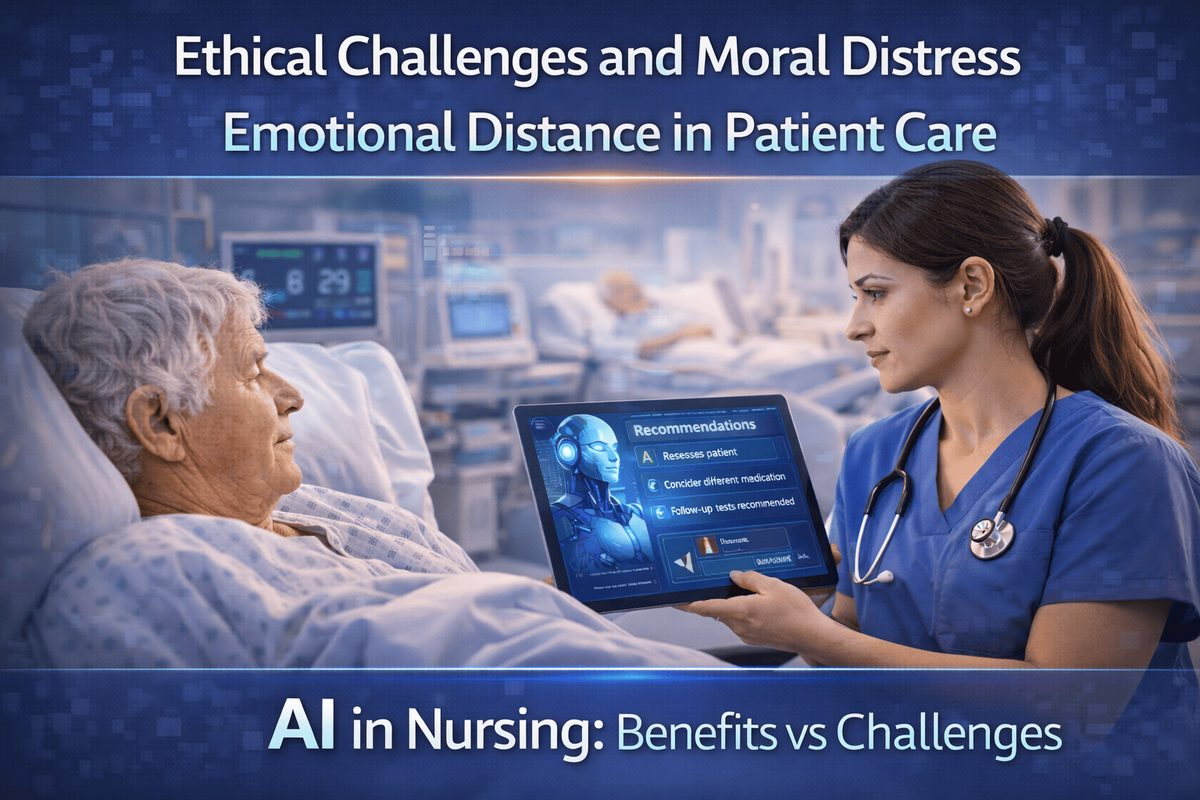
Ethics is a core part of nursing practice. AI introduces new ethical dilemmas that nurses may not feel prepared to handle.
Privacy and Confidentiality Concerns
AI systems collect large amounts of patient data. Nurses worry about:
Who can access this data
How it is stored
Whether patients truly understand consent
Moral Distress
Nurses may experience moral distress when AI recommendations conflict with patient wishes or professional values. Being forced to follow system protocols can feel ethically uncomfortable.
Bias and Inequality in AI Systems
AI systems are only as good as the data they are trained on. If the data contains bias, the AI will reflect that bias.
How Bias Affects Nursing Care
AI may:
Misinterpret symptoms in minority populations
Undervalue social determinants of health
Provide less accurate predictions for certain groups
This puts nurses in difficult positions when AI recommendations do not align with patient needs.
Increased Workload Instead of Workload Reduction
Although AI is meant to reduce workload, poorly implemented systems can actually increase it.
Why This Happens
Nurses may need to:
Double-check AI outputs
Correct documentation errors
Manage system failures
Explain technology to patients
Instead of saving time, AI can add extra tasks and frustration.
Emotional Distance in Patient Care
Nursing is built on human connection. Overuse of technology can unintentionally reduce face-to-face interaction.
Impact on Nurse-Patient Relationships
When nurses focus more on screens than patients, patients may feel:
Ignored
Confused
Less emotionally supported
This can reduce patient satisfaction and trust.
Legal and Professional Responsibility Confusion
AI creates uncertainty around legal responsibility. Nurses may ask:
Who is responsible if AI is wrong?
Can I question the system?
Will I be blamed for following AI advice?
This lack of clarity increases stress and fear of litigation.
Resistance to Change and Workplace Tension
Not all nurses feel comfortable with AI. Differences in confidence and skill levels can create tension in teams.
Common Workplace Issues
Older nurses may feel excluded
Younger nurses may feel pressured
Lack of support leads to frustration
Healthy teamwork requires proper communication and training.
The Emotional Fear of Job Replacement
Even though AI is meant to support nurses, fear of replacement still exists.
Why This Fear Persists
Media headlines often exaggerate AI capabilities. Without clear communication, nurses may feel:
Insecure about their future
Undervalued
Replaceable
This fear can lower morale and job satisfaction.
Preparing Nurses for the Future of AI
AI will continue to evolve. Nurses need education, support, and ethical guidance to use it safely.
What Nurses Need
Ongoing AI education
Clear policies and accountability
Strong leadership support
Emphasis on human-centered care
AI should strengthen nursing—not weaken it.
Frequently Asked Questions
What is the biggest challenge nurses face with AI?
Lack of proper training and fear of responsibility are the biggest challenges.
Can AI make nursing unsafe?
Yes, if used incorrectly or without clinical judgment.
Do nurses trust AI systems?
Many nurses are cautious and prefer to double-check AI recommendations.
Does AI increase nurse burnout?
Poorly designed systems can increase stress and fatigue.
Will AI replace nurses in the future?
No. Nursing requires human care, ethics, and judgment that AI cannot replace.
Conclusion
Artificial Intelligence has the power to improve healthcare, but it also brings serious challenges for nurses. From training gaps and ethical concerns to patient safety risks and emotional stress, AI must be introduced carefully and responsibly.
Nurses remain at the heart of healthcare. AI should support nursing knowledge—not override it. With proper education, ethical safeguards, and strong professional leadership, nurses can use AI confidently while protecting patient safety and the values of nursing care.