

ISBAR handover is one of the most important communication tools used in Australian healthcare settings. As a nursing student, you will hear the word ISBAR repeatedly during lectures, simulations, and especially on clinical placement. However, many students understand the structure in theory but feel completely stuck when they have to actually speak during handover on a busy ward.
First-week placement anxiety, fear of sounding “stupid,” and pressure from time-poor staff often make students rush, miss key information, or stay silent. This is dangerous because poor handover can lead to missed care, medication errors, and patient harm. At the same time, students are rarely shown realistic, student-level ISBAR examples that match what they are actually expected to say.
This article explains ISBAR in simple language and provides clear, practical ISBAR handover examples written specifically for nursing students. These examples reflect common ward situations and show how to communicate safely, confidently, and professionally—without sounding like a registered nurse or pretending to know more than you do.
1. What ISBAR Really Means for Nursing Students (Not Registered Nurses)
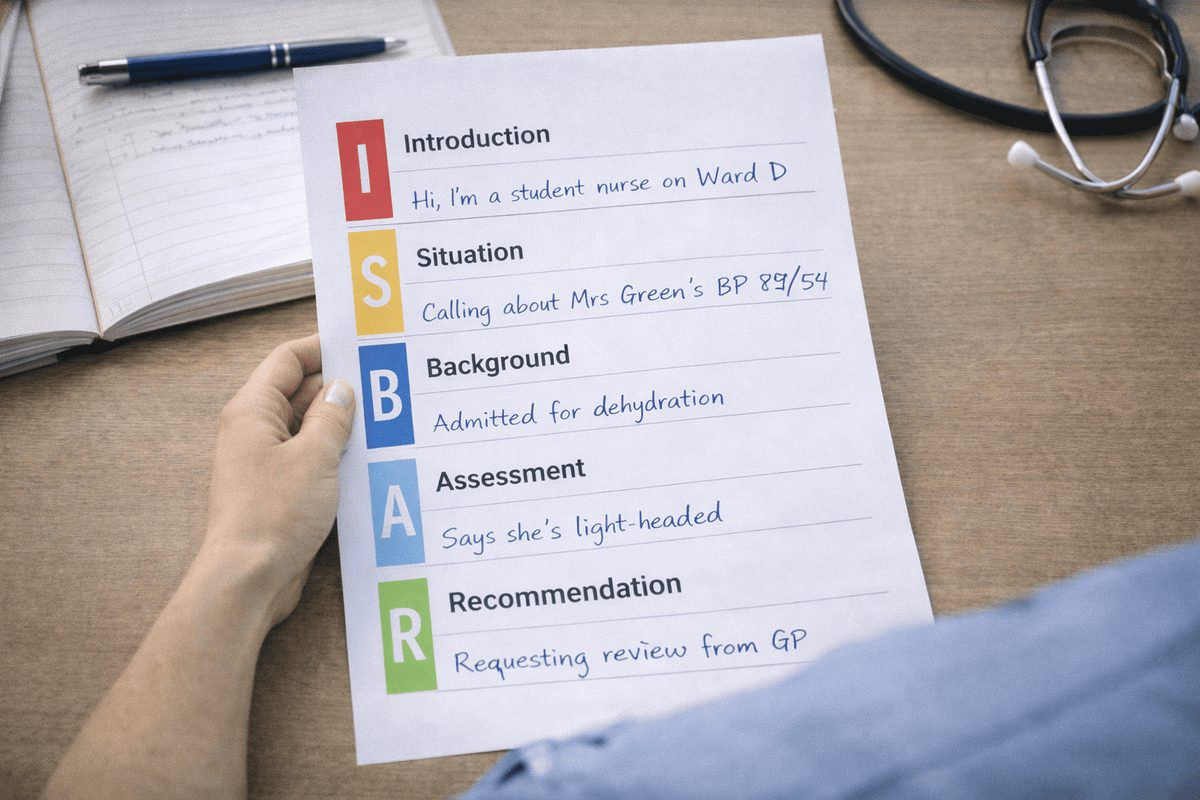
ISBAR stands for Introduction, Situation, Background, Assessment, and Recommendation. While registered nurses may give fast, complex handovers, nursing students are not expected to deliver handovers at the same level. What is expected is clarity, honesty, and safe communication within your scope.
For students, ISBAR is not about impressing staff with medical language. It is about clearly identifying who you are, explaining what is happening with the patient, sharing relevant information, and knowing when to ask for help. Many students make the mistake of either saying too little or trying to sound “advanced,” which increases anxiety and risk.
When used correctly, ISBAR actually reduces stress because it gives you a clear structure. You don’t need to guess what to say next. You simply move step by step.
2. How to Introduce Yourself Using ISBAR (Student-Safe Language)
The Introduction part is where many students feel nervous. They speak too quietly, rush their words, or forget to identify themselves as students. This can confuse staff and lead to unrealistic expectations.
A safe student introduction always includes your name, role, and location. For example:
“Hi, my name is ___, I’m a student nurse on ___ ward, and I’m calling about a patient I’m caring for with my preceptor.”
This immediately clarifies that you are a student and that you are communicating under supervision. You never need to apologise for being a student. Clear identification is professional and expected.
3. ISBAR Examples for Common Ward Scenarios (Student-Level)

This section includes 9 common ward scenarios nursing students frequently encounter. Each example uses simple, realistic language that is appropriate for students.
Scenario 1: Patient with Low Blood Pressure
A nursing student may need to report abnormal vital signs.
ISBAR Example:
“Hi, my name is ___, I’m a student nurse on medical ward B. I’m calling about Mr Smith in bed 5. His blood pressure has dropped to 88 over 54 in the last set of observations. He was admitted with dehydration and vomiting. His blood pressure was stable earlier today. He looks pale and says he feels light-headed. I’ve informed my preceptor and we are requesting a review.”
This handover is clear, factual, and safe. It does not include diagnosis or assumptions.
Scenario 2: Patient Complaining of Chest Pain
Chest pain is serious, and students must communicate calmly.
ISBAR Example:
“Hi, I’m ___, a student nurse on surgical ward A. I’m calling about a patient who is reporting chest pain. The patient says the pain started 10 minutes ago and feels tight. They have a history of hypertension. Vital signs show heart rate 110 and blood pressure 150 over 90. My preceptor is with the patient, and we are requesting urgent review.”
This shows urgency without panic and keeps within scope.
Scenario 3: Patient Refusing Medication
Students often feel unsure how to handover refusals.
ISBAR Example:
“Hello, this is ___, student nurse on ward C. I’m calling about Ms Lee in bed 3. She has refused her evening medication. She says she feels nauseous and does not want to take tablets right now. She has taken her medications earlier today. I’ve documented the refusal and informed my supervising nurse.”
This handover avoids judgement and documents actions taken.
Scenario 4: Post-Operative Patient in Pain
Pain management is common on placement.
ISBAR Example:
“Hi, I’m ___, a student nurse on orthopaedic ward. I’m calling about a post-operative patient who is reporting increased pain. The patient had knee surgery yesterday. They rate their pain as 8 out of 10 despite regular analgesia. Vital signs are stable. I’m calling to let you know and to ask for further pain management advice.”
Scenario 5: Patient with a Fall Risk Concern
Students often notice safety issues first.
ISBAR Example:
“Hello, my name is ___, student nurse on ward D. I’m calling about an elderly patient who appears unsteady when mobilising. They nearly lost balance when walking to the bathroom. The patient has a history of falls and uses a walker. Observations are stable. I’ve informed my preceptor and we would like a falls risk review.”
Scenario 6: Abnormal Blood Glucose Level
Diabetes management is a common scenario.
ISBAR Example:
“Hi, this is ___, student nurse on medical ward. I’m calling about a patient whose blood glucose level is 18.6. The patient has type 2 diabetes and is on insulin. They report feeling thirsty and tired. I’ve rechecked the result and informed my supervising nurse.”
Scenario 7: Deteriorating Mental State
Mental health changes must be reported carefully.
ISBAR Example:
“Hello, I’m ___, a student nurse on ward E. I’m calling about a patient who appears increasingly confused. They are oriented to person only and are more restless than earlier. They were admitted with infection. Vital signs show a temperature of 38.5. My preceptor is aware and we are requesting a medical review.”
Scenario 8: IV Site Concern
Students often notice IV issues.
ISBAR Example:
“Hi, I’m ___, student nurse on ward F. I’m calling about a patient’s IV site. The site appears red and swollen, and the patient reports pain at the site. The IV was inserted yesterday. I’ve stopped the infusion and informed my supervising nurse.”
Scenario 9: Patient Ready for Discharge Preparation
Students can handover progress too.
ISBAR Example:
“Hello, this is ___, student nurse on ward G. I’m calling about a patient planned for discharge. The patient is mobilising independently and pain is controlled. All observations are stable. Education has been provided with my preceptor.”
4. Common ISBAR Mistakes Nursing Students Make
Many students rush ISBAR and skip key details. Others panic and include unnecessary information. A common mistake is giving opinions instead of facts, or saying “everything is fine” without evidence.
Another mistake is forgetting to state what has already been done or who has been informed. This can make it seem like no action was taken.
Students should remember that ISBAR is not about perfection. It is about safe, structured communication.
5. How ISBAR Helps Reduce Anxiety on Placement

ISBAR gives you confidence because it removes uncertainty. When you know the structure, you don’t freeze. Practising ISBAR before placement—out loud—helps your brain respond calmly under pressure.
Using ISBAR also shows staff that you are safe, organised, and professional, even if you are nervous.
6. Final Advice for Nursing Students Using ISBAR
You do not need advanced medical language to give a good handover. Simple, clear communication saves lives. Being a student does not reduce your responsibility—but it does protect you when you communicate honestly and within scope.
ISBAR is not just a checklist. It is a safety tool for you and your patients.
📦 SUMMARY BOX (Section-Wise Explanation)
Introduction Summary:
Explains why ISBAR is stressful for students and why student-specific examples are needed.
Heading 1 Summary — Understanding ISBAR:
Clarifies how ISBAR expectations differ for students vs registered nurses.
Heading 2 Summary — Introduction Stage:
Explains how students should identify themselves safely and confidently.
Heading 3 Summary — Ward Scenarios:
Provides 9 realistic ISBAR examples written at student level.
Heading 4 Summary — Common Mistakes:
Highlights typical errors students make during handover.
Heading 5 Summary — Anxiety Reduction:
Explains how ISBAR reduces stress and improves confidence.
Conclusion Summary:
Reinforces ISBAR as a communication and safety tool for students.
🔍 People Also Ask (FAQ)