
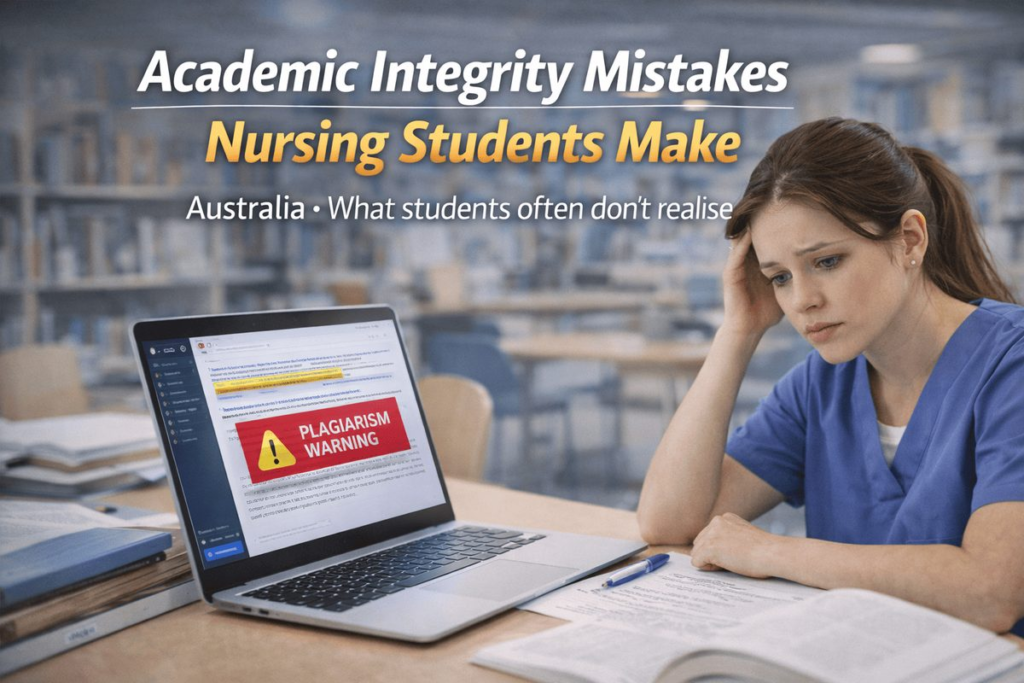
Academic integrity is one of the most serious expectations placed on nursing students in Australian universities. While many students associate academic misconduct with deliberate cheating, copying, or paying someone to do assignments, the reality is very different. A large number of nursing students breach academic integrity rules without meaning to, often because they misunderstand university policies, rely on technology incorrectly, or follow peer advice that turns out to be wrong.
Nursing programs place a strong emphasis on ethics, accountability, and professional behaviour. This is because nurses are trusted with patient lives, confidential information, and clinical decision-making. Universities therefore treat academic integrity not just as an academic issue, but as a professional suitability issue. Even small mistakes can feel frightening when students receive emails about investigations or warnings.
This article explains, in simple English, the most common academic integrity mistakes nursing students make without realising, why these mistakes happen, and how students can protect themselves. The focus is especially on AI tools, group work risks, and paraphrasing problems, which are now the leading causes of unintentional misconduct cases in Australia.
Why Academic Integrity Matters So Much in Nursing Degrees
Academic integrity matters in every university degree, but it carries extra weight in nursing. This is because nursing is a registered profession governed by strict ethical standards. Universities are responsible for ensuring that students who graduate are safe, honest, and competent.
When a nursing student submits work that is not their own, even unintentionally, it raises concerns about honesty, accountability, and decision-making. Universities worry that if a student cuts corners academically, they may do the same in clinical documentation, medication calculations, or patient care.
For this reason, nursing faculties often apply academic integrity rules more strictly than some other disciplines. Understanding this context helps students realise why universities respond seriously, even when the mistake feels small or accidental.
AI Tools: The Biggest New Risk for Nursing Students

The rapid rise of AI tools has completely changed how students study and write assignments. Many nursing students use AI to save time, reduce stress, or improve English expression. While these intentions are understandable, AI use is now the number one cause of unintentional academic misconduct in Australian universities.
A common misunderstanding is that AI is simply a “smart grammar checker.” In reality, most AI tools generate original text based on patterns, not on your own thinking. When students copy AI-generated responses and submit them as their own work, universities often classify this as unauthorised assistance or contract cheating, even if no money was involved.
Another major issue is students using AI to rewrite or paraphrase journal articles. The AI may produce text that looks different on the surface but still follows the same structure and logic as the original source. When this text is submitted without proper citation or acknowledgment of AI use, it can be flagged as plagiarism.
Many universities now use AI-detection software, but even without detection tools, assessors often notice sudden changes in writing style, vocabulary, or tone. This is especially noticeable in nursing assignments that require reflection or clinical reasoning, where personal voice is expected.
The safest approach for nursing students is to treat AI as a study aid only, not a writing tool, unless your university explicitly allows limited AI use and you clearly declare it.
Why “Everyone Uses AI” Is a Dangerous Assumption
One of the most harmful myths among nursing students is the belief that “everyone uses AI, so it must be allowed.” This assumption often comes from peers, social media, or online forums rather than official university policies.
In reality, each Australian university — and sometimes each faculty — has its own rules about AI. Some allow AI for brainstorming, some allow grammar checking, and others prohibit AI-generated content entirely. Claiming ignorance rarely protects students during misconduct investigations.
Nursing students must understand that following peer advice instead of official policy is risky. Universities expect students to read and follow academic integrity guidelines, regardless of what classmates are doing.
Group Work Risks That Catch Nursing Students by Surprise
Group assignments are designed to teach teamwork, communication, and collaboration — all essential nursing skills. However, group work also creates serious academic integrity risks that many students do not expect.
One of the biggest misunderstandings is shared responsibility. In Australian universities, when a group submits one assignment, every group member is responsible for the entire submission. This means that if one student plagiarises, uses AI incorrectly, or copies content from an online source, all group members may be investigated.
Many nursing students assume that only the person who wrote the problematic section will be penalised. Unfortunately, this is often not the case. Universities expect students to review the final submission and ensure it meets integrity standards.
Another common issue is sharing drafts with friends outside the group. Students often do this to “get feedback,” not realising that if wording is reused later, it can trigger similarity reports. Even sharing work with good intentions can be risky.
Collusion vs Collaboration: Where Students Get Confused
Collaboration is allowed in group work. Collusion is not. The line between the two is often unclear to nursing students, especially those new to university study.
Collusion occurs when students work together on tasks that are meant to be completed individually. This includes sharing answers, copying explanations, or jointly writing sections of individual assignments. Even if students write in their own words later, the shared ideas can still be considered collusion.
Nursing students often collude without realising it, especially during exam preparation or take-home assessments. Universities do not require proof of intent; similarity and communication evidence is often enough to raise concerns.
Understanding this distinction early can prevent serious consequences.
Paraphrasing Issues: The Most Misunderstood Skill in Nursing
Paraphrasing is one of the hardest academic skills for nursing students to master. Many students believe that paraphrasing simply means changing a few words or using synonyms. Unfortunately, this approach often leads to plagiarism.
True paraphrasing requires understanding the idea fully, then explaining it in your own academic voice without copying sentence structure, phrasing, or logic. This is particularly challenging in nursing, where technical language is common and sources are heavily relied upon.
Another common issue is patchwriting, where students mix their own words with phrases taken directly from the source. Even when a reference is included, patchwriting can still be flagged as plagiarism.
Paraphrasing problems are especially common among international nursing students, but local students struggle as well. Universities recognise this and often provide support — but only if students seek help early.
Using Lecture Slides and Clinical Guidelines Incorrectly

Many nursing students assume that lecture slides are “free to use” because they come from the university. This is not true. Lecture slides are still intellectual property and must be referenced if used in assignments.
Clinical guidelines also pose risks. Students often copy wording from national guidelines because they believe it cannot be paraphrased. While guidelines can be quoted, they must be cited correctly, and overuse of direct quotes can still be problematic.
Learning how to integrate sources rather than copy them is essential for academic integrity.
Referencing Errors That Escalate Into Integrity Issues
Small referencing mistakes are common and usually not punished. However, repeated or major errors can escalate into integrity concerns. Missing in-text citations, mismatched reference lists, or incorrect authorship attribution can all raise red flags.
Relying entirely on citation generators without checking accuracy is another risk. Many generators produce incorrect formats or incomplete references, especially for nursing journals.
Referencing is about honesty, not perfection. Showing clearly where information comes from protects students from accusations of dishonesty.
What Happens During an Academic Integrity Investigation
When a potential integrity issue is detected, universities usually contact the student by email. This email can be frightening, but it does not mean guilt has been decided.
Students are often asked to explain how they completed the assignment or attend a meeting. Universities consider factors such as intent, academic history, and willingness to learn. First-time breaches often result in education rather than punishment.
Being calm, honest, and reflective during this process is crucial.
Long-Term Impact on Nursing Students
Many students worry that an academic integrity issue will ruin their nursing career. In most cases, this is not true. Minor breaches, especially early in the degree, rarely affect registration or employment.
However, repeated breaches or serious misconduct can raise concerns about professional suitability. This is why understanding and preventing mistakes early is so important.
How Nursing Students Can Protect Themselves Going Forward
Protection starts with awareness. Reading university policies, asking questions, and using academic support services are key strategies. Writing slowly, referencing carefully, and avoiding shortcuts reduce risk.
Academic integrity is a skill, not an instinct. It improves with practice and support.
Conclusion: Integrity Is Part of Becoming a Nurse
Academic integrity is not just about avoiding punishment. It is about learning to act ethically, responsibly, and professionally. Nursing students who understand integrity rules early are better prepared for both university success and professional practice.
Making mistakes does not make you a bad student. Learning from them makes you a safer future nurse.
📦 SUMMARY BOX (Linked to Headings)
Introduction Summary:
Explains why unintentional integrity breaches are common in nursing.
Importance of Integrity Summary:
Links academic honesty to professional nursing standards.
AI Tools Summary:
Explains hidden risks of AI-generated content.
Group Work Summary:
Details shared responsibility and collusion risks.
Paraphrasing Summary:
Explains why rewriting can still be plagiarism.
Referencing Summary:
Covers citation errors that escalate.
Investigation Summary:
Explains what happens during misconduct reviews.
Conclusion Summary:
Reinforces integrity as a learnable professional skill.
🔍 People Also Ask