

Summary
The role of a midwife extends far beyond the physical safety of birth; it encompasses the emotional transition into parenthood. Identifying Postpartum Depression (PPD) and other perinatal mental health concerns is a vital part of postnatal care. While many new parents experience the “Baby Blues,” a significant number roughly 1 in 7 women in Australia will experience a more persistent clinical depression. For midwives, the ability to recognize these signs during routine check-ups is a fundamental skill that ensures families receive the support they need during a vulnerable time.
In the current healthcare environment, where community follow-up is a cornerstone of care, midwives are often the first to notice when a mother’s recovery is not following a typical path. Early detection not only supports the mother’s health but also fosters the developing bond between the parent and the newborn. This guide focuses on the practical indicators of PPD, the best-practice screening tools used in Australian healthcare, and the collaborative pathways for effective management.
Recognizing the Signs: Beyond the “Baby Blues”

As a midwife, your assessment begins with observing the mother’s interaction with her environment and her infant. While we often look for sadness, PPD can frequently present as persistent irritability, anger, or a noticeable “Flat Affect.” You might observe a mother who appears distant from her baby or, conversely, one who is experiencing such high levels of anxiety about the infant’s wellbeing that she is unable to rest.
Key indicators often include a mother’s inability to sleep even when the baby is settled, or a sense of “Cognitive Fog” where she finds it difficult to manage daily routines. It is also important to watch for “Avoidance Behavior.” If a mother consistently steps back from caring for her baby or expresses a deep sense of inadequacy, these are signs that she may be struggling with more than just exhaustion. Because many women feel a sense of shame regarding these feelings, these behavioral cues are often more reliable than a verbal “I’m fine.”
Best Practice Screening: The Edinburgh Postnatal Depression Scale (EPDS)
The Edinburgh Postnatal Depression Scale (EPDS) is the primary tool used across Australia to help identify mothers at risk. While the scale is a standard part of postnatal care, the professional responsibility of the midwife is to use the tool as a conversation starter rather than just a checklist. Interpreting the results within the context of the mother’s current life such as her sleep levels, support network, and physical recovery is considered best practice.
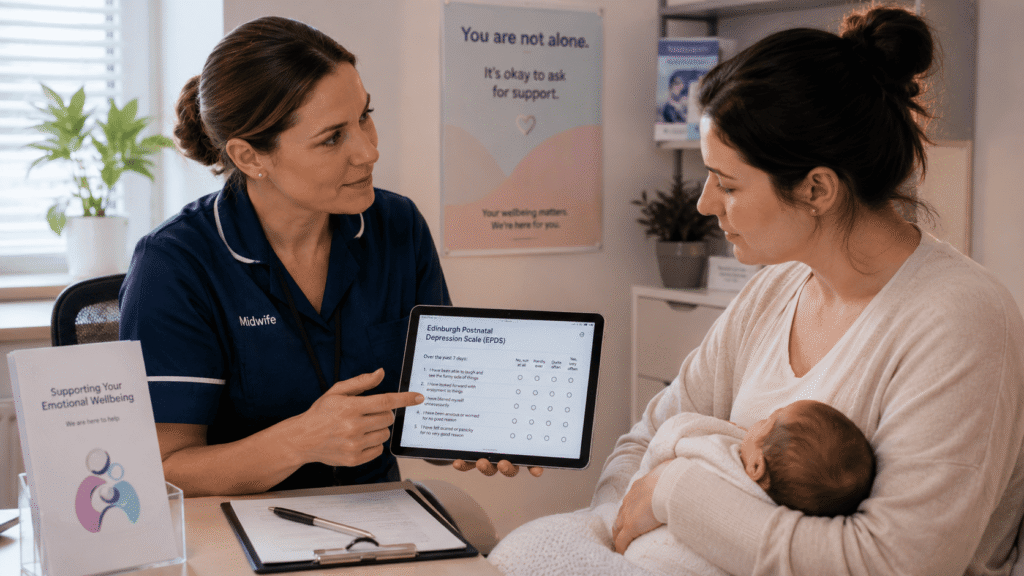
A score of 13 or higher generally indicates a need for further clinical assessment. However, Question 10, which asks about thoughts of self-harm, requires immediate attention regardless of the total score. To get an accurate reflection of a mother’s state, it is recommended to facilitate the screening in a private, comfortable space. Additionally, while not yet a universal standard, some settings are now encouraging the use of the Matthey Postnatal Depression Scale to screen partners, acknowledging that mental health challenges can affect the entire family unit.
Understanding the Triggers: Biology and Environment
The “Postpartum Period” involves a dramatic biological shift. After birth, the body experiences a rapid drop in reproductive hormones, which can significantly impact mood and brain chemistry in some women. While these shifts are natural, the speed and intensity of the change can be a major trigger for depressive symptoms. As midwives, we look at these biological changes alongside the mother’s social and physical reality.
Social triggers are often just as impactful as biological ones. A history of mental health challenges, a lack of practical support at home, or a traumatic birth experience can all increase a mother’s vulnerability. Midwives should also be mindful of the pressure surrounding breastfeeding. If a mother is struggling with feeding and it is becoming a primary source of distress or feelings of failure, supporting her to find a feeding solution that prioritizes her mental health is an important clinical intervention.
Categorizing Mental Health Concerns

It is essential for midwives to distinguish between different postnatal mental health states to ensure the correct level of intervention. The “Baby Blues” are experienced by the majority of women; they typically peak around the third to fifth day postpartum and resolve within ten days. If a mother’s low mood or anxiety persists beyond the first few weeks, it warrants a more detailed clinical discussion to explore the possibility of PPD.
At the most severe end of the spectrum is Postpartum Psychosis. This is a rare but serious clinical emergency occurring in approximately 1 in 1,000 births. Midwives must act immediately if they observe signs of mania, delusions, or hallucinations. Unlike PPD, psychosis involves a break from reality and requires urgent psychiatric assessment and often hospitalization to ensure the safety of both the mother and the infant.
Managing Care and Referrals
When a midwife identifies signs of PPD, the focus shifts to a multidisciplinary care model. The primary step is usually a referral to the mother’s General Practitioner (GP). In Australia, the GP can create a Mental Health Care Plan, which provides the mother with subsidized access to psychologists or counselors. This collaborative approach ensures the mother has a “Circle of Care” surrounding her.
Midwives also play a role in discussing treatment options, including medication. Many mothers are concerned about the safety of SSRIs (Antidepressants) while breastfeeding. It is helpful to reassure mothers that many commonly used SSRIs are considered compatible with breastfeeding under medical guidance, as the amount that reaches the baby is generally very low. By providing evidence-based information and linking the mother to community resources like PANDA, midwives help bridge the gap between identifying a problem and starting the journey to recovery.
People Also Ask (FAQ)
Q: Is it a legal requirement for midwives to screen for PPD?
While not a specific “law,” screening for perinatal mental health is considered a professional responsibility and a standard of best practice within Australian midwifery guidelines.
Q: How long do the “Baby Blues” normally last?
They usually start a few days after birth and settle down within about a week or ten days. If the feelings of sadness or anxiety last longer than two weeks, you should talk to your midwife or GP.
Q: Can I keep breastfeeding if I need to take antidepressants?
Yes, in many cases. Many SSRIs are considered compatible with breastfeeding. Your doctor will help you choose a medication that is safe for both you and your baby.
Q: Does a high score on the EPDS mean I have depression?
Not necessarily. A high score means you are experiencing symptoms that could be depression. It is a tool used to start a deeper conversation with a healthcare professional who can then provide a formal assessment.
Q: What is the biggest risk factor for PPD?
While it can happen to anyone, the strongest risk factor is often a previous history of depression or anxiety, followed by a lack of social support or high levels of stress during the pregnancy.
Disclaimer: “I researched this information on the internet; please use it as a guide and also reach out to a professional for assistance and advice.This information is not medical advice, so seek your medical professional’s assistance.”
You Can Also Read this article about
Postpartum Care During Ramadan: Advice from Midwives