

Summary
High standards, stringent laws, and a strong dedication to patient safety form the cornerstones of the Australian healthcare system. The possibility of a legal complaint or notice is a major professional worry for all nurses, from students on their first clinical placement to seasoned Nurse Practitioners. The Australian Health Practitioner Regulation National Law, which is supervised by the Nursing and Midwifery Board of Australia (NMBA) and the Australian Health Practitioner Regulation Agency (AHPRA), governs the legal environment for nurses in Australia.
A legal complaint is the start of a serious and organized process, but it does not necessarily indicate the end of your career. Knowing exactly what occurs next is crucial for safeguarding your registration and your mental health, regardless of whether the complaint concerns a medication error, a privacy violation, or an accusation of professional misconduct. In the Australian nursing setting, this article offers a thorough, step-by-step guide to the legal and regulatory process that follows a complaint.
The Initial Notification: Who Can Complain and Why?

A legal or professional complaint against a nurse in Australia typically starts with a “Notification.” Anyone who has concerns about a nurse’s performance, behavior, or health may notify AHPRA in accordance with the National Law. Patients, their relatives, employers, and even other medical professionals fall under this category. Notifications come in two primary varieties: Both mandatory and voluntary notifications are sent by coworkers or members of the public. When a practitioner or employer suspects a nurse has participated in “notifiable conduct,” such as practicing while inebriated, sexual misconduct, or putting the public at risk of injury owing to a significant departure from professional standards, mandatory notifications are legally required.
AHPRA conducts a “preliminary assessment” upon the filing of a complaint to ascertain whether the issue is within their purview. The complaint may be rejected or submitted to a health ombudsman if it is solely about a financial disagreement or a little personality conflict that has no bearing on patient safety. However, AHPRA will formally notify the nurse if the allegation indicates a risk to the public. At this point, the nurse gets a letter detailing the accusations. It is a crucial “pivot point” where the nurse must get in touch with their nursing union or Professional Indemnity Insurance (PII) provider very away before answering, since the first statement given to AHPRA can have a significant impact on the case’s overall course.
The Assessment and Investigation Phase
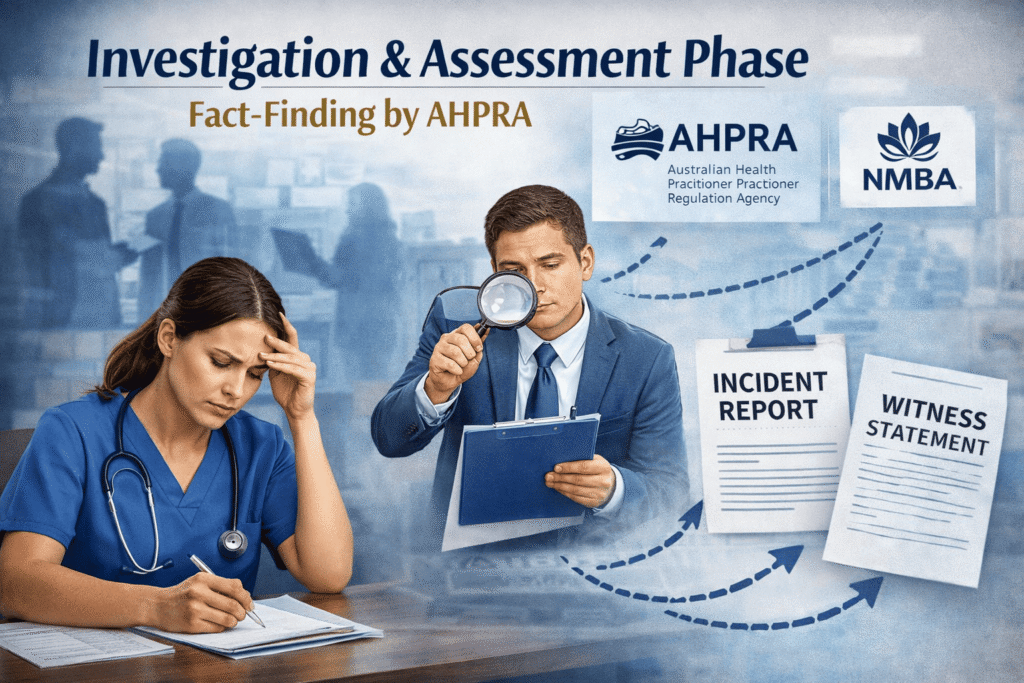
The matter enters the Assessment Phase following the initial notification. In order to determine if additional action is necessary, AHPRA collects data on behalf of the NMBA. This frequently entails asking for witness accounts, hospital event reports, and clinical data. The objective is to ascertain if the nurse’s conduct complied with the NMBA Code of Conduct and Professional Standards. This is not a trial, but a “fact-finding” journey in Australia. Investigators consider the incident’s circumstances, such as whether the hospital’s electronic medication system malfunctioned or whether the unit was dangerously understaffed.
A formal investigation may be necessary if the assessment points to a significant problem. If the complaint is related to an impairment, the nurse might have to undergo a performance evaluation or a health examination during this time. The probe may take several months to complete. The “Natural Justice” principle is in effect during this time, therefore the nurse has the right to view the facts against them and offer a thorough defense. During this stage, a nurse’s best defense is thorough documentation and impartial clinical notes. Eventually, AHPRA will put together an investigation report and submit it to the Board for a decision.
Immediate Action: Protecting the Public Interest
Before an investigation is even finished, AHPRA and the NMBA have the authority to take Immediate Action in high-risk situations. This happens if the Board has a reasonable belief that acting is in the “public interest” or that the nurse poses a substantial risk to the public’s health or safety. Immediate action is a preventative measure rather than a definitive judgment of guilt. Suspending the nurse’s registration or placing restrictions on their practice like making them work only under direct supervision or forbidding them from handling particular medications are the most popular ways to take quick action.
The nurse is typically handed a “Show Cause” notice if the Board suggests taking immediate action. This notice gives the nurse a very brief window of time typically only a few days to explain why the action should not be taken. This is a crucial legal situation that calls for knowledgeable legal counsel. The Board must strike a balance between the safety of the Australian public and the nurse’s freedom to work. The complete investigation continues to ascertain the ultimate facts even if prompt action is taken. Depending on the Board’s final conclusions, the immediate action may be reversed, modified, or made permanent after the investigation is over.
Possible Outcomes: From Cautions to Tribunals
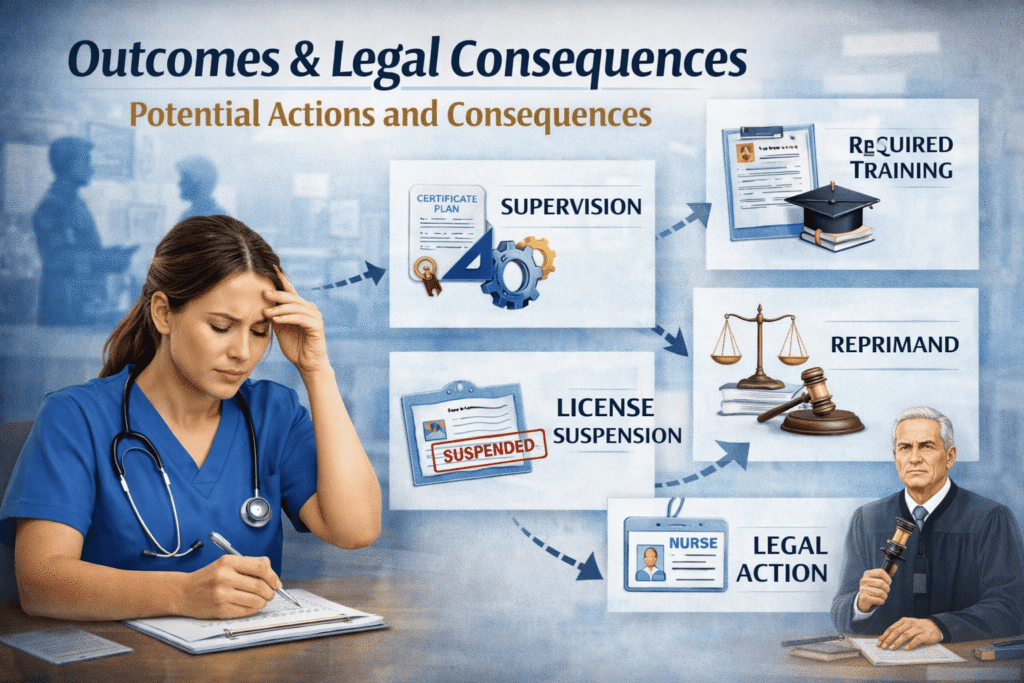
The NMBA convenes to determine the final result after the investigation is over. Australia’s regulatory framework prioritizes remediation over punishment. The Board may issue a Caution (a formal warning) or take No Further Action if they determine that the nurse’s actions constituted a minor violation of standards. The Board may place restrictions on a nurse’s registration, such as requiring additional schooling or a time of supervised practice, if it has doubts about the nurse’s abilities. These requirements are frequently included in the public “Register of Practitioners.”
A reprimand, which is a public record of the Board’s disapproval, may be issued for more significant violations. A Responsible Tribunal (such as VCAT in Victoria or NCAT in NSW) is consulted in the most serious situations, such as those involving criminal activity, excessive carelessness, or sexual misconduct. A nurse’s registration can only be revoked by a tribunal. This implies that the nurse will no longer be able to practice in Australia for a predetermined amount of time, or even forever. However, the majority of cases are handled at the Board level through monitoring and education with the intention of getting the nurse back to safe, autonomous practice.
Civil Litigation: When a Patient Sues for Damages
Civil litigation is distinct from the AHPRA regulatory procedure. This occurs when a nurse (and typically the hospital) is sued by a patient or their family for “Medical Negligence.” In Australia, a patient must demonstrate three elements in order for a negligence claim to be successful: that the nurse owed them a duty of care, that the nurse violated that duty by acting differently than a reasonable nurse would, and that the patient suffered harm or loss as a result of the breach. Professional indemnity insurance is essential in this situation since it pays for the patient’s damages and legal fees.
In Australia, mediation is used to resolve the majority of civil issues out of court. In order to determine whether a settlement can be reached, attorneys for both parties examine the clinical data during this procedure. Under the concept of “Vicarious Liability,” employers (such as state health departments) are typically liable for the conduct of their workers. This implies that the damages are typically covered by the hospital’s insurance. However, you are individually liable if you are a contractor or self-employed nurse, which is why having your own private insurance is a need for registration. Although civil trials can be drawn out and stressful, they are more concerned with monetary compensation than your right to practice nursing.
People Also Ask (FAQ)
Q: Do I have to tell my employer if AHPRA is investigating me?
Yes, usually. Many employment contracts in Australia require you to disclose if you are the subject of an AHPRA investigation or if conditions have been placed on your license. Additionally, if the Board imposes conditions on your practice, your employer will be notified by AHPRA directly.
Q: Can I use my hospital’s lawyers if a patient sues me?
While the hospital’s insurance usually covers the claim under vicarious liability, the hospital’s lawyers represent the hospital’s interests. If there is a conflict of interest—for example, if the hospital blames you for not following their policy—you may need your own independent lawyer provided by your private insurance or union.
Q: How long does an AHPRA investigation take?
There is no fixed timeline, but most assessments are completed within 60 days. However, a full formal investigation can take anywhere from 6 to 18 months depending on the complexity of the medical evidence and the number of witnesses involved.
Q: What is the difference between a “Caution” and a “Reprimand”?
A Caution is a formal warning that is generally kept in your private AHPRA record. A Reprimand is a more serious public statement of disapproval that appears on the public Register of Practitioners, meaning anyone (including future employers) can see it.
Q: If my registration is cancelled, can I ever nurse again?
If a Tribunal cancels your registration, they will usually set a “disqualification period” (e.g., two years). After that time, you can apply to be re-registered, but you will have to prove to the Board that you are now “fit and proper” to practice and that you have addressed the issues that led to the cancellation.
Useful Documents for every Nursing Student
CV Section Template for Nursing students
AHPRA – NMBA Registration Document Checklist (International Students-Graduates)
Clinical Placement Reflection Template (NMBA-aligned)
Cover Letter Template for Nursing Students
Disclaimer: “I researched this information on the internet; please use it as a guide and also reach out to a professional for assistance and advice.This information is not medical advice, so seek your medical professional’s assistance.”