

Summary
Receiving a notification from the Australian Health Practitioner Regulation Agency (AHPRA) can be one of the most distressing experiences for any Australian nurse or midwife. The word “investigation” frequently raises concerns about losing your registration or being embarrassed in front of others, whether you are an experienced registered nurse or a nursing student just beginning your clinical assignments. But it’s crucial to realize that the AHPRA investigation process is intended to be a methodical approach to guaranteeing public safety. It is a fact-finding expedition to determine whether a nurse’s behavior, health, or performance satisfies the national standards rather than a “guilty until proven innocent” situation.
The finest strategy to handle the tension and save your career prospects is to comprehend the timetable and the “mechanics” of an inquiry. How these investigations are conducted in Australia is governed by the Health Practitioner Regulation National Law. This article helps you understand what happens from the time a complaint is filed until the Nursing and Midwifery Board of Australia (NMBA) makes a final decision by breaking down the complicated legal procedures into a straightforward, step-by-step process.
The Trigger: Receiving a Notification or Complaint
A formal concern over a nurse’s clinical performance, professional conduct, or health (impairment) is referred to as a “Notification.” This is the first step in the process. It’s interesting to note that anyone can submit a notification a patient, a relative, a coworker, or even an employer. An employer or coworker is legally obligated to provide a Mandatory Notification in some severe situations, such as those involving sexual misconduct, drug usage, or a major deviation from professional norms.
After receiving the notification, AHPRA conducts a preliminary “screening” to determine whether the issue is within their purview. The complaint may be directed to a health ombudsman if it concerns a refund or an offensive remark that has no bearing on safety. AHPRA will send you an official letter if they choose to move forward. This letter, which details the precise accusations made against you, is an important document. You should get in touch with your nurse union or professional indemnity insurance provider as soon as you receive this. Your initial response can have a big impact on how the matter turns out, so don’t try to call the individual who complained or write a hasty response without legal counsel.
The Assessment Phase: Gathering the Facts
AHPRA moves into the Assessment Phase following the notification’s acceptance. A group of investigators is tasked with gathering all pertinent data throughout this phase. This could involve asking your hospital management for a statement, interviewing witnesses, or obtaining your clinical notes. They want a clear picture of what transpired. They want to know if the nurse adhered to the NMBA Code of Conduct. Did the Professional Standards get violated? Or did the hospital’s system malfunction cause the incident?
During this stage, nurses are typically given the opportunity to submit a preliminary written response. This is your chance to present your version of events. A well-written response should be cool, objective, and backed up by facts. For instance, you may offer proof of a malfunctioning barcode scanner or the ward’s high patient-to-nurse ratio that day if you are charged with a drug error. Although complicated cases may take longer, AHPRA has sixty days to finish its examination. At the conclusion of this stage, they may determine that no additional action is required or they may opt to escalate the issue to a thorough inquiry.
Immediate Action: Protecting the Public
Before the entire inquiry is even complete, AHPRA and the National Board may take immediate action in really serious cases. They take this action if they think there is a “serious risk to the health or safety of the public.” Immediate action is a temporary safety precaution rather than an ultimate penalty. This could entail immediately suspending your registration or imposing “Conditions” on your practice, such as prohibiting you from giving certain high-risk prescriptions or requiring you to work only under direct supervision.
If an immediate action is suggested, you often have a very little window of time sometimes as little as 48 hours to explain why the action shouldn’t be executed. Having a lawyer or a union representative is crucial in this high-stress circumstance. This period might result in an abrupt loss of income, which makes it the most challenging for many nurses. Nonetheless, it is an essential component of the Australian regulatory framework’s dedication to “Public Protection.” The comprehensive investigation will continue to ascertain the case’s long-term realities even if quick action is taken.
The Formal Investigation: A Deep Dive into Conduct
A formal investigation is initiated if the issue is not settled after assessment. The nurse’s background and the particular occurrence are covered in much greater detail here. AHPRA may designate a clinical specialist or an outside researcher to evaluate your work. You might have to go to an Independent Health Assessment with a physician selected by AHPRA if the issue is related to your health (such as a mental health issue or substance abuse). You may need to do a performance evaluation if your clinical expertise is the issue.
You have “Natural Justice” rights throughout the official investigation. This implies that you are entitled to view the evidence used against you and to address it. For the Nursing and Midwifery Board of Australia (NMBA), the investigator will combine all of the results into a report. The decision is subsequently made by the Board members, who are a combination of public members and seasoned nurses. They consider the “Gravity” of the behavior as well as if the nurse demonstrates “Insight” a comprehension of what went wrong and how to correct it. Compared to a nurse who is defensive or dishonest, a nurse who acknowledges a mistake and demonstrates that they have taken a course to better their skills is frequently treated more leniently.
Final Outcomes: From Cautions to Tribunal
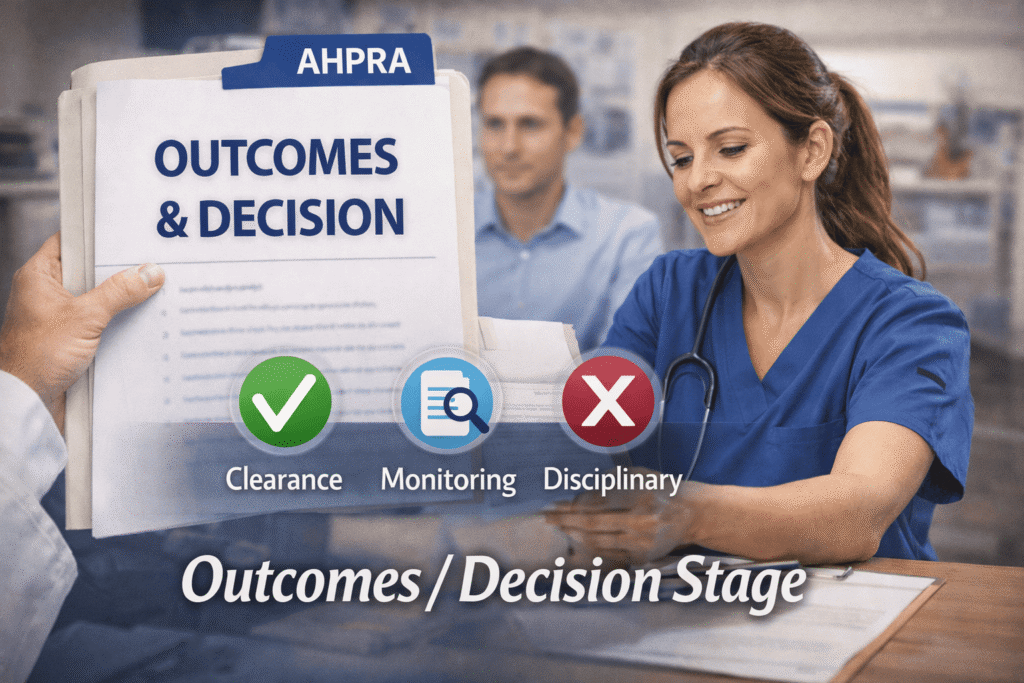
The Board’s Decision is the last phase. Depending on how serious the findings are, there are a number of possible outcomes. If the investigation reveals that you behaved appropriately, the Board may decide to take “No Further Action”. They might issue a “Caution,” which is essentially a formal warning on your record, if there was a little violation of norms. More significant situations lead to “Conditions,” which are particular guidelines you have to adhere to while working, including finishing a “Reflective Practice” essay or having a senior nurse audit you once a month.
A Tribunal is consulted in the most serious matters, such as those involving criminal activity or egregious carelessness. A tribunal is comparable to a court of law. A nurse’s registration can only be permanently revoked by a tribunal. Your case becomes public record if it gets to this stage. Nonetheless, conditions or warnings are used to settle the great majority of AHPRA notifications at lower levels. Remediation, not only punishment, is the process’s main objective. In order for you to pursue your work while maintaining public safety, AHPRA needs to make sure that you are safe to return to the ward.
People Also Ask (FAQ)
Q: How long does an AHPRA investigation usually take?
A comprehensive formal inquiry might take anywhere from six to eighteen months, but the majority of assessments are finished in sixty to ninety days. The complexity of the case and the speed at which hospitals and witnesses offer information determine the timeline.
Q: Can I keep working while I am being investigated?
A comprehensive formal inquiry might take anywhere from six to eighteen months, but the majority of assessments are finished in sixty to ninety days. The complexity of the case and the speed at which hospitals and witnesses offer information determine the timeline.
Q: Will the person who complained find out the result?
Indeed. Legally, AHPRA must notify the “notifier” of the final decision and its rationale. They do not, however, divulge critical personal information or your private health information.
Q: Do I need a lawyer for an AHPRA interview?
Although it is not required, it is strongly advised. Legal procedures are used in AHPRA investigations. You can avoid “self-incrimination” and make sure your response is appropriate and competent by consulting a health law specialist.
Q: Does an AHPRA caution stay on my record forever?
AHPRA’s internal system records a warning. Even though it isn’t constantly visible to the public on the “Register of Practitioners,” the Board will see it if you are ever the subject of another investigation.
Useful Documents for every Nursing Student
CV Section Template for Nursing students
AHPRA – NMBA Registration Document Checklist (International Students-Graduates)
Clinical Placement Reflection Template (NMBA-aligned)
Cover Letter Template for Nursing Students
Disclaimer: “I researched this information on the internet; please use it as a guide and also reach out to a professional for assistance and advice.This information is not medical advice, so seek your medical professional’s assistance.”