


Summary
Giving “culturally sensitive care” is just as crucial in the variegated realm of contemporary healthcare as giving the appropriate prescription. In order to serve Muslim patients, nursing students and medical professionals must comprehend the significance of Ramadan. Millions of people fast from sunrise to sunset during the holy month of Ramadan. When a patient is admitted to a hospital or clinic during this period, they frequently have to make the tough decision of whether to prioritize their medical care or adhere to their religious custom. You serve as the link between these two worlds as a nurse. It is your responsibility to provide a secure, courteous setting where the patient’s spiritual needs are satisfied in addition to their medical treatment, rather than to criticize their decision.
Knowing that people are not eating during the day is not enough to provide culturally responsive support. It entails adjusting nursing interventions to the patient’s rhythm, acknowledging the exemptions granted for the sick, and comprehending the emotional and spiritual weight of the month. Deep trust is developed when a nurse demonstrates respect for a patient’s faith. Better communication, increased patient happiness, and eventually improved health outcomes are all results of this trust. This article offers a thorough guidance on how nurses can support patients who are fasting throughout Ramadan.
The Importance of Early Assessment and Communication

The “Pre-Fasting Assessment” is the cornerstone of culturally sensitive care throughout Ramadan. It is not appropriate for nurses to presume that every Muslim patient will fast or that a sick patient will automatically cease fasting. Asking polite, open-ended inquiries at the beginning of the month or during the initial intake is the ideal practice. “Are you planning to observe the fast this year?” and “How can we support your religious practices during your stay?” are examples of questions that let patients express their intentions without feeling coerced. The nursing staff can identify possible hazards, such as hypoglycemia in diabetics or dehydration in patients with kidney problems, thanks to this early notification.
The nurse must act as an advocate within the multidisciplinary team once the patient’s purpose has been made apparent. In the event that a patient decides to fast, the nurse should work with the physician and pharmacist to evaluate whether medication can be changed to coincide with the non-fasting hours (Iftar and Suhoor). The patient’s family is also included in the communication. Healthcare decisions are a family matter in many cultures. The nurse makes sure that everyone is in agreement by involving the family in the conversation about the advantages and disadvantages of fasting while ill. In a high-stress hospital setting, this proactive strategy avoids miscommunication and guarantees that the patient does not feel compelled to choose between their faith and their health.
Understanding Religious Exemptions for the Sick

Teaching patients about Islamic exemptions is one of the most beneficial things a nurse can do. Even when they are very sick, many patients experience “spiritual guilt” if they are unable to fast because they feel they are not fulfilling their religious obligations. Islam specifically exempts anyone who are ill, aged, pregnant, or nursing if fasting would be detrimental to their health. Nurses should be aware of this. Understanding this enables a nurse to offer “spiritual comfort” by gently reminding the patient that caring for their body is also a highly esteemed form of worship.
A culturally sensitive nurse may recommend speaking with a local Imam or hospital chaplain if a patient is having trouble deciding whether to fast against medical advice. These religious authorities can frequently give a patient the theological “permission” they need to put their rehabilitation first. For instance, a patient recovering from major surgery or receiving chemotherapy requires continuous feeding and hydration. The patient’s internal conflict is lessened when a nurse explains the medical requirement in a way that honors their spiritual objectives. Giving the patient this support demonstrates your concern for their “whole self” their body, mind, and soul.
Modifying Clinical Routines for the Fasting Patient
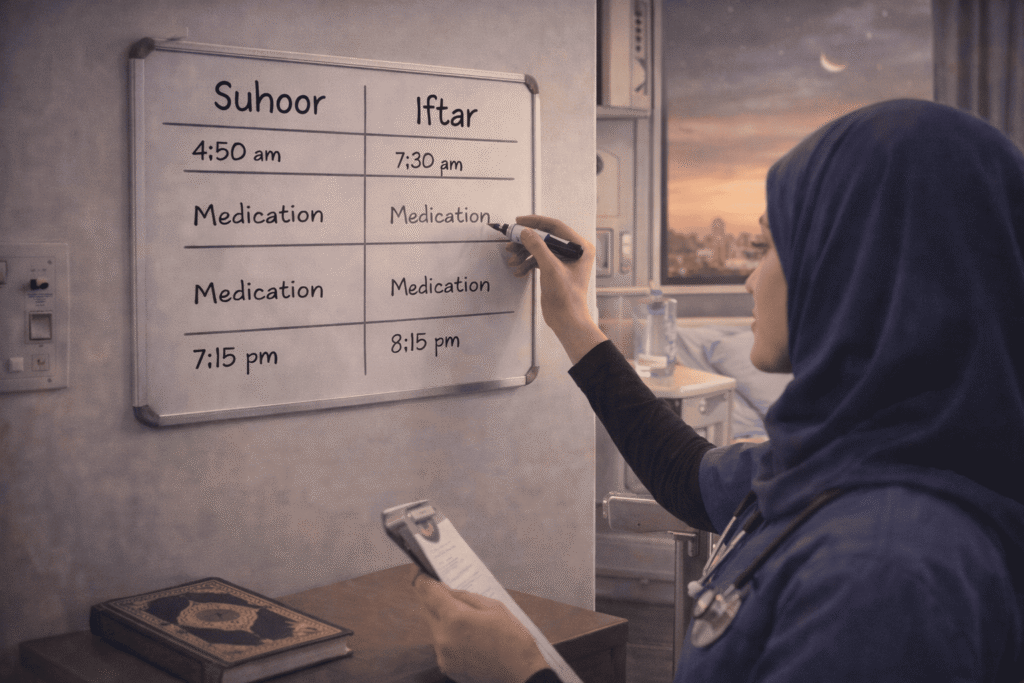
Although a hospital operates around the clock, its daily operations, such as meal deliveries, vitals checks, and medicine rounds, are often planned on a typical daytime schedule. Nurses should attempt to “synchronize” the hospital routine with the patient’s fasting schedule in order to give culturally sensitive support. This is frequently referred to as “Time-Shifting Care.” The most crucial times of day for a patient who is fasting are Iftar (sunset) and Suhoor (just before dawn). A nurse can help with this by making sure the patient’s room is not disturbed when they are trying to eat or pray during their non-fasting hours and by working with the kitchen to make sure meals are provided at the appropriate times.
Additionally, nurses need to be aware of the “afternoon slump.” Late afternoon energy levels may be lower in patients who are fasting. Physically taxing treatments, such wound debridement or extensive physical therapy, should ideally be scheduled for the morning when the patient has more energy from their Suhoor meal. Nurses should also understand the “route of administration” for prescription drugs. Many patients think that any medication will break the fast, however certain injections, nicotine patches, and eye drops are frequently regarded as “fast-safe.” The nurse assists the patient in upholding their religious observance without neglecting necessary medical care by providing them with this information.
Monitoring for Risks and Educating on “Red Flags”
A nurse’s first priority is always patient safety, even though they should respect a patient’s wish to fast. Support that is attentive to cultural differences includes “Harm Reduction.” This means that the nurse doesn’t just give up if a patient decides to fast against medical advice; rather, they keep a closer eye out for any indications of difficulty. This entails more regular blood glucose testing for a patient with diabetes. It entails closely monitoring blood pressure and fluid balance in a patient with heart failure. The “early warning system” that detects issues before they develop into emergencies must be the nurse.
Teaching patients the “Red Flags” that indicate they need to break their fast is another duty of nurses. Kindness and clarity should be used in the delivery of this instruction. “We want you to be able to fast safely, but if you feel very dizzy, start shaking, or have a severe headache, it is a sign that your body needs help,” a nurse may explain. It’s crucial to consume some water or a glucose tablet right away in these situations. Giving the patient a documented “Sick Day Rule” list empowers them to make safe choices. By emphasizing “safety within the fast” as opposed to “stopping the fast,” the nurse fulfills their professional duties while preserving a supportive connection.
Creating a Respectful and Quiet Environment for Prayer
Ramadan is a month of intense prayer, introspection, and spiritual connection; it’s not only about abstaining from eating. It might be challenging for a patient in a shared hospital room to find the silence they need to say their five daily prayers or listen to the Quran. A nurse who is sensitive to cultural differences seeks to offer this “spiritual space.” Pulling the curtain for privacy, assisting the patient in orienting oneself toward Qibla (the direction of Mecca), or offering a fresh towel in the event that the patient lacks a prayer rug are some examples of how to do this. Making the patient feel at home is greatly aided by these modest acts of respect.
The patient’s requirement for “Wudu” (ritual washing) prior to prayer should also be recognized by nurses. If water is not medically recommended, a nurse can help a patient who is bedridden or has restricted movement by providing a basin of water or “Tayammum” (a dry purification process using a clean stone or sand). The nurse’s awareness of these demands demonstrates their comprehension of the holistic nature of treatment. A patient’s stress levels decrease when they feel at peace and spiritually connected, which can actually speed up their body’s healing. In addition to being “nice,” the nurse is offering the patient excellent, evidence-based treatment that takes into account their whole well-being by supporting their religious routines.
People Also Ask (FAQ)
Q: If a patient insists on fasting even though it is dangerous for them, what should I do?
Listening to their explanations is the first thing you should do. Next, fully and impartially describe the medical dangers. Involve the physician and possibly an Imam or Muslim priest who can describe the religious exemptions for illness. If they continue to persist, concentrate on “Harm Reduction” keep a closer eye on them and make sure they understand the warning signs that indicate they need to break the fast.
Q: Does taking a blood sample for lab tests break the patient’s fast?
The majority of Islamic scholars and medical experts concur that drawing blood for diagnostic purposes does not violate the fast. The patient might be worried, therefore it’s a good idea to explain this to them. When the patient is most hydrated, try to arrange blood draws for the morning.
Q: Can I give an IV (intravenous) drip to a fasting patient?
The type of IV determines this. It is usually seen as breaking the fast if it is a nutritional drip (such as TPN) that supplies calories. Nonetheless, a number of academics concur that IV drugs or fluids for hydration do not violate the fast since they are used for medical care rather than “feeding.” If the patient is unclear, they should always address this with their religious counselor.
Q: How can I help a fasting patient who has a very dry mouth?
“Mouth care” is an excellent nursing intervention. As long as they don’t swallow it, you can give the patient a small quantity of water to rinse their mouth or a cool, damp cloth to wipe their lips. Without breaking the fast, this offers tremendous relief from thirst.
Q: Why do some patients get more visitors during Ramadan?
Ramadan is an extremely social month. In order to share a meal or offer spiritual support, families and friends frequently wish to visit patients. If the ward permits it, as a nurse, try to be accommodating with visiting hours or provide a peaceful area where the family can congregate for Iftar. The patient’s morale depends on this community support.
Useful Documents for every Nursing Student
CV Section Template for Nursing students
AHPRA – NMBA Registration Document Checklist (International Students-Graduates)
Clinical Placement Reflection Template (NMBA-aligned)
Cover Letter Template for Nursing Students
Disclaimer: “I researched this information on the internet; please use it as a guide and also reach out to a professional for assistance and advice.This information is not medical advice, so seek your medical professional’s assistance.”