

Summary
Nursing is not an exception to how artificial intelligence (AI) is transforming healthcare globally. More patients, more paperwork, and more complex treatment are demanded of nurses in today’s clinics, hospitals, assisted living institutions, and community health settings. In addition to increasing nurse productivity, artificial intelligence (AI) solutions are also helping to improve patient safety and care quality.
AI replacing nurses is a concern shared by many nursing students. AI is actually meant to assist nurses, not to take their job. Human judgment, empathy, communication, and ethical decision-making—skills that technology cannot completely replicate—are the foundation of the nursing profession. Artificial intelligence (AI) systems assist nurses in making safer judgments by minimizing repetitive tasks, analyzing vast volumes of data, and sending out alerts or reminders.
Using straightforward language, real-world nursing examples, and student-level explanations, this article highlights the advantages of AI tools for nurses in their day-to-day clinical practice. Knowing AI will help you adjust to modern healthcare, regardless of your level of experience as a registered nurse, graduate student, or professional.
What Are AI Tools in Nursing?
Computer-based systems that support clinical tasks through data, algorithms, and pattern recognition are known as artificial intelligence (AI) aids in nursing. These systems help nurses by identifying dangers, anticipating issues, and automating repetitive tasks. They learn from vast volumes of healthcare data.
AI systems don’t think like people. They operate by analyzing data more quickly than people can. The ultimate decisions are still made by nurses, who are still held legally and professionally accountable for patient care.
Examples of AI Tools Used in Nursing
- Electronic Health Records (EHRs) with smart alerts
- AI-powered patient monitoring systems
- Medication safety and barcode scanning systems
- Predictive tools for patient deterioration
- Virtual assistants for documentation and reminders
- Clinical decision support systems
These tools are already part of everyday nursing practice, even if they are not always labelled as “AI.”
Why AI Tools Are Important in Daily Nursing Practice
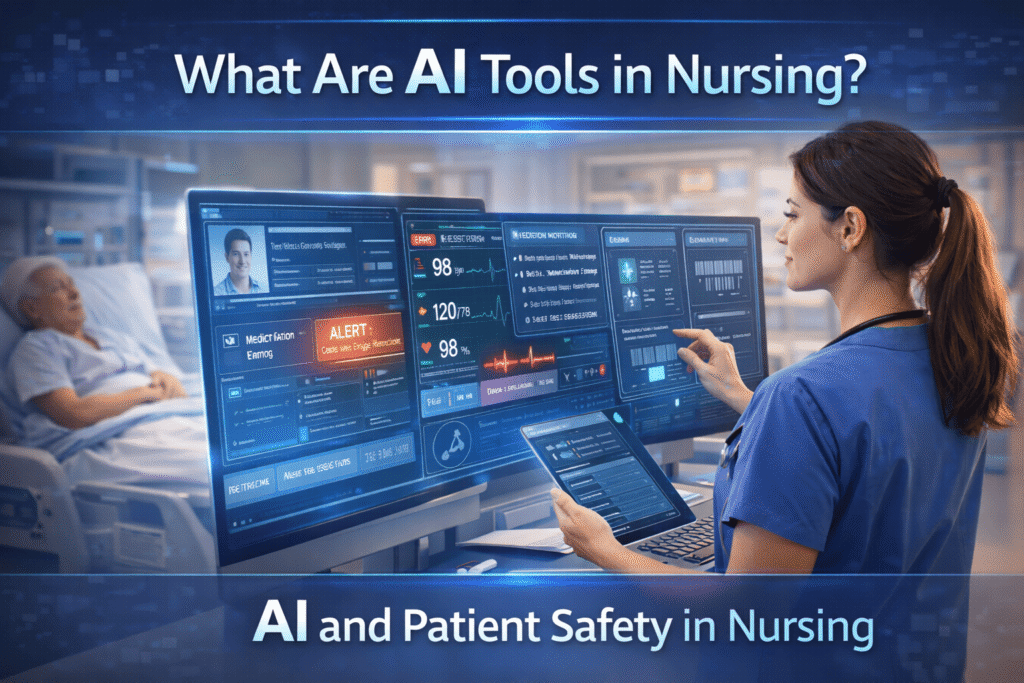
There is pressure on healthcare systems. In addition to managing staff shortages and providing care for patients with complicated needs, nurses frequently work lengthy shifts. Nurses can safely handle these issues with the use of AI tools.
Key Reasons AI Matters for Nurses
- Increasing patient numbers
- Higher documentation demands
- Complex medications and treatments
- Need for faster clinical decisions
- Nurse fatigue and burnout
AI helps nurses work smarter not harder by supporting them during busy clinical shifts.
How AI Tools Save Time for Nurses
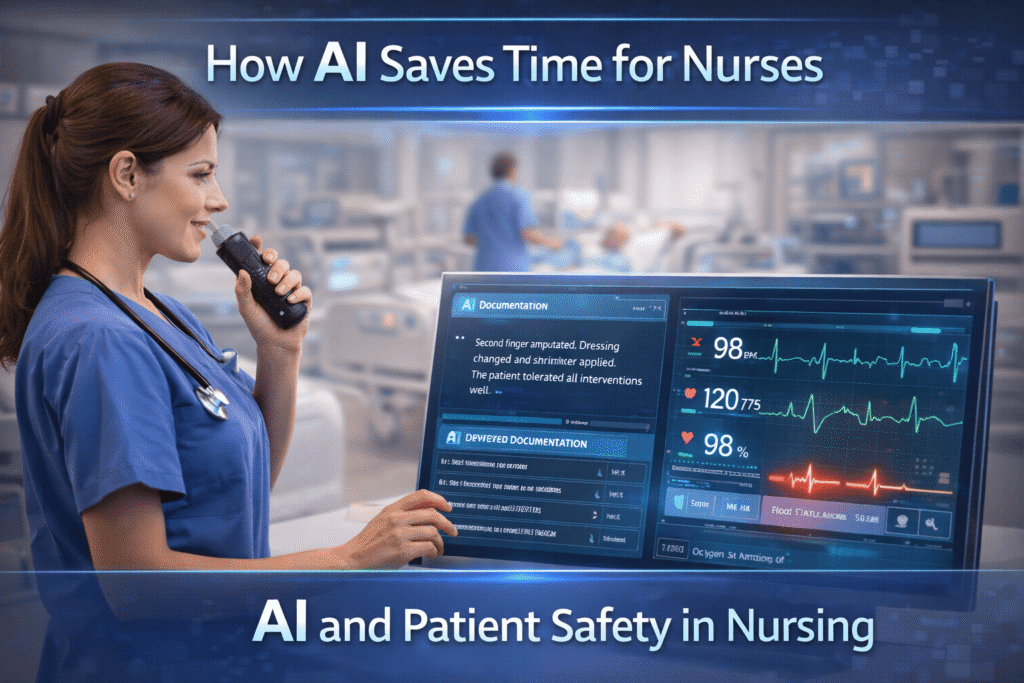
Time is one of the most valuable resources in nursing. AI tools help nurses reduce time spent on repetitive tasks so they can focus more on direct patient care.
1. Faster and Smarter Documentation
Documentation takes a large portion of a nurse’s shift. AI tools help by:
- Auto-filling patient details
- Reducing duplicate charting
- Turning voice notes into written records
- Highlighting missing documentation
This means nurses spend less time at computers and more time with patients.
2. Task Prioritisation
AI systems can analyse patient data and highlight which patients need urgent attention. This helps nurses:
- Organise workloads better
- Avoid missing critical tasks
- Manage busy shifts more safely
3. Reduced Manual Monitoring
Instead of checking vital signs repeatedly, AI monitors patients continuously and alerts nurses only when changes occur.
Improving Patient Safety with AI Tools
Patient safety is one of the strongest benefits of AI in nursing. Errors often occur due to fatigue, heavy workload, or missed information. AI helps reduce these risks.
Early Detection of Patient Deterioration
AI tools can identify early warning signs such as:
- Abnormal heart rate
- Drop in oxygen saturation
- Signs of sepsis
- Changes in blood pressure
Early alerts allow nurses to escalate care before the patient becomes critically unwell.
Medication Safety
Medication errors are a common reason students fail placements. AI tools help by:
- Checking correct patient and medication
- Alerting nurses to allergies
- Identifying drug interactions
- Confirming correct dosage and timing
These systems act as a second safety check—not a replacement for nurse responsibility.
Fall Prevention
AI-based movement sensors can alert nurses when high-risk patients attempt to move without assistance, reducing falls and injuries.
How AI Supports Clinical Decision-Making
AI does not replace clinical judgment. Instead, it supports nurses by providing evidence-based insights.
Clinical Decision Support Systems
These systems:
- Suggest reassessments
- Highlight abnormal results
- Remind nurses of protocols
They help nurses make informed decisions, especially in high-pressure situations.
Pattern Recognition
AI can recognise trends that humans might miss, such as gradual deterioration over time.
Reducing Nurse Burnout Through AI Support
Burnout is a serious issue in nursing. AI tools help reduce stress and mental load.
Lower Cognitive Load
By handling reminders and alerts, AI reduces the mental effort nurses need to remember every detail.
Improved Work Satisfaction
When nurses feel supported rather than overwhelmed, job satisfaction increases.
Better Work-Life Balance
Efficient systems reduce overtime and after-shift documentation.
AI in Patient Monitoring and Daily Care
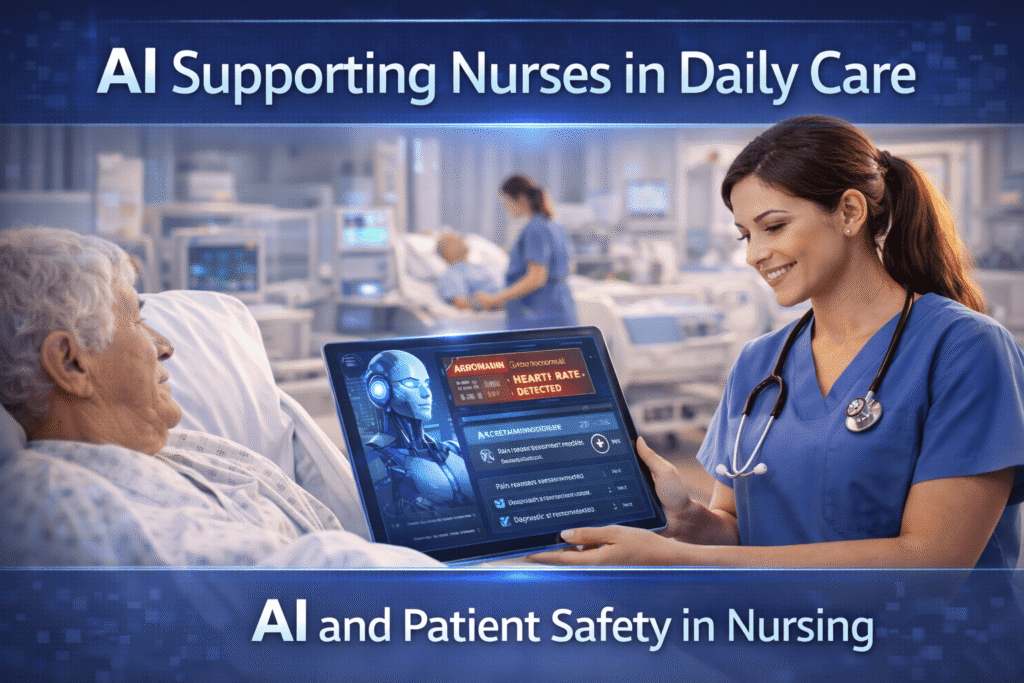
AI has transformed patient monitoring in many clinical settings.
Continuous Monitoring
AI monitors vital signs 24/7, reducing the risk of missed deterioration.
ICU and High-Risk Settings
In intensive care and emergency departments, AI helps nurses respond faster to critical changes.
Remote Monitoring
Wearable devices allow nurses to monitor patients at home, improving follow-up and continuity of care.
AI and Communication in Nursing
Communication errors are a major cause of patient harm. AI tools help improve clarity.
Safer Handover
AI-assisted handover systems organise patient information clearly, reducing missed details.
Patient Education
AI chatbots can answer basic questions, allowing nurses to focus on emotional and complex care needs.
Ethical Responsibilities of Nurses Using AI
Nurses must use AI ethically and professionally.
Key Responsibilities
- Protect patient privacy
- Maintain confidentiality
- Explain AI use clearly to patients
- Avoid blind trust in technology
- Always verify AI recommendations
AI is a tool not an authority.
Challenges of AI Tools in Nursing
AI is not perfect and has limitations.
Technology Errors
AI depends on accurate data. Incorrect input can lead to incorrect output.
Training Gaps
Nurses need education and ongoing training to use AI effectively.
Over-Reliance Risk
Nurses must never rely on AI without applying clinical judgment.
The Future of AI Tools in Nursing
AI will continue to expand in healthcare.
Future Trends
- Smarter wearable devices
- Personalised care planning
- Predictive risk assessment
- AI-assisted education for nurses
Nurses who understand AI will have better career opportunities.
Conclusion
By increasing productivity, security, and job happiness, AI technologies are revolutionizing nursing practice. They enable nurses to devote more time to patient care and less time to paperwork and monotonous duties.
Nurses will never be replaced by AI. Rather, it enhances nursing practice by utilizing intelligent systems to assist human knowledge. AI-embracing nurses will be more equipped for the healthcare industry’s future.
People Also Ask
How do AI tools help nurses daily?
They reduce workload, improve safety, and support clinical decisions.
Can AI replace nurses?
No. Nursing requires human judgment, empathy, and ethical care.
Is AI safe in nursing?
Yes, when used correctly and alongside professional judgment.
Should nursing students learn AI basics?
Yes. AI literacy is becoming essential in modern healthcare.
Does AI reduce burnout?
Yes, by reducing repetitive tasks and mental overload.
Useful Documents for every Nursing Student
CV Section Template for Nursing students
AHPRA – NMBA Registration Document Checklist (International Students-Graduates)
Clinical Placement Reflection Template (NMBA-aligned)
Cover Letter Template for Nursing Students
Disclaimer: “I researched this information on the internet; please use it as a guide and also reach out to a professional for assistance and advice.This information is not medical advice, so seek your medical professional’s assistance.”